...and thirty years ago, we sure as hell did.
And, like the annoying little kid in the Shake and Bake commercial, I helped.
For those nostalgic for the Eighties, The Great Communicator's Caribbean Triumph, or just farcical expeditionary extravaganzas, it's Grenada Month all November at Graphic Firing Table!
Friday, November 15, 2013
Monday, November 11, 2013
Open Thread
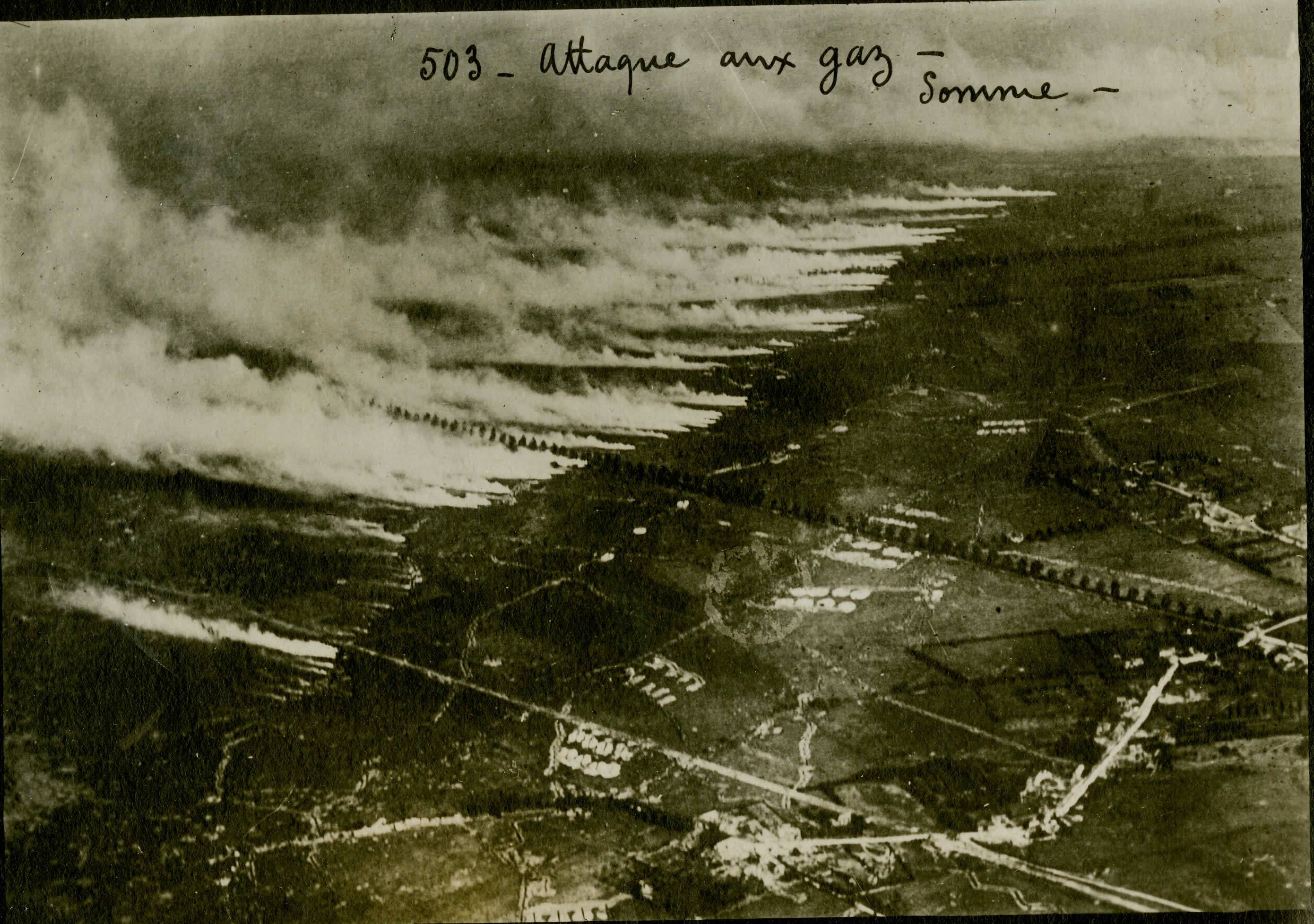
Gas attack at the Somme photo courtesy of the History Blog
Also meant to mention the 10,000 dead in Tacloban. Wasn't that MacArhtur's HQ after the Leyte landing? They also had trouble back then with flooding this time of year. Nothing like this of course, which was a million times worse. But most of the MacArthur's airfields were swamped and useless.
Sunday, November 3, 2013
Guile and Valor
Just finished reading 'The Deceivers' about the art of deception in the 2nd world war. Not the novels of the same name by Forsyth or Masters, but a well-researched nonfiction account. Boring you say, as most everybody has heard about the phantom armies in Southeast Britain facing across the channel from the Pas de Calais and perhaps about the ‘man-who-never-was’. But this book goes into the organized deception campaigns in the Chinese/Burma/India Theater, North Africa, Italy, the Eastern Front, and both the Central and Southwest Pacific Theaters also. Very detailed and interesting. The Americans and French learned it as well from the Brits. The Soviets too but that part is not quite as detailed, due I am sure to unavailability of the appropriate Russian records to an American researcher.
Admiral Hewitt in NW African waters and the western Med used
it with his Beach Jumpers for mock amphibious landings to disguise the real
intended beachhead. The original idea
came from Hollywood (Doug Fairbanks Jr) and they were later used in the
Pacific.
Nimitz took to deception and
used a notional invasion of the Kurile Islands from the Aleutians (termed
Wedlock) to mask his intentions in the Marianas and later the Palaus. That same deception plan also also benefited
MacArthur at Leyte. It worked as evidenced by
the buildup of Japanese ground troops in the Kuriles from 14K in 43 to 64K in January
44 plus four air regiments were moved to Hokkaido in February 44 from southern
Japan and from Manchuria. Later Nimitz used
a notional invasion of Formosa and mainland China coast (codenamed
Bluebird) to disguise the largest amphibious assault of the Pacific – the Okinawan
campaign.
MacArthur himself was a natural and used tactical deception brilliantly
during the Hollandia campaign. But for
strategic deception requiring coordination with other theaters his imperious Chief
of Staff, LtGen Sutherland, and his G-2 and G-3 did not take kindly to outside
advice so lost many opportunities. The
Japanese were no slouches at deception themselves as witnessed by their outfoxing
Halsey at Leyte. But they entered that
game too late and their efforts were to no avail.
Mountbatten used it extremely well in Burma, his prime practitioners
being General Slim and also Peter Fleming,elder brother to Ian, the author of the James Bond novels, some even claim that Peter was a literary clone of 007. General Stillwell did not like the
concept of deception and would not allow it by his command. His
later replacement, Wedemeyer, used a notional drive to the coast of the South China Sea by a Chinese
Army Group, reputedly led by Patton (?) so they could link up with Nimitz’s
Bluebird ruse.
The book is not new, it was published nine years ago, so is relatively
inexpensive but is well worth a look. The
author, Thaddeus Holt, is a former Deputy Under-Secretary of the Army. He has also written articles on military history for MHQ, JMH and the NYTimes. Good read but not for the faint of heart as it is 805 pages plus another
300 or so pages for the Appendices. My only beef is that he seems to spend too much time on the personalities of the various deception staff officers and some of their arguments with each other. Otherwise it
is great reference work not just for deception but also for the real operations
they were designed to protect with their <i>”bodyguard of lies”</i>.
Thursday, October 24, 2013
Defensible Terrain
--Paresh Nath, UAE
Does our ruin benefit the earth?
Does it help the grass to grow, the sun to shine?
Is this darkness in you, too?
Have you passed through this night?
--The Thin Red Line (1998)
There were many lessons from COP Keating.
One of them is that our troops should never, ever,
be put in a position
where they have to defend the indefensible
--President Obama bestowing the MOH
on SSG Romesha
There were many lessons from COP Keating.
One of them is that our troops should never, ever,
be put in a position
where they have to defend the indefensible
--President Obama bestowing the MOH
on SSG Romesha
_________________
{This is an outgrowth of the commentary @ milpub to "True Colors". This is submitted from an Infantryman's perspective -- an attempt to integrate your collective cache of knowledge on 50 years of institutional military experience.}
Per President Obama's statement above, defending the indefensible is a no-go, so why do it?
Why do we engage in combat, both offensively and defensively? The question applies to a rifle squad as well as a theatre Army. Whether fighting a counterinsurgency (COIN) or unconventional or guerrilla wars (UW/GW), why do we fight? Do we just fight to kill, or is there a military logic beyond the killing?
We put our soldiers into combat for one purpose: to facilitate future operations which will lead to a militarily achievable purpose that reflects a political reality. We do not fight for hopes or dreams, but for observable and verifiable achievements.
Why do we defend COPs -- small battle stations set on the frontier of a battle area? What should Commander's planning and guidance indicate before we even occupy the ground?
Obviously, any occupied terrain should be defensible. There must be mutual support to include logistics, personnel and supporting fires of all consideration. Historically, adjacent units provide direct fire to mutually support a friendly unit in distress. Defense is either hasty or planned, mobile or static. It is generally thought that static defense is to be avoided (think Bataan, Corregidor and Wake Island.)
So for a COP to be effective, it needs defensible terrain with adequate resources; wishful thinking does not count. Then it needs depth to the battle space, which implies a connection among all of the involved units. Reserve units historically are positioned within supporting distance, with reliable avenues of approach. This also allows engaged units to fall back to the reserve position if the situation deteriorates (or upon receipt of such orders.)
Strangely, all reported Afghan COP battles have lacked this feature. The soldiers in these COP battles could not withdraw to a friendly position on defensible terrain.
Soldiers should not be fighting for non-quantifiable metrics such as the love of the Afghan people for their government, for instance. Ranger cares that our soldiers fight and die, if necessary, for a purpose beyond the ratings bump of a saccharine news byte.
The United States can hang four Medals of Honor (MOH) from four COP fights around the necks of four extremely heroic soldiers, but that does not alter the nature of the fight. What did our good and true and loyal soldiers die for out on those hillsides? Will Afghanistan ever be a beacon of democracy? Do we even care?
Beyond that, to risk a Thin Red Line-like reverie ...
How did the Taliban become an enemy of the U.S.? Why is it our business to kill them? Are the people of Afghanistan our enemies or our friends? Further, what of other countries whose business we have been getting into -- Libya, Egypt, Tunisia, Syria and Iraq? Can the forces of arms achieve anything beyond the imposition of death? As the character of Capt. James 'Bugger' Staros thinks in "The The Thin Red Line", The tough part is, uh... Not knowing if you're doing any good. That's the hard part.
Now, a soldier on a COP does not ask these questions, but we as citizens should and must before sending the first soldier down range. It is to our eternal shame if we do not.
[cross-posted @ RangerAgainstWar.]
Thursday, October 17, 2013
True Colors
--Capt. William Swenson receiving the Medal of Honor
October 15, 2013
Show me a smile then
Don't be unhappy
Can't remember when
I last saw you laughing
--True Colors, Cyndi Lauper
_______________________
Reportage on the on the most recent Medal of Honor recipient from the
Wars on Terror -- Army Captain William Swenson -- carries a
misstatement:
"[this award] marks only the second time in the last 50 years that two American service members have received the Medal of Honor for actions in the same battle.
"In 2011, Dakota Meyer, a Marine sergeant who also is now a civilian, was awarded the Medal of Honor for his actions in that Sept. 8, 2009, battle in Afghanistan" (Obama: Washington can learn from Medal of Honor recipient.)
Ranger presumes the article's "second time" refers to the MOH's posthumously awarded to Randall David "Randy" Shughart and Master Sergeant Gary Gordon for their actions in the Battle of Mogadishu (Oct. '93).
However, in fact the Vietnam War Battle of the Ia Drang Valley (LZ X-Ray) in 1965 produced three Medals of Honor, a battle within that 50 year window. However, somehow we still give that war and its participants the short shrift.
The MOH recipients from the Battle of LZ X-Ray were 1st LT Walter J. Marm (15 Feb 67); Captain Ed Freeman (16 July 2001), and Major Bruce Crandall (26 Feb 2007). It is only appropriate that the MOH finally be awarded to an Infantry U.S. Army Captain. Capt. Swenson did what one would expect from an officer under dire circumstances; he deserves our praise. But let us not forget Marm, Freeman or Crandall.
Let us also honor the MOH recipients from that war no so long ago -- my war -- by remembering the names of those men and their actions.
Sunday, October 13, 2013
Jus Ad Bellum . . .
The lecturer is Professor Michael Schmitt, Chair of the International Law
Department at the NWC. He has some diverse opinions. Some
I object to, some others seem right to me. I won't go into them now. I am heading out of town for a short hunting trip. So I will let you decide which is which.
He is also a former
USAF JAG Officer and a visiting professor in three different British and Australian Universities. He is well published, including books and articles on the legalities of Drones, CyberWar, Blockades, Autonomous Weapons, Direct Participation of Civilians in War, and many others.
Saturday, October 5, 2013
Võ Nguyên Giáp RIP . . .
. . . or rot in hell depending on your point of view. Dead at 102. Outlived his counterpart Robert McNamara. Outlived his fall guys, Generals Navarre and Westmoreland. But then Giap had two things going for him that Navarre and Westy did not: 1] it was his backyard whereas his enemies were over 10,000 miles from home, and 2] he had a sanctuary, his enemies did not. He also outlived two other of his victims. He was still Defense Minister when Vietnam beat Pol Pot's Khmer Rouge and General Xu Shiyou's PLA. Too bad for his country that he was too old and retired from military affairs in 1988 when China occupied Vietnam's Johnson Reef and killed 64 Vietnamese soldiers.
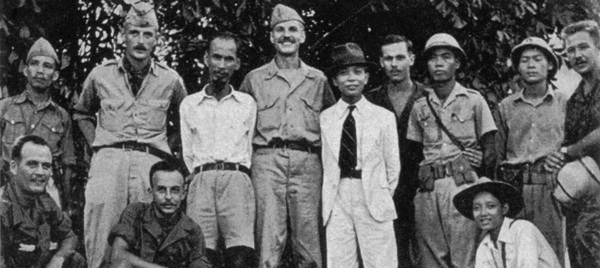
He was self-taught in matters soldierly. He did not turn to a military life until his thirties. He went to High shool in Hue, college in Hanoi, and did further study in Paris and China. Started his adulthood as a teacher and a journalist unlike Navarre who graduated from Saint Cyr, and unlike Westmoreland who was an honor graduate of West Point. But even as a younger man he read extensively of Napoleon (especially of his mountain campaigns), Sun Tzu, the American Revolutionary War, and then later he read Mao. And what Wikipedia and Vietnamese sources will never divulge, he also had some military training from an American OSS team. Giap is the short dapper one in the white suit and my father's dark fedora hat two down on the right from a young Ho Chi Minh in shorts. The American soldier between them is US Army Major Allison Thomas head of the OSS training team.
General Hal Moore, who co-wrote "We Were Soldiers Once . . . and Young" about the battle of Ia Drang, said that Giap was " ... one of the greatest military commanders of the 20th century". Westmoreland called Giap a butcher in a 1998 interview in George magazine: "Of course, he was a formidable adversary . . . but he persisted in waging a big-unit war with terrible losses to his own men. By his own admission, by early 1969, I think, he had lost, what, a half million soldiers? He reported this. Now such a disregard for human life may make a formidable adversary, but it does not make a military genius." Both Moore and Westy may both have been right, sour grapes or not.
Giap's birthplace, Quang Binh, is the province just north of the DMZ which took the brunt of America's air war against the north: thousands of tons of bombs more than any other province in the north. LBJ had no restricted targets in the North Vietnamese panhandle where Quang Binh was located. Not just B-52 arclights, and Navy and Air Force Alpha strikes, but it was also a dumping ground for any returning American aircraft that could not get to their primary target for weather or any other reason. The photo below shows Giap congratulating workers of the transport boat team on Gianh River just a few mile north of the DMZ in 1968. I first thought it was staged, but now I think not. He is one of their native sons, not some Hanoi bigwig. He is talking to them in their own drawling central Vietnamese dialect, which is as different from the harsh pronunciations of the north and the tonal patois of Saigon as is the speech of an Iowan farmer from Brooklynese or Dallas twang. They are liking him for being just a country cousin like they are and a local boy made good.
There is an interesting story that the spot he was born in was under the shadow of a jackfruit tree. Or interesting to this vet anyway. The jackfruit (mÃt in Vietnamese), although a sweet delicacy, has some martial arts overtones in central Vietnam. They have a thick pale green rind with thousands of sharp hexagonal spines. There is an old ballad from that part of the country about a blind hero using jackfruit rinds as some type of brass knuckled fist coverings during a Vietnamese boxing match. So I suspect that story may be apocryphal, sort of like Washington's cherry tree. Anyway if there is a good Viet restaurant in your neighborhood try the jackfruit salad or mo' better try the dessert of sweet ripe jackfruit in coconut milk if they have it. You won't regret it!
He was self-taught in matters soldierly. He did not turn to a military life until his thirties. He went to High shool in Hue, college in Hanoi, and did further study in Paris and China. Started his adulthood as a teacher and a journalist unlike Navarre who graduated from Saint Cyr, and unlike Westmoreland who was an honor graduate of West Point. But even as a younger man he read extensively of Napoleon (especially of his mountain campaigns), Sun Tzu, the American Revolutionary War, and then later he read Mao. And what Wikipedia and Vietnamese sources will never divulge, he also had some military training from an American OSS team. Giap is the short dapper one in the white suit and my father's dark fedora hat two down on the right from a young Ho Chi Minh in shorts. The American soldier between them is US Army Major Allison Thomas head of the OSS training team.
General Hal Moore, who co-wrote "We Were Soldiers Once . . . and Young" about the battle of Ia Drang, said that Giap was " ... one of the greatest military commanders of the 20th century". Westmoreland called Giap a butcher in a 1998 interview in George magazine: "Of course, he was a formidable adversary . . . but he persisted in waging a big-unit war with terrible losses to his own men. By his own admission, by early 1969, I think, he had lost, what, a half million soldiers? He reported this. Now such a disregard for human life may make a formidable adversary, but it does not make a military genius." Both Moore and Westy may both have been right, sour grapes or not.
Giap's birthplace, Quang Binh, is the province just north of the DMZ which took the brunt of America's air war against the north: thousands of tons of bombs more than any other province in the north. LBJ had no restricted targets in the North Vietnamese panhandle where Quang Binh was located. Not just B-52 arclights, and Navy and Air Force Alpha strikes, but it was also a dumping ground for any returning American aircraft that could not get to their primary target for weather or any other reason. The photo below shows Giap congratulating workers of the transport boat team on Gianh River just a few mile north of the DMZ in 1968. I first thought it was staged, but now I think not. He is one of their native sons, not some Hanoi bigwig. He is talking to them in their own drawling central Vietnamese dialect, which is as different from the harsh pronunciations of the north and the tonal patois of Saigon as is the speech of an Iowan farmer from Brooklynese or Dallas twang. They are liking him for being just a country cousin like they are and a local boy made good.
There is an interesting story that the spot he was born in was under the shadow of a jackfruit tree. Or interesting to this vet anyway. The jackfruit (mÃt in Vietnamese), although a sweet delicacy, has some martial arts overtones in central Vietnam. They have a thick pale green rind with thousands of sharp hexagonal spines. There is an old ballad from that part of the country about a blind hero using jackfruit rinds as some type of brass knuckled fist coverings during a Vietnamese boxing match. So I suspect that story may be apocryphal, sort of like Washington's cherry tree. Anyway if there is a good Viet restaurant in your neighborhood try the jackfruit salad or mo' better try the dessert of sweet ripe jackfruit in coconut milk if they have it. You won't regret it!
Labels:
air war,
Giap,
McNamara Westmoreland,
military education,
OSS,
vietnam
Subscribe to:
Posts (Atom)