Showing posts with label Washington Rules. Show all posts

Thursday, February 7, 2013

Perilous Seas

This post is about old "news".

The sad fact is that I've had a post simmering on the hob over at GFT and just haven't had the heart to finish it.

Because it depresses me just to look at it, for what it says about my country.

The roux that started it is found here; the now-public Department of Justice "white paper" laying out the grounds for executive killing of U.S. citizens in league with "Al Qaeda or its associates."

Let me start off by saying this; this isn't "news" in the sense that it is nothing new and nothing startling. The bit about eliding the legal limits on extra-legal killing of citizens is, a bit, but as the position paper spells out there are precedents there for the recommended military actions. This is who we are, and where we've been, since 2001. All this memo does is recapitulate the current views of the executive agencies of the U.S. government regarding the "law of war" of the "War on Terror".

No, what I find so miserably bleak about this is not what it does but what it promises.

For a moment let's step away from the specific circumstances involved, the "non-international conflict" between the United States and whatever it may define as "Al Qaeda and its associates". Let's try and remove the self-fanned furnace of fear and suspicion that fuels the sorts of flights of conspiracy-theory and terror-fantasy and look at the specific acts that this paper justifies.

It posits that the U.S. government can, and should, deploy military force against an individual if
"...an “informed, high-level” official of the U.S. government may determine that the targeted American has been “recently” involved in “activities” posing a threat of a violent attack and “there is no evidence suggesting that he has renounced or abandoned such activities.”
Most commentators have remarked, and worried, about the implications of the vague definition of such terms as "informed, high-level" and "activities". The primary concerns of the critics seem to be about both the very limited sorts of oversight on who gets be the Chooser of the Slain and what "evidence" they need to have to make that choice.

I want to suggest that our concerns, as citizens of a republic that is technically a "government of laws not of men", should be broader and deeper.

Because I want to argue that this memo is simply another link in the chain, the chain we have forged link by link since 2001, that is dragging us closer to a place we may not want to go, a place where the fundamental relationship between the nation-state, our nation-state, and individual people are sharply redefined.

First, I would posit that since the codification of the concept of the modern nation-state a system of law and the status of legal authority differentiates how states deal with each other and how they deal with individuals, persons subject to their own authority as well as foreign nationals.

Relationships between nations are dominated by the reality that there is no higher authority that can bind or loose those nations.

"Higher" levels of organization which do exist, such as the United Nations, have no legal authority, and in practice lack the power of force majeur, to impose conditions or judgements on contending nations.

Rulers of those nations, therefore, often have (or see themselves as having, which comes to the same thing) no practical recourse outside of armed force when dealing with disputes with other nations. There is no functional way to impose legal constraints on a sovereign state outside those imposed by the state itself. Ideally those nations find some way short of force to solve their issues, but failing that force of arms has and presumably will remain the ultimate argument of sovereigns. So we say that "in times of war the law falls silent".

But this rule has a corollary; nations do not make war on individuals, even during wartime. They may kill or maim those individuals as part of that conflict. But AS individuals, when taken as individuals - even as spies - they are dealt with under law, albeit often the laws of war.

A nation-state, at least in theory and typically in practice, that has a disagreement with one of its own citizens will prosecute that conflict through its legal system. Such a system might be corrupt, or misused, or ineffective, or biased...but the very basis of civil society, the place beyond Hobbes' "war of all against all" is that the individual can - must - feel secure that the nation must pursue him or her through the forest of the law.

And this even applies to persons citizens of or subject to foreign nations.

During wartime captured enemies may be tried for violations of the laws of war, or as spies. During the Cold War both foreign nationals and U.S. citizens were tried and convicted and even executed under the law for their actions.

Such citizens may be pursued through the laws of their home country, or may be extradited (or their extradition pursued) to face the rigors of the law of the pursuing nation.

But they remain, as individuals, within the boundaries of the law. Not before this time has the U.S. attempted to deal with individuals or groups of individuals as it has with other nations, arguing that no law exists, that such people should be attacked as a nation may be attacked because there is no alternative.

What I want to suggest that this memo should remind us, and warn us, of the deep, dark, dangerous waters we have ventured out upon with the passage of the 2001 Authorization to Use Military Force that give the President of the United States the authority "...to use all necessary and appropriate force against those nations, organizations, or persons he determines planned, authorized, committed, or aided the terrorist attacks that occurred on September 11, 2001, or harbored such organizations or persons, in order to prevent any future acts of international terrorism against the United States by such nations, organizations or persons."

Because, as the DOJ paper merely echoes, this is a revolutionary change in the way the United States defines war, nations, and individuals.

By making "organizations" and "persons" subject to military force this law gives the Executive the power to, in effect, define anyone as an enemy of the state, and as such unprotected by the traditional measures that have shielded individuals from the monstrous power of the modern industrial nation.

And - so long as this law remains in force - there is no legal recourse for any of us who are so defined.

Worse; given the veil of security around the entire process of collecting "evidence", of determining what are "future acts of terrorism", of what constitutes "aiding terrorists" it is entirely likely that an individual's first intimation that he or she was a terrorist would be the arrival of a missile through the living-room window.

We have all read of the recent fulminations of those Americans who are beyond incensed by what they see as the U.S. government's frightful plan to violate their rights under the Second Amendment. Groups, often angry groups, have rallied, protested, are even now speaking out in strident tones at the dreadful spectre of the loss of individual liberty inherent in the proposals now debated in various public fora.

But this...this vast and restless expanse of unlimited power, this immense, lethal sea-change in the relationship between the individual, whether foreign or citizen, and the U.S. government...remains there in public view largely not just unfought but unexamined. The broader implications - implications that frighten me when I consider the possibility that actions that I might take, say, to protest some act of my government or its allies might place me beyond all legal safety into that Hobbesean bourne from which few travelers may hope to return safely - are taken simply as an accomplished fact, the new reality of our world, the fixed bounds of the power of our nation and the settled relations between it and us.

I know this, and yet, like most of us I pass through the days without thinking about it, like a sailor who sails calm seas and gentle breezes, never considering what might happen if the winds began to rise and the sea turn rough. It is only when I am forced to contemplate the perils of the deep waters charted by such documents as this one that I am fearful of the storms we may be brewing for ourselves.
And, of course, these are the wastes to which these storms will drive you; from Charles Pierce's observations on the Brennan hearings today:
"It was most clear when Senator Ron Wyden of Oregon, a persistent critic of the administration's drone program, asked Brennan point-blank whether the president could order a drone strike on an American citizen inside the United States and Brennan didn't — or couldn't — give him an answer. What evidence, Wyden asked, does the president need to engage a drone strike? And could that power be used inside the United States?

"I have been a string proponent of being as open as possible," Brennan answered. "I believe we should optimize transparency and optimize secrecy and national security concerns. We can do both. The Office Of Legal Counsel advice established the boundaries, and we don't operate at those boundaries."

The man whom the administration has put up to head the CIA would not say whether or not the president of the United States has the power to order the extrajudicial killing of a United States citizen within the borders of the United States. (And a thousand heads on conspiracy websites explode.) And the hearing, remarkably, went on as though nothing untoward had happened.

He also couldn't answer straight out whether waterboarding is torture. He hid behind legalities as Carl Levin fumed. "I am not a lawyer," Brennan kept saying. People kept congratulating him for the blunt, straight answers he was giving. It was like watching an exotic tribe worship in its native tongue. This was not America as it would recognize itself. This was the worship of a different god."
And not, needless to add, a god of the bright shallows and clear skies, but a deity of an entirely different and stormy ocean.

Sunday, January 23, 2011

The Legacy of Ronald Reagan?


Ronald Reagan in Berlin, June 1987

Seems that the coming 6th of February is the Centennial of Ronald Reagan's birth. I've been invited to participate in a roundtable discussion of the 40th US President over at Chicagoboyz. I've been thinking about what to post, and haven't come up with much so I thought I would run if by my fellow barkeeps and our loyal clientèle and see what ya'll got to say about the subject.

I was in the audience during that particular Berlin speech, maybe five rows back and was very impressed at the time. He was of course addressing not only Berlin, but the whole world. I had voted for Reagan both in 1980 and 1984, but the gross illegalities of Iran Contra with commissioned officers destroying documents and refusing to answer questions or outright lying before Congress, not to mention the actions of Congressional Republicans in their lock-step support of these crimes, was too much for me and I left the Republican Party in 1986. I thought Ollie North should have been busted to private.

So Reagan's legacy? I'm thinking in terms of four main areas:

*The ending of the Cold War, but the continuance of Bacevich's "Washington Rules", which is a bit outside of Reagan's time, but his influence is still important.

*Ronald Reagan as the first real TV-age president. How image triumphed over substance? Some say that JFK was, but I think Reagan beats him.

*The redefinition of "conservative" as in what has become the Radical Right of today. "Government is the problem", but "government" redefined and limited to social programs. Massive defense and security spending is OK, but "government" seemingly does not include these aspects which form a sort of state socialism, that is seen as a normal and unquestioned "duty" or "obligation" of the state for unlimited intervention.

*Finally, and this is linked especially to the third point above, the hollowing out of government control over military/intelligence activities. Since William Casey, Reagan's DCI, we have seen a growing tendency to "outsource" certain questionable activities to preclude public scrutiny. This was a hallmark of Iran-Contra and it did not end there. The rise of Private Military Companies (PMC's) goes with this. From a Clausewitzian perspective this indicates a loss of material cohesion for the political authority, as well as numerous unintended consequences should the mercenaries gain too much influence. I see this as an element of the consolidating police state I have warned of.

All thoughtful comments are welcome. I'm looking for inspiration and I think I've come to the right place . . .

Monday, January 3, 2011

Blue Screen of Death

One thing we seem to keep returning to at MilPub, as a dog returneth to his vomit, is the apparent inability of the United States - both its people and its governing classes - to either formulate, or even discuss intelligently, any sort of geopolitical or military strategy.

A formula or discussion, that is, that doesn't involve someone shrieking "911! Scary! Brown! People!" at some point, usually early in the process after which all ratiocination flies out the window.

I am one of those who suspects that this is a feature, not a bug, of American society. And pat, like the Fairy Queen in pantomime, comes David Ignatius on the front page of my daily newspaper's editorial section, to remind me of why I think this.

The point of Ignatius' little screed seems to be to whip up worry about the nefarious plans of the Yellow Reds, who seem to be intent on developing a Chinese Commie Space Death Ray (read "...space weapons, lasers, pulses and other directed-energy beams") along with cunningly oriental "cyberattacks" and electromagnetic disruption aimed at knocking out our precious bodily fluids PCs and related digital command and control systems.According to Ignatius
"The nature of warfare is nearing another "hinge point," due to the advance of technology. Just as gunpowder, cannons, airplanes, rockets and nuclear power changed the face of combat, so too will a new generation of weapons that are on the drawing boards -- not just in America, but in China, India and other advanced technological nations."
Um. Well. Gee.

In a sense this is nothing new. Every generation of wonder weapons is supposed to "change the face of combat"; the arquebus, the machinegun, the aircraft, the nuclear weapons, the tank, the freeze-dried combat ration...all were supposed to do some magical thing that would make warfare...different. Replace infantrymen with tanks. Replace tanks with aircraft. Make war at sea a hidden duel of submarines.

But in another sort of sense this is depressing. Ignatius, while certainly an idiot about militaria, is a well-respected idiot, a fully-paid-up idiot member of the Beltway punditocracy. If Ignatius is saying stuff like this, then it goes a long way to suggesting that this sort of thinking is not an aberration amongst the political classes in our nation.

And this is nonsense, of course. A "beam weapon" is a gun. A cool, high-speed, low-drag, Buck-Rogers-space-ranger-slicky-boy gun, yes, but a gun. It exists at Point A and it's task is to project destruction to Point B, which is essentially the same function as the first gunpowder weapon.

It has one significant advantage; it's "projectile" can move from A to B at the speed of light, obviating the need for complex ballistic computation and negating the target's evasive maneuvers. But it has several offsetting disadvantages. The old-school ballistic projo carries a self-contained source of energy that is used and expended at the beginning of the fire mission; the beam weapon requires an external power source that must be both several orders of magnitude more powerful and must be kept online for the entire mission. Unlike the ballistic projectile, the beam weapon can be dissipated by smoke, fog, or particulates, or reflected by a simple mirror.But the bottom line is; it's a gun. It has no more chance of "changing the face of war" than the rifled musket, the machinegun, or the mortar. Possession will remain 9/10ths of the Law of War, and a man or woman with a gun, standing there, will remain the bailiff's process servers.

He has a minor point, and a point I've talked about previously, in his comment about "...aircraft-carrier battle groups -- that will soon be vulnerable to the new weapons." But he misses the point that we're already several generations into an OLD weapon - the supersonic sea-skimming missile - that proved highly dangerous to large conventional hulls in the Falklands almost thirty years ago and may pose a significant threat to our carrier decks. Unlike Ignatius' silly Star Wars scenario with the Red Chinese Death Stars beaming destruction on our fleet carriers from space, all these nefarious Asian rascals may need is better stealth technology for their submarine fleet.

If they can feel confident about their ability to get inside the ASW screen to launch a massive volley of antiship missiles they won't need some ginormous low-orbit satellite system that would be almost immediately knocked down by USAF antisatellite systems within minutes or even seconds of the first faint click of war drumsticks.

And EMP? Christ, we've been dealing with this stuff since the first radios died at Bikini Atoll, Dave. We harden our digital systems. They develop new means to scramble them. We harden them again. Wash, rinse, repeat. Making this into a major point of defense policy is like getting hysterical because of reports of Al Qaeda developing a giant mutant clothes moth to devour our troops' uniforms and make them fight naked.

Honestly!
The entire article is like this. No questions about the global geopolitical strategies, goals, needs, or wants that might dictate the allocation of military funds or the composition and capability of military forces, but lots of bloviating about "legacy systems", "innovation" and silly formulations like the U.S. as "IBM, running big, clunky mainframes, at the same it's trying to be an Apple-like innovator. We can't afford to do both."

Of course we can, Dave. That's what armies have done throughout history. You don't think that the Europeans threw away their swords when the first handgunner showed up on the battlefield, do you? Or the invention of the automatic rifle caused every trooper to throw away his pistol?

I have no idea how many people inside the Beltway are reading Ignatius and pulling their chins sagely. I hope it's no more than a handful. Because if there's any clearer evidence that this ridiculous piece that, at least in Ignatius' case, on the questions of military policy the entire CPU is toast, I have yet to see it.Makes you want to do a hard boot on Ignatius' brain and see it the damn thing makes more sense afterwards.

Sunday, August 29, 2010

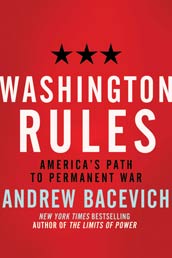
Book Review: "Washington Rules", by Andrew J. Bacevich


At the end of July I presented an analysis of an article Andrew Bacevich had written as a sort of introduction to his latest book, Washington Rules.

In that post I assumed that Bacevich was coming from a Clausewitzian perspective and that his position centered on three main points: First, "the Western concept of war sees war as a political instrument, that is in Clausewitzian terms. Military means becomes the instrument of appropriate policy ends". Second, "this is not the same as seeing war as a "problem solver" since pursuing a policy is not the same as solving a problem, which may be much more complex. One could for instance wage war in order to distract one's own population from domestic concerns, thus attempting to solve a domestic problem but using war as an instrument in a way that compromises the means and fails to consider the ultimate results of the war in question that one has initiated". And finally, "the reluctance of both the US and Israel to see the fallacy of this view". That is specifically mistaking the instrument of narrow policy for a "problem solver" that can reshape the geo-political landscape.
After reading the book, I find that my initial analysis holds up well, but that Bacevich has broader argument to make.

So what about the book as a whole? Washington Rules can be read as both a description of what has become of US political culture since 1945 and a warning of where that culture could take us if not turned around/radically changed: That is the "Rules" in the title can serve as both a noun and a verb, to rule one has to follow the rules, even if the rules themselves are dysfunctional.

"Washington" for Bacevich is
"less a geographic expression than a set of interlocking institutions headed by people who, whether acting officially or unofficially, are able to put a thumb on the helm of state . . . includes the upper echelons of the executive, legislative, and judicial branches . . . the principle components of the national security state . . . the intelligence and federal law enforcement communities . . . select think tanks and interest groups . . . big banks and other financial institutions, defense contractors and major corporations, TV networks and elite publications, even quasi-academic entities. (page 15)


The "rules" consist of two interlocking components that allow Washington to rule. These are what Bacevich describes as the "credo" and the "trinity". The credo is simply the assumption/belief that the US and the US alone is summoned "to lead, save, liberate, and ultimately transform the world" (p 12). The credo concerns purpose, whereas the trinity concerns means, or the use of means. Following Clausewitz, Bacevich's trinity has both related moral and material elements: its moral side consists of the emphasis of "activism over example, hard power over soft and coercion over suasion" (p 13), while the material are "global military presence, global power projection and global interventionism" (p 14). Bacevich writes:
The relationship between the two is symbiotic. The trinity lends plausibility to the credo's vast claims. For its part, the credo justifies the trinity's vast requirements and exertions.

Admittance to the ruling circle requires openly embracing both the credo and the trinity, something that President Obama did the night he was elected (p 19).

The whole book's purpose concerns the history, critique and dismissal of the credo and trinity and the call for popular support for a new consensus on which to build a new US foreign policy, one that is much better suited to our current reality.

In doing this Bacevich provides a revisionist view (in the most positive sense of the term) of post-World War II US history. The Washington rules first developed after 1945 under Truman, were expanded significantly under Eisenhower, and were modified and implemented under Kennedy and his successors. Bacevich notes that Eisenhower alone offered a warning at the end of his presidency of what had been created in part by his own policies (the famous warning of the "military-industrial complex" of his farewell address, pp 32-34 & 225-6). He also dismisses the argument that Kennedy would have withdrawn from Vietnam had he not been assassinated (pp 90-92).

Vietnam was the potential turning point and given the degree to which the rules had failed miserably it is astounding that they came back so quickly. Perhaps a good indication of how public attitudes had changed is in the comparison of two people, one real and one a product of the cinema. General Curtis LeMay was the creator of the Strategic Air Command, and along with Allen Dulles and the CIA, is one of the two important figures from the 1950s that Bacevich describes in detail. Going into the 1960s LeMay was still a national hero. By 1968, as George Wallace's running mate for the presidency on a third party ticket he had been reduced to a "dangerous buffoon" for suggesting that a few well-placed nuclear bombs could reverse the tide of the Vietnam war (p 124). An indication of where this was leading is shown by the brilliant portrayal of Brigadier General Jack D. Ripper by Sterling Hayden in the classic Dr Strangelove of 1964. By 1970, not only Vietnam, but US nuclear policy, which LeMay had championed, had been called into question.
What was the result? Did the Washington rules come to a well deserved end? Instead of a reassessment, by the end of the Carter administration and with the election of Ronald Reagan in 1980, the rules had been reestablished without much question at all, as Bacevich writes, "Seldom has a war been so fervently memorialized even as it was being so thoroughly drained of meaning" (p 128). Much of this had to do with the nature of the official assessment which allowed for only acceptable views to be expressed. Scapegoats were identified, the failure due essentially to "tactics" and the actual strategic nature of the defeat buried. Those in power simply had too much interest in maintaining the status quo. This narrow-minded self interest remains with us today in George W Bush's War on Terror, since to call into question the events that "paved the way for September 11, 2001" would "call into question a national security tradition that goes back decades" (p 86). Approaches go under new names, but are simply repeats of past failed policies, for example Global COIN as a repeat of JFK's "Flexible Response", Bush's delusional "transformation of the Middle East" as the flip side of Eisenhower's domino theory and Obama's targeted assassinations by predator drone a high-tech repeat of "Operation Mongoose" and the "Phoenix Program". The durability of the credo/trinity precludes any strategic reevaluation and reduces the problem once again to tactics which only allows for their tool kit of military responses.

This is turn eliminates the possibility of effective strategic thought or useful application of strategic theory. As an excellent example of this we have the Surge of 2007, which "trivialized the very concept of strategy" (p. 190). The Surge was all about marketing and (re-)packaging, allowing those who had supported the Iraq war to regroup under a new banner and turn the tables on those we did not support the war. Questioning the success of the Surge was unpatriotic, even Unamerican, attacking the troops and the great man of the hour General David Petraeus.

Bacevich describes Petraeus's actual achievement thus:
Changing the way that a war was perceived - whether within the inner circle of power or in the eyes of the public - could be tantamount to changing reality itself. In a time of crisis, the soldier who demonstrated a capacity to alter perspections might well parlay military authority into influence extending well beyond the narrow realm of military affairs. (p. 195)

Not success, but the illusion of success for the delusional, which well describes our national security situation at present. It is also important to point out that Petraeus's "success" required that he adhere to the Washington rules and play to the strengths of a powerful propaganda machine, that is success is seen as maintaining the status quo no matter what the actual reality may dictate. To Bacevich's credo we can thus add the comforting assumption that the American enterprise of Empire is deemed as "too big to fail", only a question of keeping the US public supportive. Petraeus - and even presidents - simply become instruments for the continuation of the national security state and the rules under which it functions.

Bacevich's description of the Washington Rules seems at first glance remarkably similar to Thomas Kuhn's concept of a "paradigm" in that it comprises a world view in which the institutions involved measure and judge the phenomenon under investigation. Scientists are trained, evaluated and rewarded based on their adherence to the paradigm of their community. Kuhn himself doubted the applicability of his concept to the social sciences - to which strategic theory and political science belong. For this reason the Washington Rules are better classified as an ideology which has a much less firm connection to reality, and which to me would indicate we could remain under the thrall of the Washington rules until we reach political and social collapse. Bacevich agrees (p. 229).

Bacevich's conclusion is that the American people are complicit in the continuance of the Washington rules. An all volunteer force and massive deficit spending allow the price of Empire to be localized to a relative few while the costs are shifted to future generations. The choice other than the Washington rules, if it can ever get wide-spread dissemination, is an older trinity which defined the military as made up of mostly citizen soldiers serving to defend the narrow interests of America itself, not an Empire that benefits the ever expanding intersts of a corrupt parasitic elite.

To disenthrall ourselves from the Washington rules is in essence to rediscover ourselves as a nation. This book serves as wake up call for exactly that.

Post script:

Andrew Bacevich has just come up with a brilliant article in The New Republic . . .

He makes some very important points:

Operation Desert Storm didn’t turn out that way. An ostensibly great victory gave way to even greater complications. Although, in evicting the Iraqi army from Kuwait, U.S. and coalition forces did what they had been sent to do, Washington became seized with the notion merely turning back aggression wasn’t enough: In Baghdad, Bush’s nemesis survived and remained defiant. So what began as a war to liberate Kuwait morphed into an obsession with deposing Saddam himself. In the form of air strikes and missile attacks, feints and demonstrations, CIA plots and crushing sanctions, America’s war against Iraq persisted throughout the 1990s, finally reaching a climax with George W. Bush’s decision after September 11, 2001, to put Saddam ahead of Osama bin Laden in the line of evildoers requiring elimination.

Emphasis mine. Then there's this . . .
Unable to win, unwilling to accept defeat, the Bush administration sought to create conditions allowing for a graceful exit. Marketed for domestic political purposes as “a new way forward,” more commonly known as “the surge,” this modified approach was the strategic equivalent of a dog’s breakfast. President Bush steeled himself to expend more American blood and treasure while simultaneously lowering expectations about what U.S. forces might actually accomplish. New tactics designed to suppress the Iraqi insurgency won Bush’s approval; so too did the novel practice of bribing insurgents to put down their arms.

And this . . .
Which brings us to the present. After seven-plus years, Operation Iraqi Freedom has concluded. Operation New Dawn, its name suggesting a skin cream or dishwashing liquid, now begins. (What ever happened to the practice of using terms like Torch or Overlord or Dragoon to describe military campaigns?) Although something like 50,000 U.S. troops remain in Iraq, their mission is not to fight, but simply to advise and assist their Iraqi counterparts. In another year, if all goes well, even this last remnant of an American military presence will disappear.

So the Americans are bowing out, having achieved few of the ambitious goals articulated in the heady aftermath of Baghdad’s fall. The surge, now remembered as an epic feat of arms, functions chiefly as a smokescreen, obscuring a vast panorama of recklessness, miscalculation, and waste that politicians, generals, and sundry warmongers are keen to forget.