Showing posts with label Andrew Bacevich. Show all posts

Wednesday, February 29, 2012

End of the American Century

Professor Andrew Bacevich has a new book out, a collection of essays entitled The Short American Century. Bacevich is well known by the barkeeps here and to our readers as well I assume. His is one of the few voices of reason heard in contemporary America today, which says a lot.

On this post I would like to introduce Bacevich's new book as well as point out two other articles one from November 2011 and the other published this month. The book provides necessary context while the two articles provide an analysis of our current situation. I'll start with the older article, then proceed to the newer article and finish with an extract from the book which ties the two together.

--

The first article, from 2011, entitled Big Change Whether We Like It or Not provides a thoughtful analysis of America going into the current year. Perhaps the worst aspect of the situation is not the overwhelming change we are facing, but the attitude of the current political/economic elite:

In Washington, meanwhile, a hidebound governing class pretends that none of this is happening, stubbornly insisting that it’s still 1945 with the so-called American Century destined to continue for several centuries more (reflecting, of course, God’s express intentions).

Here lies the most disturbing aspect of contemporary American politics, worse even than rampant dysfunction borne of petty partisanship or corruption expressed in the buying and selling of influence. Confronted with evidence of a radically changing environment, those holding (or aspiring to) positions of influence simply turn a blind eye, refusing even to begin to adjust to a new reality.


With the onrush of political, economic, environmental, even military changes happening now, our national leadership prefers to pass off bromides, sound bits of past glories and worn-out boilerplate from chicken dinner speeches to the people as if they offered some sort of proper response.

Bacevich lists "four converging vectors involved" although he admits there may be more. They are:

First the Collapse of the Freedom Agenda which was Washington's response to 9/11 in the form of Bush's invasion of Iraq:

Intent on accomplishing across the Islamic world what he believed the United States had accomplished in Europe and the Pacific between 1941 and 1945, Bush sought to erect a new order conducive to U.S. interests -- one that would permit unhindered access to oil and other resources, dry up the sources of violent Islamic radicalism, and (not incidentally) allow Israel a free hand in the region. Key to the success of this effort would be the U.S. military, which President Bush (and many ordinary Americans) believed to be unstoppable and invincible -- able to beat anyone anywhere under any conditions.

Alas, once implemented, the Freedom Agenda almost immediately foundered in Iraq. The Bush administration had expected Operation Iraqi Freedom to be a short, tidy war with a decisively triumphant outcome. In the event, it turned out to be a long, dirty (and very costly) war yielding, at best, exceedingly ambiguous results.


In retrospect it seems amazing that there was so little resistance to this "policy" which was more the nature of corruption mixed with systemic failure at a whole variety of levels. None of the elite come out looking even halfway competent or even trustworthy here which is why they would just a soon sweep it all under the rug. "Next war please!" As it is "history's actors" got bitch slapped by reality, as if it could have turned out any other way . . .

Second, the Great Recession:

Instead of being a transitory phenomenon, it seemingly signifies something transformational. The Great Recession may well have inaugurated a new era -- its length indeterminate but likely to stretch for many years -- of low growth, high unemployment, and shrinking opportunity. As incomes stagnate and more and more youngsters complete their education only to find no jobs waiting, members of the middle class are beginning to realize that the myth of America as a classless society is just that. In truth, the game is rigged to benefit the few at the expense of the many -- and in recent years, the fixing has become ever more shamelessly blatant.

This realization is rattling American politics. In just a handful of years, confidence in the Washington establishment has declined precipitously. Congress has become a laughingstock. The high hopes raised by President Obama’s election have long since dissipated, leaving disappointment and cynicism in their wake.


This vector is probably the most difficult to deal with since it affects our every day existence. An economic system and money itself rests on trust, trust that bills will be paid and that the money used as payment will be accepted as payment. So if more and more people think they are being scammed and that there are powerful interests who are making fortunes off this crisis/their misfortune, then what do you do?

The American view of history up to now (with a short hiatus during the Great Depression) was that if you work hard you can get ahead and that if you provide for your family, getting them for instance a good education, they will be better off economically than you were. That used to work in enough cases where it was believable, but now? Tell a young family that now and see their reaction. This type of social economy has been on the way out for a long time, but the current crisis has lifted the veil for a lot of people which explains the current Populist response. Today we have the economy as casino and our political "representatives" have stood back or actively supported this change before our very eyes. To get an idea of the change I'm talking about we have to think of the economy not as money but as a value system. Consider the closing scene from Executive Suite of 1954 which adequately describes the clash between two perspectives. I would add to this the thought of the novelist Ayn Rand who remains widely (or "wildly") popular today.

In effect a new faith has taken over, "the Market" (portrayed as a synthesis of accounting principles/financial management and Ayn Rand), but that faith is breaking apart against the rocks of an ever more brutal reality. While those in power profit from the current situation, how much longer will it be taken as fact by the American public?

Third is the Arab Spring:

Although Washington abjured the overt colonialism once practiced in London, its policies did not differ materially from those that Europeans had pursued. The idea was to keep a lid on, exclude mischief-makers, and at the same time extract from the Middle East whatever it had on offer. The preferred American MO was to align with authoritarian regimes, offering arms, security guarantees, and other blandishments in return for promises of behavior consistent with Washington’s preferences. Concern for the wellbeing of peoples living in the region (Israelis excepted) never figured as more than an afterthought.

What events of the past year have made evident is this: that lid is now off and there is little the United States (or anyone else) can do to reinstall it. A great exercise in Arab self-determination has begun. Arabs (and, arguably, non-Arabs in the broader Muslim world as well) will decide their own future in their own way. What they decide may be wise or foolish. Regardless, the United States and other Western nations will have little alternative but to accept the outcome and deal with the consequences, whatever they happen to be.


This is only the most recent manifestation of what Zbigniew Brzezinski calls the Global Political Awakening. This is a "worldwide yearning for human dignity" that has been ongoing since at least the French Revolution. What it triggers is populist activism which can be channeled in different ways to quite different effects. Dictators can rise by popular acclaim, even be voted into office . . . What we have here is not the decline of the state, but the overthrow of the last vestiges of Western imperialism in the Arab world, which will usher in new political forms and thus new state apparatuses. The state is simply the apparatus of political control, how the leadership in fact rules, is not something that can simply disappear. Our influence in regards the Arab Spring is limited, even negligible, or counter-productive to our interests, and for that reason our responses have to be considered in that light.

But then what are the chances of that? We see that our attitudes in regards to the first two vectors actually preclude it, and along with our still intact assumptions as to the infinite application of military force actually determine our seemingly self-defeating response.

The Fourth and last Vector that Bacevich lists is Europe:

Today, Europe has once again screwed up, although fortunately this time there is no need for foreign armies to sort out the mess. The crisis of the moment is an economic one, due entirely to European recklessness and irresponsibility (not qualitatively different from the behavior underlying the American economic crisis).

Will Uncle Sam once again ride to the rescue? Not a chance. Beset with the problems that come with old age, Uncle Sam can’t even mount up. To whom, then, can Europe turn for assistance? Recent headlines tell the story:

“Cash-Strapped Europe Looks to China For Help”
“Europe Begs China for Bailout”
“EU takes begging bowl to Beijing”
“Is China the Bailout Saviour in the European Debt Crisis?”

The crucial issue here isn’t whether Beijing will actually pull Europe’s bacon out of the fire. Rather it’s the shifting expectations underlying the moment. After all, hasn’t the role of European savior already been assigned? Isn’t it supposed to be Washington’s in perpetuity? Apparently not.


Shifting expectations is again the point here. Since all these assumptions are based on US dominance, we see that this dominance in fact no longer exists, as if we needed yet another example to prove that.

I think Bacevich overstates the case and misses the real turnaround. How much of the current crisis was the result of Europe "screwing up" and how much was a direct result of the economic "heresy"/scams coming out of the US? Would this current crisis have happened at this time without the Wall Street implosion? The view I see as gaining ground in Portugal is that the Wall Street "vandals" sucked what they could out of the US and then came to Europe to do the same . . . this accepting that plenty of mistakes had been made on this side of the Atlantic. It was the gaming of the crisis which has destroyed a lot of European faith in US business methods and economics. Add to this, the profound disappointment in Barack Obama and how he utterly failed to deal with the financial crisis, essentially co-opting to the banks. The "US", although few will say this openly, is now seen by many Europeans as akin to a highway robber, operating outside the "rule of law".

--

The second and more recent article, From Liberation to Assassination, Scoring the Global War on Terror describes how the Global War on Terror has evolved. From the Shock and Awe of the Rumsfeld Era we proceeded to the COIN of the Petraeus Era and are now in what Bacevich calls the turn to assassination by RPA/Special Operations Forces. Instead of a high-profile official like Rumsfeld or Petraeus, the "emblematic figure of the war formerly known as the Global War on Terror (WFKATGWOT)" is a relatively unknown figure by the name of Michael Vickers.

Bacevich concludes this article:

How round three will end is difficult to forecast. The best we can say is that it’s unlikely to end anytime soon or particularly well. As Israel has discovered, once targeted assassination becomes your policy, the list of targets has a way of growing ever longer.

So what tentative judgments can we offer regarding the ongoing WFKATGWOT? Operationally, a war launched by the conventionally minded has progressively fallen under the purview of those who inhabit what Dick Cheney once called “the dark side,” with implications that few seem willing to explore. Strategically, a war informed at the outset by utopian expectations continues today with no concretely stated expectations whatsoever, the forward momentum of events displacing serious consideration of purpose. Politically, a war that once occupied center stage in national politics has now slipped to the periphery, the American people moving on to other concerns and entertainments, with legal and moral questions raised by the war left dangling in midair.
-

In other words chronic strategic confusion as a result of possibly terminal political dysfunction. At least that is how I would read it.

The glowing Washington Post piece I linked above had this to say:

Today, as the top Pentagon adviser on counterterrorism strategy, Vickers exudes the same assurance about defeating terrorist groups as he did as a 31-year-old CIA paramilitary officer assigned to Afghanistan, where he convinced superiors that with the right strategy and weapons, the ragtag Afghan insurgents could win. "I am just as confident or more confident we can prevail in the war on terror," Vickers, 54, said in a recent interview, looking cerebral behind thick glasses but with an energy and build reminiscent of the high school quarterback he once was. "Not a lot of people thought we could drive the Soviets out of Afghanistan."

Vickers joined the Pentagon in July to oversee the 54,000-strong Special Operations Command (Socom), based in Tampa, which is growing faster than any other part of the U.S. military. Socom's budget has doubled in recent years, to $6 billion for 2008, and the command is to add 13,000 troops to its ranks by 2011.

Senior Pentagon and military officials regard Vickers as a rarity -- a skilled strategist who is both creative and pragmatic. "He tends to think like a gangster," said Jim Thomas, a former senior defense planner who worked with Vickers. "He can understand trends then change the rules of the game so they are advantageous for your side."


Emphasis mine. The first highlighted item could as well be said of us, but I doubt if the irony was as potentially obvious in 2007 when the article was written. Also notice the term "strategist" linked with "gangster".

Have we ever really had a coherent strategy at all? That is if we consider strategy as using military means to achieve a military aim in support of a political purpose. Our goal all along has seemingly been simply to impose and maintain dominance. The secondary goal of achieving permanent and complete security (essentially the 1% Doctrine) is not really an achievable goal since total security is never possible.

So why does the GWOT go on? Is it because it has gained a constituency with a personal interest in its further continuance no matter how much it costs or how many foreigners it kills or lives it destroys? Especially under the new version it could go on for some time irregardless of the backlash it is building against us . . . Perhaps the answer is in the four vectors discussed in the first article.

--

The last Bacevich piece I will include here is a short essay from the new book, The American Century Is Over - Good Riddance. In it besides proclaiming the obvious end of American dominance we also see the end of the American claim to global leadership, what Henry Luce referred to in 1941 as the great mission of the US. That mission has now come to an end.

For me the money paragraphs were these two:

But I suspect that's not going to happen. The would-be masters of the universe orbiting around the likes of Romney and Obama won't be content to play such a modest role. With the likes of Robert Kagan as their guide—"It's a wonderful world order," he writes in his new book, The World America Made (Knopf)—they will continue to peddle the fiction that with the right cast of characters running Washington, history will once again march to America's drumbeat. Evidence to support such expectations is exceedingly scarce—taken a look at Iraq lately?—but no matter. Insiders and would-be insiders will insist that, right in their hip pocket, they've got the necessary strategy.

Strategy is a quintessential American Century word, ostensibly connoting knowingness and sophistication. Whether working in the White House, the State Department, or the Pentagon, strategists promote the notion that they can anticipate the future and manage its course. Yet the actual events of the American Century belie any such claim. Remember when Afghanistan signified victory over the Soviet empire? Today, the genius of empowering the mujahedin seems less than self-evident.

Strategy is actually a fraud perpetrated by those who covet power and are intent on concealing from the plain folk the fact that the people in charge are flying blind. With only occasional exceptions, the craft of strategy was a blight on the American Century.


So "strategy" as scam, con game for the suckers who are only expected to foot the bill.

Strategy as marketing. But the marketing of dominance through domestic propaganda. Next new product out . . . war with Iran . . .

Postscript-

"Gloomy". That's what this perspective is called: not by those here, us barkeeps or the readers, not imo. The ones who refer to us as "gloomy" post on their own Neocon or Robbish doctrinal speculation blogs. They then comfort themselves with the self-serving notion that we don't really understand how tough it could get . . . the "warriors" know far better than we lesser mortals could ever . . .

The "warriors" don't listen to Bacevich either, which puts us in good company. It also indicates what we all have in common . . . the simple understanding that any reform/change will require acknowledgment of the problems and suitable solutions. Avoiding the painfully obvious with faith in "balance" or Randian "objectivity" is a decedent even nihilistic response.

We, the opposition to the "warriors", simply keep chipping away, like Andrew Bacevich does . . .

Like Publius does, like Al does, like FDChief does, like jim does, and everyone else reading who understands and agrees with my words.

Sunday, August 29, 2010

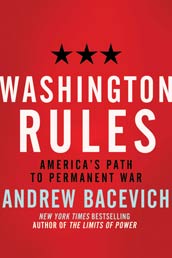
Book Review: "Washington Rules", by Andrew J. Bacevich


At the end of July I presented an analysis of an article Andrew Bacevich had written as a sort of introduction to his latest book, Washington Rules.

In that post I assumed that Bacevich was coming from a Clausewitzian perspective and that his position centered on three main points: First, "the Western concept of war sees war as a political instrument, that is in Clausewitzian terms. Military means becomes the instrument of appropriate policy ends". Second, "this is not the same as seeing war as a "problem solver" since pursuing a policy is not the same as solving a problem, which may be much more complex. One could for instance wage war in order to distract one's own population from domestic concerns, thus attempting to solve a domestic problem but using war as an instrument in a way that compromises the means and fails to consider the ultimate results of the war in question that one has initiated". And finally, "the reluctance of both the US and Israel to see the fallacy of this view". That is specifically mistaking the instrument of narrow policy for a "problem solver" that can reshape the geo-political landscape.
After reading the book, I find that my initial analysis holds up well, but that Bacevich has broader argument to make.

So what about the book as a whole? Washington Rules can be read as both a description of what has become of US political culture since 1945 and a warning of where that culture could take us if not turned around/radically changed: That is the "Rules" in the title can serve as both a noun and a verb, to rule one has to follow the rules, even if the rules themselves are dysfunctional.

"Washington" for Bacevich is
"less a geographic expression than a set of interlocking institutions headed by people who, whether acting officially or unofficially, are able to put a thumb on the helm of state . . . includes the upper echelons of the executive, legislative, and judicial branches . . . the principle components of the national security state . . . the intelligence and federal law enforcement communities . . . select think tanks and interest groups . . . big banks and other financial institutions, defense contractors and major corporations, TV networks and elite publications, even quasi-academic entities. (page 15)


The "rules" consist of two interlocking components that allow Washington to rule. These are what Bacevich describes as the "credo" and the "trinity". The credo is simply the assumption/belief that the US and the US alone is summoned "to lead, save, liberate, and ultimately transform the world" (p 12). The credo concerns purpose, whereas the trinity concerns means, or the use of means. Following Clausewitz, Bacevich's trinity has both related moral and material elements: its moral side consists of the emphasis of "activism over example, hard power over soft and coercion over suasion" (p 13), while the material are "global military presence, global power projection and global interventionism" (p 14). Bacevich writes:
The relationship between the two is symbiotic. The trinity lends plausibility to the credo's vast claims. For its part, the credo justifies the trinity's vast requirements and exertions.

Admittance to the ruling circle requires openly embracing both the credo and the trinity, something that President Obama did the night he was elected (p 19).

The whole book's purpose concerns the history, critique and dismissal of the credo and trinity and the call for popular support for a new consensus on which to build a new US foreign policy, one that is much better suited to our current reality.

In doing this Bacevich provides a revisionist view (in the most positive sense of the term) of post-World War II US history. The Washington rules first developed after 1945 under Truman, were expanded significantly under Eisenhower, and were modified and implemented under Kennedy and his successors. Bacevich notes that Eisenhower alone offered a warning at the end of his presidency of what had been created in part by his own policies (the famous warning of the "military-industrial complex" of his farewell address, pp 32-34 & 225-6). He also dismisses the argument that Kennedy would have withdrawn from Vietnam had he not been assassinated (pp 90-92).

Vietnam was the potential turning point and given the degree to which the rules had failed miserably it is astounding that they came back so quickly. Perhaps a good indication of how public attitudes had changed is in the comparison of two people, one real and one a product of the cinema. General Curtis LeMay was the creator of the Strategic Air Command, and along with Allen Dulles and the CIA, is one of the two important figures from the 1950s that Bacevich describes in detail. Going into the 1960s LeMay was still a national hero. By 1968, as George Wallace's running mate for the presidency on a third party ticket he had been reduced to a "dangerous buffoon" for suggesting that a few well-placed nuclear bombs could reverse the tide of the Vietnam war (p 124). An indication of where this was leading is shown by the brilliant portrayal of Brigadier General Jack D. Ripper by Sterling Hayden in the classic Dr Strangelove of 1964. By 1970, not only Vietnam, but US nuclear policy, which LeMay had championed, had been called into question.
What was the result? Did the Washington rules come to a well deserved end? Instead of a reassessment, by the end of the Carter administration and with the election of Ronald Reagan in 1980, the rules had been reestablished without much question at all, as Bacevich writes, "Seldom has a war been so fervently memorialized even as it was being so thoroughly drained of meaning" (p 128). Much of this had to do with the nature of the official assessment which allowed for only acceptable views to be expressed. Scapegoats were identified, the failure due essentially to "tactics" and the actual strategic nature of the defeat buried. Those in power simply had too much interest in maintaining the status quo. This narrow-minded self interest remains with us today in George W Bush's War on Terror, since to call into question the events that "paved the way for September 11, 2001" would "call into question a national security tradition that goes back decades" (p 86). Approaches go under new names, but are simply repeats of past failed policies, for example Global COIN as a repeat of JFK's "Flexible Response", Bush's delusional "transformation of the Middle East" as the flip side of Eisenhower's domino theory and Obama's targeted assassinations by predator drone a high-tech repeat of "Operation Mongoose" and the "Phoenix Program". The durability of the credo/trinity precludes any strategic reevaluation and reduces the problem once again to tactics which only allows for their tool kit of military responses.

This is turn eliminates the possibility of effective strategic thought or useful application of strategic theory. As an excellent example of this we have the Surge of 2007, which "trivialized the very concept of strategy" (p. 190). The Surge was all about marketing and (re-)packaging, allowing those who had supported the Iraq war to regroup under a new banner and turn the tables on those we did not support the war. Questioning the success of the Surge was unpatriotic, even Unamerican, attacking the troops and the great man of the hour General David Petraeus.

Bacevich describes Petraeus's actual achievement thus:
Changing the way that a war was perceived - whether within the inner circle of power or in the eyes of the public - could be tantamount to changing reality itself. In a time of crisis, the soldier who demonstrated a capacity to alter perspections might well parlay military authority into influence extending well beyond the narrow realm of military affairs. (p. 195)

Not success, but the illusion of success for the delusional, which well describes our national security situation at present. It is also important to point out that Petraeus's "success" required that he adhere to the Washington rules and play to the strengths of a powerful propaganda machine, that is success is seen as maintaining the status quo no matter what the actual reality may dictate. To Bacevich's credo we can thus add the comforting assumption that the American enterprise of Empire is deemed as "too big to fail", only a question of keeping the US public supportive. Petraeus - and even presidents - simply become instruments for the continuation of the national security state and the rules under which it functions.

Bacevich's description of the Washington Rules seems at first glance remarkably similar to Thomas Kuhn's concept of a "paradigm" in that it comprises a world view in which the institutions involved measure and judge the phenomenon under investigation. Scientists are trained, evaluated and rewarded based on their adherence to the paradigm of their community. Kuhn himself doubted the applicability of his concept to the social sciences - to which strategic theory and political science belong. For this reason the Washington Rules are better classified as an ideology which has a much less firm connection to reality, and which to me would indicate we could remain under the thrall of the Washington rules until we reach political and social collapse. Bacevich agrees (p. 229).

Bacevich's conclusion is that the American people are complicit in the continuance of the Washington rules. An all volunteer force and massive deficit spending allow the price of Empire to be localized to a relative few while the costs are shifted to future generations. The choice other than the Washington rules, if it can ever get wide-spread dissemination, is an older trinity which defined the military as made up of mostly citizen soldiers serving to defend the narrow interests of America itself, not an Empire that benefits the ever expanding intersts of a corrupt parasitic elite.

To disenthrall ourselves from the Washington rules is in essence to rediscover ourselves as a nation. This book serves as wake up call for exactly that.

Post script:

Andrew Bacevich has just come up with a brilliant article in The New Republic . . .

He makes some very important points:

Operation Desert Storm didn’t turn out that way. An ostensibly great victory gave way to even greater complications. Although, in evicting the Iraqi army from Kuwait, U.S. and coalition forces did what they had been sent to do, Washington became seized with the notion merely turning back aggression wasn’t enough: In Baghdad, Bush’s nemesis survived and remained defiant. So what began as a war to liberate Kuwait morphed into an obsession with deposing Saddam himself. In the form of air strikes and missile attacks, feints and demonstrations, CIA plots and crushing sanctions, America’s war against Iraq persisted throughout the 1990s, finally reaching a climax with George W. Bush’s decision after September 11, 2001, to put Saddam ahead of Osama bin Laden in the line of evildoers requiring elimination.

Emphasis mine. Then there's this . . .
Unable to win, unwilling to accept defeat, the Bush administration sought to create conditions allowing for a graceful exit. Marketed for domestic political purposes as “a new way forward,” more commonly known as “the surge,” this modified approach was the strategic equivalent of a dog’s breakfast. President Bush steeled himself to expend more American blood and treasure while simultaneously lowering expectations about what U.S. forces might actually accomplish. New tactics designed to suppress the Iraqi insurgency won Bush’s approval; so too did the novel practice of bribing insurgents to put down their arms.

And this . . .
Which brings us to the present. After seven-plus years, Operation Iraqi Freedom has concluded. Operation New Dawn, its name suggesting a skin cream or dishwashing liquid, now begins. (What ever happened to the practice of using terms like Torch or Overlord or Dragoon to describe military campaigns?) Although something like 50,000 U.S. troops remain in Iraq, their mission is not to fight, but simply to advise and assist their Iraqi counterparts. In another year, if all goes well, even this last remnant of an American military presence will disappear.

So the Americans are bowing out, having achieved few of the ambitious goals articulated in the heady aftermath of Baghdad’s fall. The surge, now remembered as an epic feat of arms, functions chiefly as a smokescreen, obscuring a vast panorama of recklessness, miscalculation, and waste that politicians, generals, and sundry warmongers are keen to forget.

Friday, July 30, 2010

The End of the Western Concept of War?


In my last post I presented a "stay the course" view in regards to the Afghan war. In this referring to Professor Andrew Bacevich's latest article, we see a very different perspective. Bacevich talks about his book here.

Both are probably seen as responses to the recent wikileaks document dump which Chief has presented on a couple of posts. While Rove's is a probable response, Bacevich's is probably not since it is an introduction to a book that will be coming out soon. That is Rove's is more a reaction imo, whereas Bacevich's is a much more thought out and reasoned presentation. Also since it is introducing a book, one should not expect the "whole story", rather one is expected to read the book, as I will.

My assumption is simply that Professor Bacevich is coming from a Clausewitzian perspective and that his argument will reflect that. This article - following this perspective - is incomplete since it serves primarily as an introduction to the book.

The article is typical Bacevich in quality and style. I recommend it highly. There is only one comment I wish to make concerning it which goes beyond the situation of the US today, and even the US situation since 1945, but that addresses the title of this post.

Bacevich writes:

All of this furious activity, whether undertaken by France or Great Britain, Russia or Germany, Japan or the United States, derived from a common belief in the plausibility of victory. Expressed in simplest terms, the Western military tradition could be reduced to this proposition: war remains a viable instrument of statecraft, the accoutrements of modernity serving, if anything, to enhance its utility.

Grand Illusions

That was theory. Reality, above all the two world wars of the last century, told a decidedly different story. Armed conflict in the industrial age reached new heights of lethality and destructiveness. Once begun, wars devoured everything, inflicting staggering material, psychological, and moral damage. Pain vastly exceeded gain. In that regard, the war of 1914-1918 became emblematic: even the winners ended up losers. When fighting eventually stopped, the victors were left not to celebrate but to mourn. As a consequence, well before Fukuyama penned his essay, faith in war’s problem-solving capacity had begun to erode. As early as 1945, among several great powers -- thanks to war, now great in name only -- that faith disappeared altogether.

Among nations classified as liberal democracies, only two resisted this trend. One was the United States, the sole major belligerent to emerge from the Second World War stronger, richer, and more confident. The second was Israel, created as a direct consequence of the horrors unleashed by that cataclysm. By the 1950s, both countries subscribed to this common conviction: national security (and, arguably, national survival) demanded unambiguous military superiority. In the lexicon of American and Israeli politics, “peace” was a codeword. The essential prerequisite for peace was for any and all adversaries, real or potential, to accept a condition of permanent inferiority. In this regard, the two nations -- not yet intimate allies -- stood apart from the rest of the Western world.

Emphasis is mine.

Three points that correspond to the three highlighted sections:

First the Western concept of war sees war as a political instrument, that is in Clausewitzian terms. Military means becomes the instrument of appropriate policy ends. According to Clausewitz war is made up of a remarkable trinity of passion, chance and the subordination to policy/politics. War is not an independent phenomenon, but part of political intercourse, that is belonging to a larger social whole. Notice that the definition of "politics" here is intentionally broad, encompassing various aspects associated with power in the context of both within and between political communities.

Second, this is not the same as seeing war as a "problem solver" since pursuing a policy is not the same as solving a problem, which may be much more complex. One could for instance wage war in order to distract one's own population from domestic concerns, thus attempting to solve a domestic problem but using war as an instrument in a way that compromises the means and fails to consider the ultimate results of the war in question that one has initiated (chance and passion).

I think it no accident that Bacevich mentions the First World War in this regard. JFC Fuller in his The Conduct of War writes in connection with the aims of the two opposing alliances in 1914:

As regards the aims of the two alliances, which their respective policies should have co-ordinated with the means at their disposal as well as with strategical and other conditions [notice the influence of Clausewitz here], they may be inferred from the causes which brought the two alliances into being. That of France was to cripple Germany, regain Alsace-Lorraine, and reestablish her leadership on the continent, which she had been deprived of by Sadowa and Sedan. That of Russia was to absorb the Balkans, and with them gain Constantinople and an outlet to the Mediterranean, which meant the emasculation, if not the disintegration, of the Austro-Hungarian Empire. That of Germany was to prevent either of these contingencies, and maintain her supremacy. That of Great Britain was to destroy Germany as a trade rival, which she could only do with the aide of France and Russia. pp153-4


The war aims of the Entente required the complete defeat of the Central Powers. That is the political aims of France, Russia and Britain were of such a radical nature that they would require tremendous resources to achieve, to even have the chance of achieving. Given a war of this intensity and scope it was unavoidable that chance (unexpected/unintended political consequences) and passion (new ideologies/loss of respect for old elites/mass radicalization) would present themselves, making for a situation which was in many ways worse than what had preceded it.

To ensure success, what was also necessary was that the populations of the Entente powers believe they were in fact waging a defensive war, a war against an aggressive Germany. German operational success and actions in Belgium provided for the cover initially, along with ever more aggressive German war aims as their losses went up and the war went on, so that with the final defeat in 1918 Germany was relatively easily and necessarily burdened with the sole guilt for having started the war in the first place. With the overthrow of the Hohenzollern monarchy, that left the German people holding the bag. That is the "peace treaty" became a means of maintaining domination over a people, in effect continuing the war, but through other means (continued economic blockade/harsh treaty terms). The Allies - including the US - had essentially blurred the distinction between war and peace and had waged war for - especially in the case of the US - bombastically utopian goals which unsurprisingly fell far short in reality. Thus both the Allied and Central Power perspectives ceased to see war as a rational instrument, but rather as an unlimited "problem solver" which was carried over in some form in the following post-war period.

The third point I wish to bring out from Bacevich's article that I quoted is the reluctance of both the US and Israel to see the fallacy of this view. They continue to play in effect by the Entente's rules of 1914-1920. The result then as now will be a continuously deteriorating international situation with ever increasing demands on US/Israeli resources in what is a situation which does not lend itself to a military solution.

It's time we got back to the idea of limits in regards to what can be achieved by military means.

So is it the end of the Western concept of war? Not imo, but rather the realization that the wars of the 20th and now the 21st Centuries have in some cases been the result of political radicalism which expected massive social transformation through war. Thus the grandiose nature of the politics involved (in effect imposing total domination on the enemy including defining his political identity), not the potential use of the military instrument per say, is what has come to a cross roads.

Can we carry on doing things and saying things the way we have for the last nine years?

Postscript-

If we recall the assumptions associated with Karl Rove's view of the war on terror from my last thread:

1. We are engaged with an existential threat that wishes to both harm us and take away our liberty.

2. Afghanistan is the right place to fight this threat, but not necessarily the only place. The overall war aim is one of remaking Afghanistan to suit our purposes, essentially a clean sweep.

3. We can only defeat ourselves, it is only a lack or resolve among our leaders reflected in their poor choice of words that can lead us to defeat in this war. Time is always on our side. Essentially we are "too big to fail".

4. Only ever increasing levels of violence - the emphasis is clearly on military action, on military victory, will assure success. Success is only defined in military terms. Hand-wringing squeamishness is only defeatism.

5. Politics = power = war. You win by having broken the other side, having them accept your view even to their own disadvantage. Whether at home or abroad, it makes no difference.


And compare them with Bacevich's view as presented in his latest article and recent interviews, we see that they are essentially opposites. It is as if Rove and Bacevich exist in two different worlds.

Furthermore, Rove's assumptions will not be questioned and Bacevich's questions will hardly be addressed. Instead he is dismissed politely as a "paleo-conservative" and the sham "debate" moves on. Notice that simple "conservative" has a different meaning today than before, meaning in effect "Cheney and neo-con stooge". Conservativism along with Liberalism have both been gutted as belief systems, as sets of interlocking ideals/values; today in America they simply stand for "interests" or "prejudices" those notions that relieve us of any discomfort should we get a glimpse of what is really going on behind that threadbare curtain. Some may have wondered my reason for posting anything about Rove, why? Because I have had a very uneasy feeling: as if Bush were still on his throne and Cheney still in his bunker at the controls . . . Now, why should I feel that? Could it have something to do with a possible level of betrayal and cowardice that seems increasingly manifest?

Still the basic question remains, how long can a country, even a world hegemon, continue to operate as if it were in some different reality? Assuming that its power is unlimited and that it can in effect bend reality to its own will, create its own situation on the ground? Seventeenth Century Spain was such a country and as FDChief and I have pointed out in the past, its attempt at continued hegemony in the face of material, moral and physical decline only hastened its inevitable collapse.

I support Andrew Bacevich in his attempt to reach the American people with his message. I only hope that this post, in whatever small way, has assisted him in his goal. Andrew Bacevich's warning is a flashing red light that we ignore at our peril.