Showing posts with label modern warfare. Show all posts

Sunday, May 5, 2024

Commo check

 It's been so long I'd almost forgotten this place, but what seems deeply ironic is that just as I thought we had nothing more to talk about - the Forever Wars in SW Asia were winding down - the Putin government of Russia decided to re-imagine the last years of WW2 by attacking westwards into the plains of Ukraine.

Whoodathunkit?

Plus the Netanyahu government of Israel decided to respond to a bloody provocation raid by going from apartheid to active ethnic cleansing.

Let's say that I didn't have this stuff on my foreign policy bingo card.

Is there any enthusiasm for discussion of any of this?

Not sure what I myself can add; I don't see anything hopeful coming out of either conflict. Instead it seems increasingly likely that all the parties involved will end up worse off, proving that the destructive nature of modern warfare has gone a long way to reducing its utility as "politics by other means". 

But if there IS any interest feel free to leave a suggestion in the comments.

Sunday, March 20, 2022

Lessons learned in blood and fire

I've been kicking this around for a while, and wanted to get it down before I wander away from it.

What have we learned from what's been happening in Eastern Europe over the past month or so?

 
1. Thucydides is still correct: the strong do what they can and the weak suffer what they must.

We like to think, we pampered wealthy white Americans, that there is a "justice" that transcends simple brute force. If we're Christian we like to think that there's a "God" (and his kid) who cares about people and sort of wants them to do justly and love mercy.

And then comes something like Ukraine, where the ugly reality is impossible to hide.

So no. There's no arc of history that bends towards justice. If people want justice, they need to defend it, by force at times, with their lives if they must.

That lesson is bolded by the actions of Russia in Ukraine. But it should resonate with us here, since we have steadfastly refused to take action against those who have already attempted once to use force to "do what they can" thinking that they were the strong and we are the weak. If we do not, then we ARE the weak, and they will do with us what they can.

Putin isn't the only leader of authoritarian goons in the northern hemisphere.


2. When someone tells you what they are, believe them.

Vladimir Putin has said one thing consistently since loooong before he was Donald Trump's mancrush; that the devolution of the USSR was the Worst Thing EVAH and that if he could he would get the band back together.

Well, because the successor state to the Soviet Union looked like a shitshow and its' dictator seemed full of shit like many other dictators, a lot of us got complacent about how serious he was.

Ask the resident of Kyiv how serious.

If I was a Latvian or and Estonian right now I'd be hugging everyone who insisted that the Baltics scurry into NATO as soon as the Сове́тский флаг came down.

Now the NATO countries - including the U.S. - need to accept that those former Soviet republics are all on Putin's list. That means taking Article 5 seriously. Is Riga worth Manhattan? We might find out sooner than we like, because...

 
3. The Russian military is proving what a bad fucking idea personal autocracy is.

We in the Western militaries listened to and, often, believed the tales the Russian media and government told about the modernization and professionalization they'd done with the successor to the old Soviet Red Army.

I'm not sure if they were fooling us, or themselves, or both, but boy fucking howdy were they full of shit.

Turns out that the Russian conventional forces are bad. Reeeeally bad. "Iraqi Army" bad.

It's hard to imagine that Putin kicked off this war knowing that Saddam's Republican Guard made his regulars look like an anime goon squad. So I suspect he's been fed the diet of bullshit and flattery that people who can kill you whenever they please tend to get. His military advisors told him what he wanted to hear, not what he needed to hear.

"Dictatorships foster oppression, dictatorships foster servitude, dictatorships foster cruelty; more abominable is the fact that they foster idiocy." ~ Jorge Luis Borges

But the bottom line is that modern warfare is goddamned hard to do, and the Russians are no better at it than you'd think given the open kleptocracy and brutal autocracy that permeates Russia the country.

That's...actually kind of a Bad Thing for us as well as for them.

Because if the Russian armed forces would get waxed in the first 48 hours of combat with a Western military?

All Putin has to swing is his nukes.

And that should worry all of us at least a little bit.

Update 3/21: Someone named "Kamil Galeev" has an interesting thread discussing one of the main reasons that the Russian ground force is so damn bad; it's designed that way. It's a feature, not a bug. Long read but worth a look to think about why a putative Great Power would want to handicap its military in the way we've seen in Ukraine.


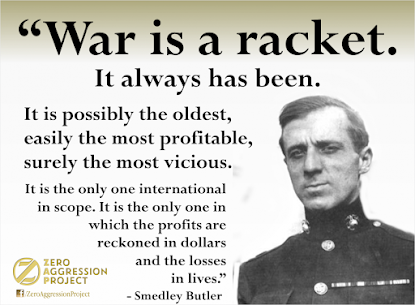
4. Smedley Butler is still right, too; war was a racket and still is.

No matter the outcome in Ukraine, everyone involved is likely to be the worse for it. Obviously the dead, but those wounded, or homeless, the refugees, the prisoners, those impoverished by war or sanctions or economic collapse. Those who have lost family, friends. The citizens of Russia's "near abroad", who must now fear that success in Ukraine will make them next in line for death and mayhem.

Of course, the Russian leadership is likely to be insulated from all that. War "leaders"  -unless they make the mistake of losing war and being captured by the victors - are seldom punished, no more than the "leaders" here that committed the identical war crime of waging aggressive war in 2003 were punished. 

It's always the "ordinary" people who suffer when the Great and the Good amongst us choose to use force to get - or try and get - what they want.

So, like most rackets, it's the bosses that profit and the footsoldiers - military and civilian - that die.

I wish I had a happier conclusion.

But, just like Ukraine today, there is no lightness; only ruin and hatred, the strong doing what they can and the weak, well, suffering.

Monday, May 6, 2013

Neither Art nor Science

Interesting little article over at the NY Times "Disunion" blog, Winning the Field but Not the War. The author's conclusion is that the reason that there were no "decisive battles" in the ACW was not technical or tactical but political and emotional:
"The system of pitched battle broke down because wars like the American Civil War and the Franco-Prussian War were fought over high ideals, and because they were fought by republics, not monarchies. The wars of the 18th century were legal procedures, fought over carefully stated legal royal claims to territory, and were justified by carefully formulated legal briefs. They were staged in orderly ways intended to symbolize the glory and civilization of royal courts. But in the mid-19th century the two Americans republics and the French Republic began to fight more bitter and more horrible wars, in the name of grander ideals. Hard though it is to accept, democratic idealism and widespread death began to march hand in hand."
Now I would begin by saying that I believe this analysis is flawed. Both the ACW and the Franco-Prussian War (along with WW1 and WW2) DID end with military victories. It's just that those wars, as did most of the industrial-era wars that followed the mid-19th Century, perforce required the "economic" defeat of the losing side (Update: or, as Sven points out in the comments section, at least in the Franco-Prussian War an period of "mopping-up" where the victor had to run around stomping out the remains of the loser's deadenders).

An industrial nation as well as a nation-in-arms couldn't be defeated by "destroying" the national army alone. So long as the economic base remained new conscript armies could be raised if the government had the political will to continue. So IMO what happened was that "pitched battle" became just part of the larger political and economic campaign to destroy the opposing nation's (or peoples') will to fight.

But I wonder...does the increasing number of inter-theological and inter-racial wars play into this increasing "complexity" and insolubility of modern war as well? Do the intractability of religious, tribal, and racial hate play into the long-simmering conflicts that seem to have troubled us so much since 1945? Is there not only just an issue of "grander ideals" but the collision of fundamental social, philosophical, and religious differences that make these conflicts nearly impossible to solve by military means short of outright genocide?

Sunni v. Shia in the Gulf region (and now Syria), Tamil/Hindu v. Sinhalese Buddhist in Sri Lanka, Israeli Jew v. Levantine Muslim in the former Ottoman Levant, Christian southern tribes v. Muslim northern tribes in Nigeria (where our old pals MEND are acting up again...), everybody and their damn tribal grandfathers in Afghanistan...it seems like we've reopened a box of very old troubles; Christian versus Muslim versus Jew, Arab or African versus Westerner, tribe versus tribe.

Our old friend Seydlitz used to like to talk about how so much of the problems faced by the United States around the world were because the U.S. had lost the ability to think cogently about national interests and how they translated into military strategy.

But...what if the biggest single part of the problem is that too many modern problems are no longer amenable to military strategy?

Or, rather, to military strategy alone?

What if, instead, the U.S. is faced with the dilemma that ancient Rome faced; an amorphously hostile "barbarian frontier" that is no more malleable over the long term to military defeat than the ocean is to bailing dry with a bucket. That there is always a sea of troubles, and that a nation that tries to defend everywhere ends up defending nowhere...in that you can end up throwing a hell of a lot of blood and treasure at problems that you can't solve without making a wasteland and calling it peace, or using nothing but complex combination of force, persuasion, bribery, treachery, local proxies...and pure indifference; picking your fights and choosing to walk away from those you can't do anything about?

So I think the question becomes...to what degree DO you expend blood and treasure overseas (or overland, in the case of Mexico where there are certainly enough elements of instability to cause at least a level of concern)? How do you calculate your "national interests" in such an environment, and determine which are amenable to diplomacy, which to a mixture of guile and force, which to force alone, and which to a combination of all?

And what are the "better options" to raw military force in places like these? Again, Seydlitz talked several times about the question of "soft power". Is such soft power an option, say, in places as different as Syria, Nigeria, Pakistan, and Indonesia and to what degree where? What would such power look like, and what could it do? And to what degree would the velvet touch have to have a mailed fist cocked behind the U.S.'s back? Little? Much? Constantly? And what would make the application of force more useful, more directed, less likely to produce "collateral damage" and blowback?

And - MOST importantly, in my view - how do you develop a national ability to figure this all out?

I guess my thought is that this entire question is as much about "craft" as it is either the art or the science of "strategic thinking". And I think the problem inherent in the U.S. politico-military system as currently constituted is that our system a) emphasizes short-term domestic political bunfighting over long-term geopolitical thinking, and b) discourages people from staying in one place long enough to perfect their "craftsmanship"; that is, the integration of technical and intellectual learning with practical experience to develop the skills for this sort of thinking, and c) produces "leaders" that are good at a) to the detriment of bothering to pay attention to the relatively low-level craftsmen who are good a b) and thus intensifies the negative-feedback loop. The craftsmen aren't good at their craft but even when they are the "leaders" don't listen which, in turn, discourages the perfection of the craft which, in turn, reinforces the "leaders" willingness to listen to their prejudices and fears rather than the craftsmen who understand the localities...

I will be the first one to say; I don't have an answer but rather a wilderness of questions. Consider this an open thread to add your own, or anything you might have by way of answers...

But I do think that this will become an ever-increasing problem as the U.S. continues its slide back into Gilded Age oligarchy. One of the real problems with oligarchy is that the oligarchs tend to become obsessed with protecting the privileges of their class rather than the welfare of the polity as a whole. To return to the analogy of Rome, the tragedy of the Revolt of the Gracchi was that the senatorial class focused on protecting itself rather than the vitality of the Republic. That, in turn, led to reliance on long-term professional soldiers who owed their loyalty to their commanders instead of the nation.

And we all recall where the bridge across the Rubicon led.

Update: I should draw attention to Sven's post that addresses something of this subject over at his Defence and Freedom site. And the conclusion he's not afraid to draw is even more pessimistic than mine: This is 100% not going to happen, and that's a pity if not doomed to end in tragedy.

Yike.

Saturday, April 7, 2012

"Technology and War" - The View from 1939

I'm currently reading a book entitled The Failure of Technology, written by Friedrich Georg Jünger. It was written during the summer of 1939, but then only published after the war in 1946, since the publisher didn't wish to risk government disapproval, which would have been obvious. An English translation came out in 1947. Friedrich Georg was a brother of the writer Ernst Jünger.

Below is the chapter on technology and war. Notice that there is mention of Clausewitz and a short analysis. Jünger has some interesting things to say about technology and its social effects. I'm working on a post on strategy within a disintegrating society and provide this post/chapter as context for my own upcoming post. This chapter brings up some disturbing questions. One which comes to mind is how would we define "total war" today? Jünger most likely picked up the concept from the writings of Erich Ludendorff.

--

TECHNOLOGY AND WAR

IT IS AN axiom of the natural sciences that the laws of nature are stable, unchangeable, and of perman­ent mechanical validity. Faith in scientific progress strangely enough presupposes the existence of laws which are completely exempt from any kind of prog­ress. These laws are indispensable to the natural sciences as rigid and dependable substrata. The law of causality, for instance, states that the same causes must always produce the same effects.

The scientist who voices a doubt in the validity of the law of causality is obviously attacking the foundation on which the whole Babylonian tower of scientific knowledge rests. He who raises the question whether all this knowledge is worth know­ing likewise attacks these foundations. This very question is outside the scientific field, for we are breaking through the sacred precincts of science if we are not content with its obvious and wonderful results. We undermine these foundations if we ask what insights really are gained by scientific dis­ coveries, what good they do us, and where mankind will be once science has achieved its goal.

Here we approach the ultimate illusion which attaches to scientific progress. Obviously the strive­ing for rationalization must come to an end at some time . Obviously it attains its end once that state of perfection has been reached for which it is striv­ing so untiringly. For the idea of unending progress is absurd and inane, because the infinite motion that rapIdity and forcefulness of technical rationalization it presupposes is contradictory. It is exactly the rapidity and forcefulness of technological rationalization which indicate that we are approaching a finale, an ultImate stage of technology where everything tech­nical attains the same degree of perfection long since achieved in the tools of handicrafts. Perhaps the moment when this will come about is not far off,
but it would be idle to speculate on this.

In any case, this is the great moment which is the main theme of the utopists, the moment upon which they concentrate their hopes. We often meet with the idea that all of mankind's sufferings, all the sacrifices that must be endured for the sake of tech­ nical progress will be compensated for at the end. Such theories of reward, however, while quite right and proper to homo religiosus, have nothing to do with technology. It is not the beginning but the end that has to bear the burden. It would be more fitting to see in these sacrifices and sufferings, the price of man's thirst for power.

The absolute notions of harmony with a state of technical perfection or to suppose a political and social idyll where it can never be found is sheer pipe­ dreaming. Those dreams of leisure, freedom, and wealth created by technical progress are utopian, and so are the ideas of peace, well-being and happiness in future times. They are utopian because they combine what cannot be combined. The ma­chine is not a godhead lavishing cornucopias of happiness, and an era of the machine does not lead to a peaceful and charming idyll. At all times the power proffered by technology has exacted, and for­ever will exact, a high price; the price of the blood and sinew of human hecatombs who in one way or another get caught in the cogs and wheels of that vast engine. The price is being paid by the leaden monotony of factory and business life that is now reaching its peak; by mechanical work for one's living; by the operator's dependence upon the auto­matic tool. The price is paid by the devastation of spiritual life which grows in step with mechanization. We would do well, indeed, to say good-bye to all illusions about the blessings forthcoming from technology, but most of all to that illusion of peaceful happiness it is supposed to bring. Technology has not the wherewithal to bring back Eden.

Indeed, the shape of things to come is vastly different. Since technology is based upon the mining of resources and since its progress spells the progressive pillage of the earth, it is obvious that in a state of perfection it will practice the most complete and the most intensive exploitation on a planetary scale, a mining of all its resources in the most ra­tional manner. This sapping and mining is bound to produce losses which must become increasingly unbearable. The devastations of this pillage are not limited to the exhaustion of mines, of oil wells and other resources. Neither this nor the reckless exhaustion of the topsoil which spreads erosion and the sinking of water tables will be decisive in them­selves, although - in America, for instance - these warning signals are already looming big.

What will spell the end is rather the total char­ acter of these losses which include the human beings within the technical organizations. It becomes con­ stantly more evident that the sum total of the tech­nological efforts and investments overtaxes human capacities, that the sheer weight of the mechanical burden is getting too heavy, that once technology has reached perfection, it will not be long before modem man collapses. Symptoms of this over­burdening are already evident in the mental and the physical spasms of this day and age, the contortions of which betray the high pressure under which we live. Everywhere in the world we see forced, over­ taxing efforts. They are bound to be followed by the reaction that invariably comes after excesses of will power and nervous overstrain: exhaustion,­ apathy, and dull depression.

In this overstraining we also find the key to an understanding of the ideas and plans for total mo­bilization and total war. Whatever their opponents may object, these ideas make perfectly good sense, inasmuch as they outline with precision the situation in which we find ourselves. For this reason they deserve an attention and a respect demanded by any momentous thoughts which do not shrink from logi­cal consequences no matter how grave they may be. The objections raised against total mobilization and total war significantly fail to hit at the crux of the matter.

What is the meaning of total mobilization and total conduct of war? How does total war differ from other wars? Clausewitz, the leading war theorist of the nineteenth century, never described such a war. True, in his definition of war he remarks that there is a tendency toward the extreme use of force and that there are no inherent limits to such use. He mentions specifically three reciprocal elements in war as conducive to extremes. But in the same breath he also speaks of the forces which modify and moderate the extreme and absolute concepts of war; the human relations, for instance, which actually continue between the belligerents even in war. His ideas of war, in other words, show plainly that they belong to a time which could have no clear concepts of the colossal growth of technical organization. The Napoleonic wars could still give no hint of this potential. What Clausewitz assumes as basic in waging war is the use of limited means for limited ends. But total war presupposes total technical organization. By its very concept, total war rejects all limitations of means and purposes. Its total not only in its preparation, its strategic and tactical means and ends; it is total above aU in its mentality of ruthless extermination which no longer recognizes any barriers.This destructive mentality is the counterpart of technological progress. It develops in the exact proportion in which technology itself breaks down all barriers of space and develops a destructive potential which is unJimited.

Even total war, however, has its modifications; even its inherent trend toward the extremes of vio­lence is subjected to limitations and restraints. One such limitation lies in the fact that a war which is waged by every means must lead also to the exhaus­tion of every resource, provided that a certain bal­ance of strength exists between the opponents. By definition, total mobilization or total war abolishes all and every reserve since no reserve remains un­touched. There are neither stores nor funds that remain intact or inviolate, nothing immobile even that does not get mobilized, no inalienable owner­ship that does not get disowned.

For proper understanding of these developments, we must consider the over-all situation of modem man. What characterizes the situation in the mechanized war of the industrial worker or the soldier who is, in fact, a worker, as is everybody who lives in a state of advanced industrialization?

The situation of the worker is signalized by his dependence on machinery and organization. It is signalized by the absence of reserves on which he could fall back. He is reduced to the sale of his bare working capacity, and he must sell it unceas­ingly and unstintingly if he wants to live. He has no funds to guarantee him peace of mind, leisure, or even an extended vacation. This already existing pattern of so-called normal, civilian life, simply gets incorporated into the pattern of total war. In it all human and material resources are drafted, mobilized, and brought into action. Plainly, there is a reverse side to this process, namely, the total consumption caused by total war. Such a war is by no means a spontaneous, voluntary mass uprising where enthusiasm makes up for primitive technical equipment. It is a struggle between technically highly developed organizations which show all the mechanical, automatic features characteristic of an advanced stage of technology. That is why the most important goal of modern war is to smash the technical potential of the opponent.

Technical progress and conduct of war today are merging. We have reached a state of affairs where the technical potential of a state is the determining factor in the event of war. Superior technology means victory, inferior technology means defeat; that is the briefest possible formula to which a definite phase of technical progress can be reduced. This equation forces all modem states, with relent­lessly increasing mechanical compulsion, to support, to speed up, and to push to the utmost the drive for technical perfection. For its own self-preservation, the modern state has to promote, and subject every­thing possible to, technical automatism . Since the technical potential is decisive in war, it is actually a form of armament. Technical progress now drops the economic mask it had been wearing in the early days of technical organization. Technically organized work becomes preparation for war; its connection with war becomes constantly more unmistakable.

Nothing can prevent this. It is conceivable that war can be prevented in a specific case. But it is inconceivable that, in the event of war, the state would refrain from using to the full its technical potential. The incessant pointing to this potential, the propagandist efforts to make it look formidable and terrifying, are parts of modern political tactics even in so-called peace. It also becomes clear why states depart more and more from the old law of nations which requested a formal declaration of war. The stigma of being termed "aggressor" is outweighed too far by the advantage of high preparedness coupled with surprise attack made possible by the technical potential.

Just as a technically organized economy becomes more and more a war economy, so technology de­velops more and more into a war technology; it reveals ever more clearly its armament character. In our dynamic age, technology steps up its pillage of world resources; but while it devours material for war preparation, it reduces at the same time our living standards. It shakes off all fetters of economic laws and finances its organization by methods which constantly increase the burdens on the workers.

The question of just what is gained by total war is, not limited to specialists. That question is raised by the consideration that the total consumption demanded by a total war may well consume whatever gains result even from the winning of the war. What must be anticipated is a condition where there is neither victor nor vanquished, but only general exhaustion. Are we still in a position where we can hope for a gain? Or is the call for total war proof in itself that the fight for sheer survival has begun? In other words: Has technical progress reached a stage where its consumption has grown so tremendous that of necessity it must radically change the territorial and political organization of all states?

Friedrich Georg Jünger, Spring 1939

Monday, November 1, 2010

The Dean of Washington Rules

One of the primary U.S. history tropes can be summarized as "WW2 pulled the U.S. out of the Depression".

This is usually taken as a just a kind of fact. But (appropriately enough) on the weekend of Halloween the very-very-serious pundit David Broder actually used it as a template for the recovery from the Great Recession. What we needed to drag the U.S. economy from the economic doldrums of 2010 is...(wait for it)...

War with Iran.Now as far as this goes it is probably factually correct; government spending does help stimulate an economy caught in a depression cycle. People are employed in war production, they spend, generating orders for consumer goods, which in turn ramps up civilian manufacture, etcetera. All of this is acceptable Econ101.

Assuming you're willing to order a side of dead Iranian women and kiddies with that.

Dean Baker over at the CEPR does a perfectly good job of taking down the Dean for eliding that it has nothing to do with war - it's government spending that does the trick;
"Yes, that's right, all the forms of stimulus spending that Broder derided so much because they add to the deficit will increase GDP and generate jobs just like the war that Broder is advocating."
but it's worth pausing for a moment to consider this entire conversation.

David Broder, a man widely heard, widely "respected", vastly influential, is actually arguing that in order to help reduce your country's fiscal difficulties you embark on a course of action very likely to bring pain, fear, misery, wounding or death to themand themand these girlsand this entire group in order to kill the man in the middle and those like him.Oh, and as a "benefit" from a plan to reduce our nation's economic woes.

Now you might think that in a sane world, a place where proposing massive death and suffering for selfish economic purposes, in a part of the world where similar military adventures have led to lingering, pointless low-intensity wars, radically polarized, hostile populations, enormous economic dislocation and political dysfunction was considered inapt at best and monstrously inhuman at worst, that such a man suggesting such a thing would result in universal revulsion and violent condemnation.

You might think that such a man suggesting such a thing would have to flee, have to hide from plain sight for fear of being brutally assaulted for suggesting that those men, women and children deserved to die because U.S. unemployment is running a little high.

You might think that decent, humane Americans of all political stripes and categories would unite in reviling and rejecting such a vile scheme as worthy only of the worst villains of literature and the movies.

You might think that.

But you'd be wrong.

Monday, October 18, 2010

Now they have.

"Whatever happens, we have got
The Maxim gun, and they have not."
(Hilaire Belloc)

Jason over at Armchair Generalist has a good little discussion about the icon of modern rebellion, the AK-47. Jason objects, sensibly, to the sensationalist journalism that labels the rifle a "weapon of mass destruction" but points out that
"What makes the AK-47 such a distinctive weapon system isn't its accuracy or the number of widgets that you can add onto the rifle. It's a cheap, long-lasting, low-maintenance system that has an overwhelming abundance of available ammunition (that is )not the best weapon to use against other militaries, but works fine against noncombatants and poorly-armed security forces."
For what it's worth, I would opine that the combination of the cheap, rugged, low-tech automatic weapon and the mine are what has made colonialism such a mug's game since the middle 1940's.Back when it was us having the Maxim gun and they had not it was pretty simple to run an empire on the cheap. But now every dimestore Westbumfuckian Liberation Front can lay their hands on a couple of shiploads of AKs and a bunch of PMD shoebox mines (or just some Semtex and a Palestinian- or Iraqi-for-hire to show them how to wire the things for sound) and all of a sudden the White Man's Burden becomes hard for low-population-growth, expensive Western volunteer armies to bear.As the Sri Lankans showed us, crushing these groups is possible, but you have to be able to use genocidal-level force, and for a Western occupier in the age of CNN/Al Jazeeera I'm not sure that's possible anymore.

So the Sunni rebellion in Iraq is controllable, either by buying out the rebels as "Sons of Iraq" or by arming their Shia and Kurdish rivals and letting them do the genocide. But absent a truly competent government, and given the strength of the rebel forces on the outside, this may not be possible in places like Afghanistan or Pakistan, and for the Western press and governments to pretend otherwise seems extremely irresponsible.

Obviously it's hard to predict the arc of competence here, but I would suggest that if the ANA/AP haven't managed to outperform their rivals after eight years of Western instruction the window for their doing a Sri Lanka on the Talibs is closing fast.