
Showing posts with label vietnam. Show all posts
Showing posts with label vietnam. Show all posts
Monday, February 26, 2018
At least he's good for a laugh once in a while...
In a dim, dirty hostess bar on a sultry backstreet in the Pham Ngu Lao district of Valhalla, a bunch of the tattered shades of the boys from the 66th NVA Regiment and the 1/7th Cav take a break from pounding warm "33" beer and talking shit about the ARVN to stand up, drop their khaki and OD trousers, and hang a collective moon on the guy who couldn't run from their war fast enough but now claims that he would rush a mad gunman barehanded.
 Over at the corner table Trung sĩ Vo and Staff Sergeant Baker spit sourly on the filthy floor and yell at the hostess for another round, cold this time, goddammit, but Hạ sĩ Nguyen thinks that the idea of Five-Deferment Donnie as a rootin' tootin' heeeero is so fucking funny he spits beer out his nose and Private Bookwalter has to pound him on the back so hard that he hits his face on the table and the whole squad, including Loi the B-girl, breaks up laughing.

Friday, August 12, 2016
More rubble = more trouble
Interesting study (Dell and Querubin, 2016) released this summer on some effects of "kinetic warfare" (i.e. bombing, shelling, and strafing) in the RVN in 1969.
 The study's conclusion should surprise none of us who have watched the "more rubble, less trouble" approach to the Middle Eastern problems over the last two decades or more:
How well this study conflates with the current enthusiasm for various Western polities' for bombing the shit out of the Middle East is difficult to assess. But it certainly does seem to suggest that John Paul Vann may or may not have been right about the best weapon for suppressing rebellions but he seems to have been absolutely correct about the WORST.

"While U.S.intervention aimed to build a strong state that would provide a bulwark against communism after U.S. withdrawal, bombing instead weakened local government and non-communist civic society. Moving from no to sample mean bombing reduced the probability that the village committee positions were filled by 21 percentage points and reduced the probability that the local government collected taxes by 25 percentage points. The village committee was responsible for providing public goods. Bombing also decreased access to primary school by 16 percentage points and reduced participation in civic organizations by 13 percentage points."In other words; bombing the living shit out of people pisses them off and makes them LESS likely to go along with whatever cunning plans you have for winning their hearts and minds, or grabbing their balls, for that matter.
How well this study conflates with the current enthusiasm for various Western polities' for bombing the shit out of the Middle East is difficult to assess. But it certainly does seem to suggest that John Paul Vann may or may not have been right about the best weapon for suppressing rebellions but he seems to have been absolutely correct about the WORST.
Thursday, December 24, 2015
Merry Christmas!
Opened our presents Christmas Eve. The youngest granddaughter did not believe she could possibly sleep without opening a few. I am a happy camper with my gelt. I scored a new book: 'John le Carre, the Biography' by Adam Sisman and a new flannel shirt to replace my raggedy one. And now we are watching Jimmy Stewart and Donna Reed in Capra's classic Christmas film. Although the little one just cannot seem to understand what happened to the color on our TV set.
Speaking of black and white pictures:


Bob Hope always put on great Christmas shows - jokes and girls were what the troops needed and he always provided. Raquel Welch was my main fantasy back then. But unfortunately I missed her live shows and only saw it much later on video. I did see Ms Margaret and Heatherton, I think it was 1969(?) but was so far back in the crowd that both they and Mr Hope looked like ant people. It was good regardless. Although with that crowd one rocket or mortar round could maybe have inflicted mass casualties.
Here is Christmas in Vietnam today:

Speaking of black and white pictures:


Bob Hope always put on great Christmas shows - jokes and girls were what the troops needed and he always provided. Raquel Welch was my main fantasy back then. But unfortunately I missed her live shows and only saw it much later on video. I did see Ms Margaret and Heatherton, I think it was 1969(?) but was so far back in the crowd that both they and Mr Hope looked like ant people. It was good regardless. Although with that crowd one rocket or mortar round could maybe have inflicted mass casualties.
Here is Christmas in Vietnam today:

Saturday, May 24, 2014
7th of May 1954
Big year for anniversaries! The Bi-Centennial in August for the occupation of Washington DC and the burning of the Capitol by the British. Again in August the Centennial for the start of WW1. The 70th in June for D-Day at Normandy. And the 60th this month for the Battle of Dien Bien Phu. BBC Radio on the 4th broadcast a documentary on that battle. It was well done, although superficial on details as it would have to be to treat a five month siege in a scant 50 minutes. Worth listening to though.
I am surmising much of it was probably based on British author Martin
Windrow’s book 'TheLast Valley', which has been claimed by many readers to be the best work written
on the battle. I reserve judgment
on that. Windrow did a great job
detailing the achievements of the Viet Minh in the use of artillery, AAA,
camouflage, and combat engineering as well as their mobilization and logistical
superiority. However, for a better feel
of the battle itself and for the political battles and blunders leading up to
it, Bernard Fall’s 'Hell in a Very Small Place' cannot be beat and his prose is a
much better read than Windrow’s.
Genevieve de Galard, a nurse and the only Frenchwoman at the
battle, wrote an excellent book, 'Angel of Dien Bien Phu', a must read IMHO. There were other women there also; the French
troops had a mobile bordello there staffed with Algerian and Vietnamese prostitutes. But when the merde hit the fan, they stopped
doing business and some helped out as nursing assistants. Reportedly they were sent to re-education
camps after capture. You have to wonder
what eventually happened to them and if their stories have ever been told.
The story of the French
survivors of both the battle and captivity has been well told. BTW more died in Viet Minh
prison camps than in the battle itself. Only 30% or the Dien Bien Phu POWs were repatriated, what happened to the others? Frenchmen
were a minority within French troops at Dien Bien Phu and throughout French Forces in Indochina
as a whole. What happened to the vast
non-French contingent of the garrison after capture? Nobody has written of them that I have
found at least not in English. So probably the huge numbers of Viets, Lao,
and Hmong fighting for the French went to re-education camps and maybe ended up
years later fighting the Americans in South Vietnam and Laos? The Algerian, Moroccan, and West African tirailleurs
were proselytized. Perhaps many of the Algerians returned home
and fought against their former comrades during the guerre d’Algerie? Or perhaps
some of them remained loyal to France during that time and per Alistair Horne’s claim after the cease fire
were forced by the FLN to ”…dig their own tombs, then swallow
their decorations before being killed;…”? The
Foreign Legionnaires, although not French by birth or citizenship, for the most
part were repatriated to France. But
what happened to those legionnaires from Eastern Europe or the Soviet Union, did they also return? I have yet to find any English language sources
that address any of these questions.
Saturday, October 5, 2013
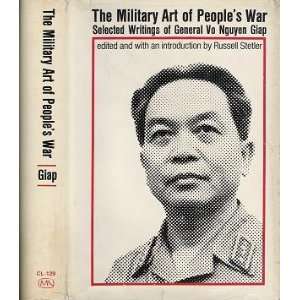
Võ Nguyên Giáp RIP . . .
. . . or rot in hell depending on your point of view. Dead at 102. Outlived his counterpart Robert McNamara. Outlived his fall guys, Generals Navarre and Westmoreland. But then Giap had two things going for him that Navarre and Westy did not: 1] it was his backyard whereas his enemies were over 10,000 miles from home, and 2] he had a sanctuary, his enemies did not. He also outlived two other of his victims. He was still Defense Minister when Vietnam beat Pol Pot's Khmer Rouge and General Xu Shiyou's PLA. Too bad for his country that he was too old and retired from military affairs in 1988 when China occupied Vietnam's Johnson Reef and killed 64 Vietnamese soldiers.

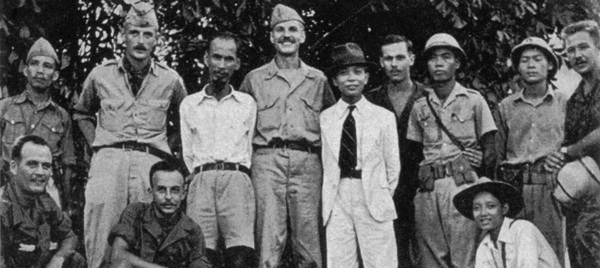
He was self-taught in matters soldierly. He did not turn to a military life until his thirties. He went to High shool in Hue, college in Hanoi, and did further study in Paris and China. Started his adulthood as a teacher and a journalist unlike Navarre who graduated from Saint Cyr, and unlike Westmoreland who was an honor graduate of West Point. But even as a younger man he read extensively of Napoleon (especially of his mountain campaigns), Sun Tzu, the American Revolutionary War, and then later he read Mao. And what Wikipedia and Vietnamese sources will never divulge, he also had some military training from an American OSS team. Giap is the short dapper one in the white suit and my father's dark fedora hat two down on the right from a young Ho Chi Minh in shorts. The American soldier between them is US Army Major Allison Thomas head of the OSS training team.

General Hal Moore, who co-wrote "We Were Soldiers Once . . . and Young" about the battle of Ia Drang, said that Giap was " ... one of the greatest military commanders of the 20th century". Westmoreland called Giap a butcher in a 1998 interview in George magazine: "Of course, he was a formidable adversary . . . but he persisted in waging a big-unit war with terrible losses to his own men. By his own admission, by early 1969, I think, he had lost, what, a half million soldiers? He reported this. Now such a disregard for human life may make a formidable adversary, but it does not make a military genius." Both Moore and Westy may both have been right, sour grapes or not.
Giap's birthplace, Quang Binh, is the province just north of the DMZ which took the brunt of America's air war against the north: thousands of tons of bombs more than any other province in the north. LBJ had no restricted targets in the North Vietnamese panhandle where Quang Binh was located. Not just B-52 arclights, and Navy and Air Force Alpha strikes, but it was also a dumping ground for any returning American aircraft that could not get to their primary target for weather or any other reason. The photo below shows Giap congratulating workers of the transport boat team on Gianh River just a few mile north of the DMZ in 1968. I first thought it was staged, but now I think not. He is one of their native sons, not some Hanoi bigwig. He is talking to them in their own drawling central Vietnamese dialect, which is as different from the harsh pronunciations of the north and the tonal patois of Saigon as is the speech of an Iowan farmer from Brooklynese or Dallas twang. They are liking him for being just a country cousin like they are and a local boy made good.

There is an interesting story that the spot he was born in was under the shadow of a jackfruit tree. Or interesting to this vet anyway. The jackfruit (mít in Vietnamese), although a sweet delicacy, has some martial arts overtones in central Vietnam. They have a thick pale green rind with thousands of sharp hexagonal spines. There is an old ballad from that part of the country about a blind hero using jackfruit rinds as some type of brass knuckled fist coverings during a Vietnamese boxing match. So I suspect that story may be apocryphal, sort of like Washington's cherry tree. Anyway if there is a good Viet restaurant in your neighborhood try the jackfruit salad or mo' better try the dessert of sweet ripe jackfruit in coconut milk if they have it. You won't regret it!
He was self-taught in matters soldierly. He did not turn to a military life until his thirties. He went to High shool in Hue, college in Hanoi, and did further study in Paris and China. Started his adulthood as a teacher and a journalist unlike Navarre who graduated from Saint Cyr, and unlike Westmoreland who was an honor graduate of West Point. But even as a younger man he read extensively of Napoleon (especially of his mountain campaigns), Sun Tzu, the American Revolutionary War, and then later he read Mao. And what Wikipedia and Vietnamese sources will never divulge, he also had some military training from an American OSS team. Giap is the short dapper one in the white suit and my father's dark fedora hat two down on the right from a young Ho Chi Minh in shorts. The American soldier between them is US Army Major Allison Thomas head of the OSS training team.
General Hal Moore, who co-wrote "We Were Soldiers Once . . . and Young" about the battle of Ia Drang, said that Giap was " ... one of the greatest military commanders of the 20th century". Westmoreland called Giap a butcher in a 1998 interview in George magazine: "Of course, he was a formidable adversary . . . but he persisted in waging a big-unit war with terrible losses to his own men. By his own admission, by early 1969, I think, he had lost, what, a half million soldiers? He reported this. Now such a disregard for human life may make a formidable adversary, but it does not make a military genius." Both Moore and Westy may both have been right, sour grapes or not.
Giap's birthplace, Quang Binh, is the province just north of the DMZ which took the brunt of America's air war against the north: thousands of tons of bombs more than any other province in the north. LBJ had no restricted targets in the North Vietnamese panhandle where Quang Binh was located. Not just B-52 arclights, and Navy and Air Force Alpha strikes, but it was also a dumping ground for any returning American aircraft that could not get to their primary target for weather or any other reason. The photo below shows Giap congratulating workers of the transport boat team on Gianh River just a few mile north of the DMZ in 1968. I first thought it was staged, but now I think not. He is one of their native sons, not some Hanoi bigwig. He is talking to them in their own drawling central Vietnamese dialect, which is as different from the harsh pronunciations of the north and the tonal patois of Saigon as is the speech of an Iowan farmer from Brooklynese or Dallas twang. They are liking him for being just a country cousin like they are and a local boy made good.

There is an interesting story that the spot he was born in was under the shadow of a jackfruit tree. Or interesting to this vet anyway. The jackfruit (mít in Vietnamese), although a sweet delicacy, has some martial arts overtones in central Vietnam. They have a thick pale green rind with thousands of sharp hexagonal spines. There is an old ballad from that part of the country about a blind hero using jackfruit rinds as some type of brass knuckled fist coverings during a Vietnamese boxing match. So I suspect that story may be apocryphal, sort of like Washington's cherry tree. Anyway if there is a good Viet restaurant in your neighborhood try the jackfruit salad or mo' better try the dessert of sweet ripe jackfruit in coconut milk if they have it. You won't regret it!
Saturday, January 19, 2013
The Generals (Ricks, 2012)
I just finished Tom Ricks' The Generals, a work I've been meaning to review for some time.
Summary: Ricks conducts an analysis is U.S. Army generalship - specifically the selection, management, and retention of general officers - between WW2 and today and what he believes to have been a clear deterioration of the quality of these commanders and a failure of the U.S. Army's command management process over that time.
Contents: The volume is a fairly clear display of Ricks' strengths and weaknesses, but in my opinions his conclusions are less well-drawn, less useful for the civilian reader, and less practical as a plan for military reform.
For a work of nonfiction The Generals is quite readable; Ricks is a good writer of general military history. It contains some brief but well-drawn portraits and summaries of the careers of the general officers from WW2, Korea, Vietnam, and the "War on Terror" periods, including Marshall, Mark Clark, Patton, and Terry Allen from WW2; O.P Smith, MacArthur, and Ridgeway from Korea; Taylor, Westmoreland, and DePuy from Vietnam; and Powell, Schwartzkopf, Franks, Sanchez, and Petraeus from the past two decades. In each section Ricks uses the officers he profiles to illustrate what he considers the characteristics of flag officer policy in each period and the results in terms of combat effectiveness or the lack of same.
To summarize his overall thesis, he begins by positing that GEN Marshall crafted a system of flag officer selection and employment during the opening years of WW2 that was characterized by idiosyncratic promotion and placement of officers in command slots based on a rather personal assessment of their potential for command.
Of necessity this meant that Marshall and his subordinate theater commanders made some mistakes, and so the other essential component of this system was the early and ruthless relief of officers who were, or appeared to be, not competent at that level of command.
But because of the very nature of the appointments these reliefs were not particularly prejudicial (unless the general officer involved was clearly criminally incompetent or personally troubled) and involved at least one second chance for the officer relieved. Ricks takes the time to point out several men who were relieved, reassigned, and subsequently worked their way back up to command positions.
So by the end of WW2 the "Marshall System" consisted of a linked system of appointment-relief-reassignment conducted as a public process. Relief was - at least according to Ricks - not associated with punishment, not hidden from sight, and not considered a failure of either the individual or the system but rather the understanding that command was a privilege and the critical function of command was the efficient use of (and, where possible, preservation of) U.S. soldier lives.
Ricks then documents the transition from this to what he describes as the current system of U.S. GO management in which reliefs are almost impossible, intimately associated with failure both of the system and the relieved officer, and, consequently, problematic in that incompetent commanders are not quickly removed from the system.
This, in Ricks' view, is directly responsible for problems that the U.S. Army encountered in Korea, Vietnam, Afghanistan, and Iraq.
The work is well constructed, and arguments made with care, and in general I have no problem with Ricks' historical examples. The body of the work makes a good case for Ricks' thesis that the Marshall System has broken down and has been effectively replaced with a dysfunctional GO management process that promotes and places in command officers with severe military and geopolitical flaws.
However, I believe that The Generals also features a number of Ricks' weaknesses on prominent display as well.
He provides absolutely no context for his thesis; no other general officer systems outside the U.S. Army are detailed. He briefly discusses what he considers the differences between the U.S., British, and German armies of WW2 as organizations without any comparison between their differing methods of handling command assignments - which I assume there were. Such a comparison might be very useful.
He is inordinately impressed with the U.S. Army as an organization (which, while an opinion I share as a former GI, is not one that would seem helpful in the author of a work questioning Army policy). His intense focus on the Army, I think, also tends to minimize the role other institutions and branches of the U.S. Government and branches played in the evolution of the role of Army general officers and weakens his analysis.
As just a single example that occurred to me as I was reading his account of the increasing difficulty and complexity of the civil-military relationship during the Fifties (which he lays primarily at the feet of the "atomic military" and the problems the Army had with its role in the early nuclear age); he never once brings up the creation of the National Security Advisor position that effectively superseded the role GEN Marshall had played in WW2.
Certainly the interposition of a civilian appointee tasked with determining the scope, and even the details, or "national security" must have had some impact on the role of the Joint Chiefs, of the Army chief, and the commanders of Army theater-level organizations. But what that impact was, or whether there was any at all? Ricks has nothing to say on the subject.
Ricks doesn't deeply examine the role of military professionals in the pre-war debates leading to the the run-up to the post-WW2 interventions. He mentions, for example, that there might have been (and are) some teensy weensie problems with getting the citizens of a democratic republic to enthusiastically support a series of complex cabinet wars with difficult-to-articulate (at least if the speakers were being honest) objectives without discussing the effect this might have on the role, or ability, of general officers to influence the approach to or conduct of such wars.
Conclusions: Rick's draws the following conclusions:
1. That the current general officer corps of the U.S. Army has been crafted to be technically and tactically competent but is hopeless at anything more complex, being both too intimately entwined with civilian politics while at the same time poorly trained and educated about strategic and geopolitical issues and the current methods of training, promoting, and retaining generals should be changed.
2. That the civil-military relationship is deeply flawed, with both too much and too little interplay between the elected officials and the generals, and that a change in general officer management will improve this.
3. That the U.S. Army is, as a result, a superb instrument at the tactical-to-operational levels but deeply flawed for anything above that; i.e. that the U.S. Army can win battles but not wars, and that a change in GO management will improve this as well.
Recommendations: So far, so unexceptional. His final chapter containing the recommandations, however, sort of throws up its hands at ways to address this.
First, he recommends a return to the Marshall-style early relief-but-without-prejudice system. He then admits that in the small, insular world of the post-draft U.S. Army that this might not be possible, although he posits some potential moves to make this happen. My assessment would be even less optimistic. Ricks doesn't provide anything remotely like a way to develop a constituency inside or outside the Army that would drive this process. Marshall's revolution occurred at a unique moment in U.S. Army history. A revolution of similar magnitude - and that is what this would be - would need a similar setting.
Some of his other, relatively innocuous suggestions include personnel management changes such as the "360 review" concept (including juniors' as well as seniors' assessments in an officer evaluation report), extending the retirement age for senior officers (which is interesting, given Ricks' extensive documentation of Marshall's removal of an entire generation of senior officers in 1941 and '42 for being too elderly to command in the rapid pace of mechanized war), and revising officer education to produce general officers with the skills to think and plan strategically and improvise tactically in unexpected geopolitical situations. All worthy discussion-starting points in my opinion.
I consider that perhaps his least practical recommendation is his suggestion that unit rotations be halted or severely limited in counterinsurgency situations.
Given that this implies that U.S. soldiers would likely be locked into fighting against foreign rebellions for years the notion is beyond impossible both militarily (the probability of running out of troops is not inconceivable) and politically.
More troubling to me is Ricks practice throughout the work of avoiding questioning the usefulness of, or the role of the general officers in pointing out the likelihood of problems to, Great Power intervention in Third World rebellion suppression, more of which below.
Assessment: As a historical review and a potential discussion-starter I can cautiously recommend The Generals. It is eminently readable, and Ricks' work is not without value on the history of the U.S. Army's general officer policies and procedures.
As an actual prescription for constructive change in the U.S. Army, however, I consider this work severely limited.
First, it accepts without demur the formulation that an "increasingly chaotic" uni- or multi-polar world implies the need for U.S. military adventures in foreign domestic insurrections, rebellions, and disturbances.
Second, it implies that "better generals" can improve the likelihood that U.S. forces can successfully intervene in such conflicts. For example, although in his section on the Vietnam War Ricks mentions that the post-Tet success in counterinsurgency came largely as the result of the combination of the decimation of the COSVN guerrillas and the improvement of the ARVN - instead of any particular change in U.S. officer competence, and his section on Iraq specifies the employment of bribery of the Sunni muj and the success of Shia ethnic cleansing as the reason that the U.S. occupation "succeeded", he still considers these to have been be amenable to "better" U.S. generalship, a conclusion that I consider tenuous at best and unsupported at worst.
His formulation also elides the problem of the larger, mainly civilian/political formulations of "more rubble/less trouble" and "Muslims = terrorists" that seems to drive these open-ended interventions. Ricks seems as bound as his troubled generals to the tactical aspects of geopolitics, unwilling to accept that many foreign troubles contain too many unknown - and unknowable - strategic aspects for even the most widely read and deep-thinking general officer will be unable to predict.
Who, for example, would have been able to foresee that providing Western military aid to rebels against the Algerian, Tunisian, and Libyan dictatorships would have helped foment a rebellion in Mali that Western military assets are presently fighting? And would a U.S. general- even a well-informed strategic thinker - genuinely be willing to suggest that since the West has a great deal to actually create the conditions for this revolt that that the best response might be to wait and watch, doing as little as possible beyond providing whatever the local proxies might need to limit the success of most anti-Western of the rebels?
So while Ricks' The Generals suggests a link between in improvement in U.S. general officer policies and improved success in the "little wars" the U.S. has been fighting since the early Nineties, my thought would be - I wonder...if such improvement, had it been in place before Vietnam, before Iraq, today...have resulted in fewer such wars, instead?
The Generals: American Military Command from World War II to Today, by Thomas Ricks (Penguin Books, 2012) ISBN-10: 1594204047 20.22 HC at Amazon.com
Summary: Ricks conducts an analysis is U.S. Army generalship - specifically the selection, management, and retention of general officers - between WW2 and today and what he believes to have been a clear deterioration of the quality of these commanders and a failure of the U.S. Army's command management process over that time.
Contents: The volume is a fairly clear display of Ricks' strengths and weaknesses, but in my opinions his conclusions are less well-drawn, less useful for the civilian reader, and less practical as a plan for military reform.
For a work of nonfiction The Generals is quite readable; Ricks is a good writer of general military history. It contains some brief but well-drawn portraits and summaries of the careers of the general officers from WW2, Korea, Vietnam, and the "War on Terror" periods, including Marshall, Mark Clark, Patton, and Terry Allen from WW2; O.P Smith, MacArthur, and Ridgeway from Korea; Taylor, Westmoreland, and DePuy from Vietnam; and Powell, Schwartzkopf, Franks, Sanchez, and Petraeus from the past two decades. In each section Ricks uses the officers he profiles to illustrate what he considers the characteristics of flag officer policy in each period and the results in terms of combat effectiveness or the lack of same.
To summarize his overall thesis, he begins by positing that GEN Marshall crafted a system of flag officer selection and employment during the opening years of WW2 that was characterized by idiosyncratic promotion and placement of officers in command slots based on a rather personal assessment of their potential for command.
Of necessity this meant that Marshall and his subordinate theater commanders made some mistakes, and so the other essential component of this system was the early and ruthless relief of officers who were, or appeared to be, not competent at that level of command.
But because of the very nature of the appointments these reliefs were not particularly prejudicial (unless the general officer involved was clearly criminally incompetent or personally troubled) and involved at least one second chance for the officer relieved. Ricks takes the time to point out several men who were relieved, reassigned, and subsequently worked their way back up to command positions.
So by the end of WW2 the "Marshall System" consisted of a linked system of appointment-relief-reassignment conducted as a public process. Relief was - at least according to Ricks - not associated with punishment, not hidden from sight, and not considered a failure of either the individual or the system but rather the understanding that command was a privilege and the critical function of command was the efficient use of (and, where possible, preservation of) U.S. soldier lives.
Ricks then documents the transition from this to what he describes as the current system of U.S. GO management in which reliefs are almost impossible, intimately associated with failure both of the system and the relieved officer, and, consequently, problematic in that incompetent commanders are not quickly removed from the system.
This, in Ricks' view, is directly responsible for problems that the U.S. Army encountered in Korea, Vietnam, Afghanistan, and Iraq.
The work is well constructed, and arguments made with care, and in general I have no problem with Ricks' historical examples. The body of the work makes a good case for Ricks' thesis that the Marshall System has broken down and has been effectively replaced with a dysfunctional GO management process that promotes and places in command officers with severe military and geopolitical flaws.
However, I believe that The Generals also features a number of Ricks' weaknesses on prominent display as well.
He provides absolutely no context for his thesis; no other general officer systems outside the U.S. Army are detailed. He briefly discusses what he considers the differences between the U.S., British, and German armies of WW2 as organizations without any comparison between their differing methods of handling command assignments - which I assume there were. Such a comparison might be very useful.
He is inordinately impressed with the U.S. Army as an organization (which, while an opinion I share as a former GI, is not one that would seem helpful in the author of a work questioning Army policy). His intense focus on the Army, I think, also tends to minimize the role other institutions and branches of the U.S. Government and branches played in the evolution of the role of Army general officers and weakens his analysis.
As just a single example that occurred to me as I was reading his account of the increasing difficulty and complexity of the civil-military relationship during the Fifties (which he lays primarily at the feet of the "atomic military" and the problems the Army had with its role in the early nuclear age); he never once brings up the creation of the National Security Advisor position that effectively superseded the role GEN Marshall had played in WW2.
Certainly the interposition of a civilian appointee tasked with determining the scope, and even the details, or "national security" must have had some impact on the role of the Joint Chiefs, of the Army chief, and the commanders of Army theater-level organizations. But what that impact was, or whether there was any at all? Ricks has nothing to say on the subject.
Ricks doesn't deeply examine the role of military professionals in the pre-war debates leading to the the run-up to the post-WW2 interventions. He mentions, for example, that there might have been (and are) some teensy weensie problems with getting the citizens of a democratic republic to enthusiastically support a series of complex cabinet wars with difficult-to-articulate (at least if the speakers were being honest) objectives without discussing the effect this might have on the role, or ability, of general officers to influence the approach to or conduct of such wars.
Conclusions: Rick's draws the following conclusions:
1. That the current general officer corps of the U.S. Army has been crafted to be technically and tactically competent but is hopeless at anything more complex, being both too intimately entwined with civilian politics while at the same time poorly trained and educated about strategic and geopolitical issues and the current methods of training, promoting, and retaining generals should be changed.
2. That the civil-military relationship is deeply flawed, with both too much and too little interplay between the elected officials and the generals, and that a change in general officer management will improve this.
3. That the U.S. Army is, as a result, a superb instrument at the tactical-to-operational levels but deeply flawed for anything above that; i.e. that the U.S. Army can win battles but not wars, and that a change in GO management will improve this as well.
Recommendations: So far, so unexceptional. His final chapter containing the recommandations, however, sort of throws up its hands at ways to address this.
First, he recommends a return to the Marshall-style early relief-but-without-prejudice system. He then admits that in the small, insular world of the post-draft U.S. Army that this might not be possible, although he posits some potential moves to make this happen. My assessment would be even less optimistic. Ricks doesn't provide anything remotely like a way to develop a constituency inside or outside the Army that would drive this process. Marshall's revolution occurred at a unique moment in U.S. Army history. A revolution of similar magnitude - and that is what this would be - would need a similar setting.
Some of his other, relatively innocuous suggestions include personnel management changes such as the "360 review" concept (including juniors' as well as seniors' assessments in an officer evaluation report), extending the retirement age for senior officers (which is interesting, given Ricks' extensive documentation of Marshall's removal of an entire generation of senior officers in 1941 and '42 for being too elderly to command in the rapid pace of mechanized war), and revising officer education to produce general officers with the skills to think and plan strategically and improvise tactically in unexpected geopolitical situations. All worthy discussion-starting points in my opinion.
I consider that perhaps his least practical recommendation is his suggestion that unit rotations be halted or severely limited in counterinsurgency situations.
Given that this implies that U.S. soldiers would likely be locked into fighting against foreign rebellions for years the notion is beyond impossible both militarily (the probability of running out of troops is not inconceivable) and politically.
More troubling to me is Ricks practice throughout the work of avoiding questioning the usefulness of, or the role of the general officers in pointing out the likelihood of problems to, Great Power intervention in Third World rebellion suppression, more of which below.
Assessment: As a historical review and a potential discussion-starter I can cautiously recommend The Generals. It is eminently readable, and Ricks' work is not without value on the history of the U.S. Army's general officer policies and procedures.
As an actual prescription for constructive change in the U.S. Army, however, I consider this work severely limited.
First, it accepts without demur the formulation that an "increasingly chaotic" uni- or multi-polar world implies the need for U.S. military adventures in foreign domestic insurrections, rebellions, and disturbances.
Second, it implies that "better generals" can improve the likelihood that U.S. forces can successfully intervene in such conflicts. For example, although in his section on the Vietnam War Ricks mentions that the post-Tet success in counterinsurgency came largely as the result of the combination of the decimation of the COSVN guerrillas and the improvement of the ARVN - instead of any particular change in U.S. officer competence, and his section on Iraq specifies the employment of bribery of the Sunni muj and the success of Shia ethnic cleansing as the reason that the U.S. occupation "succeeded", he still considers these to have been be amenable to "better" U.S. generalship, a conclusion that I consider tenuous at best and unsupported at worst.
His formulation also elides the problem of the larger, mainly civilian/political formulations of "more rubble/less trouble" and "Muslims = terrorists" that seems to drive these open-ended interventions. Ricks seems as bound as his troubled generals to the tactical aspects of geopolitics, unwilling to accept that many foreign troubles contain too many unknown - and unknowable - strategic aspects for even the most widely read and deep-thinking general officer will be unable to predict.
Who, for example, would have been able to foresee that providing Western military aid to rebels against the Algerian, Tunisian, and Libyan dictatorships would have helped foment a rebellion in Mali that Western military assets are presently fighting? And would a U.S. general- even a well-informed strategic thinker - genuinely be willing to suggest that since the West has a great deal to actually create the conditions for this revolt that that the best response might be to wait and watch, doing as little as possible beyond providing whatever the local proxies might need to limit the success of most anti-Western of the rebels?
So while Ricks' The Generals suggests a link between in improvement in U.S. general officer policies and improved success in the "little wars" the U.S. has been fighting since the early Nineties, my thought would be - I wonder...if such improvement, had it been in place before Vietnam, before Iraq, today...have resulted in fewer such wars, instead?
The Generals: American Military Command from World War II to Today, by Thomas Ricks (Penguin Books, 2012) ISBN-10: 1594204047 20.22 HC at Amazon.com
Monday, March 12, 2012
The Big Picture
The Big Picture? I would define it as looking at a problem/situation, whether historical or current, as a "whole", that is within a rich and complex (especially political) context. For some reason Americans, in general, don't seem to be very good at this. The reason why we don't excel at this particular skill could have something to do with the way our political parties developed in the 19th Century, the whole Walter Karp argument of "US Nation" versus "US Republic". A specific example of this inability to deal effectively with our own complex social reality is our dubious assumption that Democrats and Republicans represent the ying and yang, the two sides of the coin, the one and the other, of American politics. They don't. Never have. Rather two shop-worn labels behind which various elite and moneyed interests congregate. When was the last real big political shakeup in the US? Nineteen thirty-two? Karp would say 1892 . . . and what followed that was a manufactured war of imperialist pretenses.
I'm not going to attempt to reproduce Karp's argument here, his prose is much better than mine, but rather simply point out that there does seem to exist an almost "genetic" American tendency to avoid the everyday political reality in favor of emphasizing assumed ideological "virtue", although we would be loath to label it "ideological". In other words we focus on the pretty wrapping but don't worry about what is actually inside the box or where it came from or what it took to get it. The important thing is how it makes us feel . . .
And of course, like any other political community in the world, we like to feel good about ourselves and what we do/have done. One blatant example of this are the names given various policies to make them seem something which they arguably are not, such as "Operation Iraqi Freedom", the "Patriot Act", or anything containing the word "strategy". Whenever one sees a label like this it is a sure indication that the level of bamboozling is high and that our great-grandchildren will probably be cursing us for our stupidity, but then what could be more American than constantly scamming and fleecing the "rubes" or rather playing the rube? It's essentially the national pastime at least among our political and economic elite.
And it's probably always been so, at least in terms of our domestic politics (which of course drive our foreign policies in different ways). The difference today is that contrary to the past we don't seem to have a certain number, a minimum percentage of the public who can yell "wait a minute there!" and bring enough of the masses to their senses so that the scam doesn't get completely out of hand. Or is it rather that minimum number no longer has a podium from which to be heard, all the hoopla concerning the Facebook world to the contrary?
Perhaps we need to promote a different way of looking at the world, recapture the real meaning of "strategy".
So, first let's start with my definition of strategy which has been presented before:
Then let's consider how these various sources of power or considerations fit together. As I mentioned in the previous thread, I think the great Clausewitzian Aleksandr Svechin puts the "whole perspective" well:
Which brings us back to "the big picture", but to get what I'm driving at we need a suitable example . . . and perhaps the best example that comes to mind is the current debate about the Vietnam War. The latest round of this seemingly endless discussion involves the trashing of a familiar historical figure associated with the US defeat in Vietnam, General Westmoreland. Colonel Gian Gentile has responded effectively imo.
I am no expert on this subject. In terms of background, I enlisted in the US Marine Corps Reserve in April 1975, the same month that Saigon fell, and later saw what had become of that branch of the US military post-Vietnam, which for a young and idealistic recruit on active duty for training was hair-raising, but that was the very limited extent of my experience. I have read some books on the subject and have had many discussions with veterans of that war, but nothing like an insightful view through study of the specific history of the conflict. So I profess no specialized knowledge of the subject, but I am a strategic theorist and look at this war - as I look at all wars - from a Clausewitzian strategic theory perspective.
It is interesting that in a book review of Sorley's Westmoreland, in Parameters no less, the word "China" does not appear even once. This in a book explaining how we lost the Vietnam War?
This is particularly relevant when considering that those in high government positions in the Johnson Administration were taking China very seriously. Without China and Chinese ambitions(those assumed to be such in Washington) what was the reason for US intervention in Vietnam? Surely it was not seen as an important US strategic goal that Vietnam stay divided, or that the South Vietnamese government survive as regards to Vietnam itself or even Indochina. What made Vietnam important was the effect the conflict had on China and these supposed Chinese intentions . . . Thomas Schelling, writing in 1966, put the complex situation relatively clearly from this US strategic perspective:
The decisive factor in North Vietnam's eventual success was outside support, from both the Soviet Union and from China. With the North enjoying this advantage, at the strategic level, the US could not exercise enough coercion on the North for them to forsake their goal of political unification with the South. Invasion of the North would have triggered Chinese intervention and the US intended to keep this war "limited". Overthrowing the North Vietnamese government was simply not a viable option. And as the war dragged on, even US bombing became unsustainable due to the ever increasing sophistication of anti-aircraft defenses in North Vietnam. It was here from a strategic theory perspective that the war was lost.
Tweeking the tactics on the ground in South Vietnam would have perhaps inflicted higher losses on the North's invasion force, may have bought the Saigon government a bit more time, but to what purpose? Would this US tactical success have changed the character of South Vietnam's ruling elite? Would it have made the people in the South willing to die to save the RVN government? Tactics comes down to the implementation of violence to achieve specific and limited goals which supposedly build on one another to create operational and finally strategic success. Violence has it's uses, and war is essentially organized violence, but it is not going to build a political community. Outstanding tactical virtuosity still would not have translated into a US victory in Vietnam.
At this point the tendency of tactical myopia leading to grand tactical speculation becomes clear and the reason for it as well. It allows us to avoid what the real main questions are and what failure actually entails. It also indicates how limited, and complex, even at times self-defeating, the role of violence is in many wars, especially when used as an instrument by "outside" political players. Which is all very depressing for a society conditioned not to question its ideologically framed motives and endlessly fed the pap that large explosions and massive destruction always lead inevitably to "victory".
For this reason, a lack of sense of the big picture becomes a necessity, actually the possible basis for a career as "snake oil salesman" in the current or even next "war of choice". Much more soothing for the gullible is to instead focus on narrow tactics that we assume that we excel in. All that "warrior" stuff is ever so flashy.
Like cattle we follow the same worn path leading to exactly the same place, but with little consciousness that we have traveled this route before. We share the advantages and disadvantages of any herd animal to our and our decedents' regret.
I'm not going to attempt to reproduce Karp's argument here, his prose is much better than mine, but rather simply point out that there does seem to exist an almost "genetic" American tendency to avoid the everyday political reality in favor of emphasizing assumed ideological "virtue", although we would be loath to label it "ideological". In other words we focus on the pretty wrapping but don't worry about what is actually inside the box or where it came from or what it took to get it. The important thing is how it makes us feel . . .
And of course, like any other political community in the world, we like to feel good about ourselves and what we do/have done. One blatant example of this are the names given various policies to make them seem something which they arguably are not, such as "Operation Iraqi Freedom", the "Patriot Act", or anything containing the word "strategy". Whenever one sees a label like this it is a sure indication that the level of bamboozling is high and that our great-grandchildren will probably be cursing us for our stupidity, but then what could be more American than constantly scamming and fleecing the "rubes" or rather playing the rube? It's essentially the national pastime at least among our political and economic elite.
And it's probably always been so, at least in terms of our domestic politics (which of course drive our foreign policies in different ways). The difference today is that contrary to the past we don't seem to have a certain number, a minimum percentage of the public who can yell "wait a minute there!" and bring enough of the masses to their senses so that the scam doesn't get completely out of hand. Or is it rather that minimum number no longer has a podium from which to be heard, all the hoopla concerning the Facebook world to the contrary?
Perhaps we need to promote a different way of looking at the world, recapture the real meaning of "strategy".
So, first let's start with my definition of strategy which has been presented before:
Focused adaptation of divergent sources of power assisted by control over time in pursuit of a political purpose through methodological theoretical construct (strategic theory) with the aim of creating strategic effect/a strategic dynamic greater than the sum of the individual power sources. For the strong political community, strategy can be an option, for the weak it is a necessity.
Then let's consider how these various sources of power or considerations fit together. As I mentioned in the previous thread, I think the great Clausewitzian Aleksandr Svechin puts the "whole perspective" well:
Every question the strategist must resolve is extremely simple, but a correct answer requires a great depth of understanding of the situation of the war as a whole; theory can only emphasize the diversity of possible solutions as a function of different conditions. But a strategist cannot limit himself to correct answers for each question individually. The answer to one strategic question will only be correct when it is in harmony with the answers to other strategic questions. We have put harmony in the preparations of a nation for war at the forefront, but it is no less important in the leadership of a war, only the characteristics of harmony in this case are immeasurably more subtle. This coordination, this achievement of harmony, is the essence of strategy and it forces us to classify practical work on strategy as an art.
Strategy, p 306
Which brings us back to "the big picture", but to get what I'm driving at we need a suitable example . . . and perhaps the best example that comes to mind is the current debate about the Vietnam War. The latest round of this seemingly endless discussion involves the trashing of a familiar historical figure associated with the US defeat in Vietnam, General Westmoreland. Colonel Gian Gentile has responded effectively imo.
I am no expert on this subject. In terms of background, I enlisted in the US Marine Corps Reserve in April 1975, the same month that Saigon fell, and later saw what had become of that branch of the US military post-Vietnam, which for a young and idealistic recruit on active duty for training was hair-raising, but that was the very limited extent of my experience. I have read some books on the subject and have had many discussions with veterans of that war, but nothing like an insightful view through study of the specific history of the conflict. So I profess no specialized knowledge of the subject, but I am a strategic theorist and look at this war - as I look at all wars - from a Clausewitzian strategic theory perspective.
It is interesting that in a book review of Sorley's Westmoreland, in Parameters no less, the word "China" does not appear even once. This in a book explaining how we lost the Vietnam War?
This is particularly relevant when considering that those in high government positions in the Johnson Administration were taking China very seriously. Without China and Chinese ambitions(those assumed to be such in Washington) what was the reason for US intervention in Vietnam? Surely it was not seen as an important US strategic goal that Vietnam stay divided, or that the South Vietnamese government survive as regards to Vietnam itself or even Indochina. What made Vietnam important was the effect the conflict had on China and these supposed Chinese intentions . . . Thomas Schelling, writing in 1966, put the complex situation relatively clearly from this US strategic perspective:
We need to recognize that China, as a "strategic" adversary, could not be taken care of by "strategic war" planning that was developed during two decades of preoccupation with the Soviet Union. China is a different strategic problem altogether. New modes of coercive limited warfare might have to be developed for coping with the problem. The entire tempo of war would be wholly different from anything contemplated against the Soviet Union; except for a small retaliatory force that the Chinese might possess some time in the future, there would be few or no targets of such urgency as to make the initial moments, even the initial days of weeks, as critical as they are bound to be in planning for the contingency of Soviet-American war. The idea of "limited strategic war" between the Soviet Union and the West is often dismissed as plain impracticable, and those who dismiss it may be right; between China and the United States a war would have whatever tempo the US decided on, or a tempo determined by Chinese actions in some local theater, not the hypersonic tempo of preemptive thermonuclear exchanges.
The need to distinguish a campaign intended to eliminate the regime from one intended only to coerce the regime into good behavior could be supremely important when the Chinese possess a nuclear retaliatory capability (against the US or against any other population center that they might choose). Making clear to them that, the most potent coercion might be a target strategy that threatened the regime - eventually, gradually, or uncertainly, not suddenly and decisively - and such a strategy would require discriminating what it is that the regime most treasures and where it is most vulnerable.
Whatever its effect on the North Vietnamese willingness to support the Vietcong, and whatever the capacity of North Vietnam to control the Vietcong in submission to the threat of continued bombing attacks, the bombing of North Vietnam must have had one implication for China that went far beyond that war in Southeast Asia. Forcible resistance to them outside their borders can never cost the Chinese more than the resources they knowingly put at risk, the troops and supplies they send abroad; but the bombing of North Vietnam is a mode of warfare that the record now shows to be a real possibility, one that the US has not only thought of but engaged in. It is a mode of warfare that, at least with air supremacy and the absence of modern anti-aircraft weapons, can be conducted deliberately over a protracted period. And it is a mode of warfare that, if quantitatively increased, could cause extensive physical damage inside the target country, denying any guarantee that the costs of aggression could be confined to the expeditionary force put at risk outside one's border.
Thomas Schelling, Arms and Influence, pp 187-8
The decisive factor in North Vietnam's eventual success was outside support, from both the Soviet Union and from China. With the North enjoying this advantage, at the strategic level, the US could not exercise enough coercion on the North for them to forsake their goal of political unification with the South. Invasion of the North would have triggered Chinese intervention and the US intended to keep this war "limited". Overthrowing the North Vietnamese government was simply not a viable option. And as the war dragged on, even US bombing became unsustainable due to the ever increasing sophistication of anti-aircraft defenses in North Vietnam. It was here from a strategic theory perspective that the war was lost.
Tweeking the tactics on the ground in South Vietnam would have perhaps inflicted higher losses on the North's invasion force, may have bought the Saigon government a bit more time, but to what purpose? Would this US tactical success have changed the character of South Vietnam's ruling elite? Would it have made the people in the South willing to die to save the RVN government? Tactics comes down to the implementation of violence to achieve specific and limited goals which supposedly build on one another to create operational and finally strategic success. Violence has it's uses, and war is essentially organized violence, but it is not going to build a political community. Outstanding tactical virtuosity still would not have translated into a US victory in Vietnam.
At this point the tendency of tactical myopia leading to grand tactical speculation becomes clear and the reason for it as well. It allows us to avoid what the real main questions are and what failure actually entails. It also indicates how limited, and complex, even at times self-defeating, the role of violence is in many wars, especially when used as an instrument by "outside" political players. Which is all very depressing for a society conditioned not to question its ideologically framed motives and endlessly fed the pap that large explosions and massive destruction always lead inevitably to "victory".
For this reason, a lack of sense of the big picture becomes a necessity, actually the possible basis for a career as "snake oil salesman" in the current or even next "war of choice". Much more soothing for the gullible is to instead focus on narrow tactics that we assume that we excel in. All that "warrior" stuff is ever so flashy.
Like cattle we follow the same worn path leading to exactly the same place, but with little consciousness that we have traveled this route before. We share the advantages and disadvantages of any herd animal to our and our decedents' regret.
Tuesday, October 11, 2011
365 Bottles of Beer
 --A license to do something
--I help people with problems
--Problem solver?
--More of a problem eliminator
--License to Kill (1989)
How can you mend this broken man?
How can a loser ever win?
Please help me mend my broken heart
and let me live again
--How Can You Mend a Broken Heart,
The Bee Gees
We are here to help the Vietnamese,
because inside every gook
there is an American trying to get out
--Full Metal Jacket (1987)
And the day came when the risk to remain
tight in a bud was more painful than the risk
it took to blossom
--Anais Nin
________________________
Below is an excerpt from "365 Bottles of Beer", the story of a young troop's drop into the COIN zone (published @ RAW in its entirety. Links are HERE and HERE.)
Any personal observations are appreciated:
"Like every other soldier, whether draftee or enlisted, [I] was fully prepared to do whatever my Army required to win the war. Every last one of us were willing to kill or be killed in the process of doing what our country required of us, but therein lies the crux of the biscuit: What was required?
When I stepped off that airplane wearing jump boots, crossed rifles, junior jump wings and a Ranger tab with a Green Beret on my high and tight head, I had absolutely no idea what I was doing on the ramp of that airplane, stepping into a war that almost everyone knew was lost (it was 1970). What I did possess was every infantry skill required to kill people, be it on an organizational or personal level.
After I stepped off that plane, 18,000 soldiers died for a policy that was as dead as an old man's dick, but we soldiered on because that is what soldiers do. We are not quitters."
Subscribe to:
Posts (Atom)