Showing posts with label World War II. Show all posts

Tuesday, June 7, 2016

Whose Souls Cry Out, and Who is Awakened?

 
--Nuclear Future, Paresh Nath (UAE)

The tragedy is not that things are broken.
The tragedy is that things are not mended again.
--Cry, the Beloved Country,
Alan Paton

  The West's post-Holocaust pledge that genocide
 would never again be tolerated proved to be hollow,
and for all the fine sentiments inspired,
by the memory of Auschwitz,
the problem remains that denouncing evil
is a far cry from doing good
--We Wish to Inform You That Tomorrow
We Will Be Killed With Our Families,
Phillip Gourevitch

Bellum ominum contra omnes
 --Thomas Hobbes
_________________________

President Obama recently laid a wreath at the Hiroshima Peace Memorial in the presence of Japanese Prime Minister Shinzo Abe. His disingenuous proclamation played well to the crowd, but was so much well-scripted fluff. He said Hiroshima was,

 “the start of our own moral awakening”. We come to mourn the dead. Their souls speak to us, they ask us to look inward, take stock of who we are.”

So let's talk about morals and some dead, of the recent variety. When the United States handed Saddam Hussein over to the new Shia-led government, they set on him like a pack of hyenas, snapping his neck with a rough cow rope in a mosh pit of celebration after an amateur show trial.

The U.S. Celebrated in the carnage and joined in the morbid ebullience, despite the fact that Hussein had done nothing to the U.S. to warrant such bloodlust. What had he done that our friends the Saudis or Egyptians do not?

Ditto the grotesque murder of Libyan President Muommar Qaddafi. Our sociopathic Secretary of State Hillary Clinton gleefully acknowledged his death-by-mob in the street on commercial television. Her delusions of grandeur were exposed with her petty, "We came, we same, he died."  

And yet life for Libya and its people -- just as for Iraqis post-Saddam -- has grown exponentially worse since Qaddafi was deposed. What, exactly, does the U.S. have to crow about, and what moral direction can it provide?

But to the Japanese empire circa August, 1945. Hirohito was the divine emperor of an operation in which Koreans were used as labor and sex slaves. U.S. and British Prisoners of War were tortured, murdered and used for bayonet practice. Japanese medical officers used U.S. P.O.W.'s in chemical and biological research. The litany of terror goes on (even ignoring the fact that the Japanese bombing of Pearl Harbor brought the U.S. into the war.)

The point is: the Emperor was a war criminal of the highest order, and yet the U.S. never bothered to treat him as such. [He reigned until his death in 1989.]

What has changed from 1945 to 2016? Do our recent actions speak of a "moral awakening"? 

Are we listening to the voices of the newly-dead which we have created, and what do we see when we "take stock of who we are"?

Friday, November 23, 2012

Fall 1942 - The Turning Point of the War in Europe

November 1942 provides us with one of those events in military history where we can say in retrospect, that it was from this particular point in time that everything started to unravel, in this case, go bust for Nazi Germany in World War II. While I would argue (and I think FD Chief agrees) the actual or "strategic" turning point was probably the June invasion of the USSR and then on December 11, 1941, the declaration of war against the US, Stalingrad provides us with the "operational" turning point. Since we have learned from our own (American since 2001) experience that in war the operational outcome can lag significantly behind the strategic outcome, this only proves the importance of this operational level and how hanging on operationally can influence to some extent the final result, although not to the point of reversing the strategic reality. Rather what seems to be the case is that the losing side loses only more, but at a greater cost to the victor.
My intent here is not to examine the Stalingrad campaign or analyze the operational decisions, but rather to put it within the strategic context of what Germany - or rather Hitler since he was calling all the shots - had to deal with seventy years ago.
On 19 November the Red Army launched an attack against the northern flank of German Army Group B (the German 6th Army, most of 4th Panzer Army and the Romanian 4th Army) that was engaged at Stalingrad and occupying almost all of the city and blocking river traffic along the Volga river. The next day Marshall Zhukov launched the southern wing of his double envelopment from the southern flank. On 23 November (the Germans say the afternoon of 22 November) the two spearheads met at Kalach trapping about 250,000 Axis troops. The Soviets staged a repeat of the meeting for a propaganda film (at 1:20-29).
Reading the German Oberkommando der Wehrmacht war diaries one gets something of the overwhelming character that Hitler's leadership/decisions had put the Germans in strategically. Besides the Eastern Front with its various Army Groups engaged, there were the Eastern Mediterrain, Libya, Tunisia, the Balkans, southern France (the occupation of Vichy), Finland, and the various air and naval operations to contend with.
One gets the impression that the Russian Front was not seen as a single theater, but rather as five separate fronts: Finland, Army Group North facing Leningrad, Army Group Center facing Moscow, Army Group B at Stalingrad, and Army Group A in the Caucasus. Thus each individual front competed individually with those in the West and keeping Italy in the war was Hitler's priority towards the end of 1942. This possible perspective regards only the operational decisions, not those involving logistics, production, genocides, and other matters that Hitler reserved for himself. That the situation with Army Group B was dangerous was recognized relatively early on with the 20 November order to establish Army Group Don from the staff of the 11th Army under the command of Field Marshall von Manstein to take command of Army Group B and other forces coming in. This headquarters was to be tasked with reestablishing the front on the Don/Volga. This distinction is important, it was not first to reestablish contact with Stalingrad, but to re-establish the front as it had existed prior to the Soviet offensive, it was assumed that those forces in Stalingrad would remain in place. A withdrawal from Stalingrad and the Volga was never seriously considered until it was too late. Manstein and his staff were at Vitebsk and due to the weather and rail conditions were unable to arrive in theater until 24 November.
It is also important to remember that the Germans were in the middle of a major troop movement regarding Tunisia. There the 5th Panzer Army was in the midst of being established with significant air assets having been earlier withdrawn from Russia. Movement of the 10th Panzer Division, the Hermann Göring Divison and other formations were underway. In fact on the 20th of November the 22nd Luftlande (Airborne) Division, another capable formation, finished its deployment to the island of Crete which was under no threat at all.
At this point it is important to consider what had led to the summer offensive in the East in the first place. First, the Germans considered the Russians to be on their last legs. The situation of the civilian population in the unoccupied areas of European Russia was known to be catastrophic (based on captured letters to Red Army soldiers). Much of the industrial potential had been seemingly neutralized, and finally the Red Army had suffered tremendous losses up to that point. It seemed from the German perspective unlikely that the Red Army would be able to reconstitute an effective fighting force under the stress of war given what remained. Second, while Moscow was the political center, the Caucasus and the Don/Volga area provided necessary resources. Seizing these resource centers would both considerably weaken the Red Army and strengthen the Wehrmacht at the same time, or so it was assumed.
And then there was the city of Stalingrad itself. On 9 November 1942 in Munich, Hitler had given a speech:
. . . I should say that for my enemies, not for our soldiers. For the speed with which our soldiers have now traversed territory is gigantic. Also what was traversed this year is vast and historically unique. Now I do not always do things just as the others want them done. I consider what the others probably believe, and then do the opposite on principle. So if Mr. Stalin expected that we would attack in the center, I did not want to attack in the center, not only because Mr. Stalin probably believed I would, but because I didn't care about it any more at all. But I wanted to come to the Volga, to a definite place, to a definite city. It accidentally bears the name of Stalin himself, but do not think that I went after it on that account. Indeed, it could have an altogether different name. But only because it is an important point, that is, there 30 million tons of traffic can be cut off, including about 9 million of oil shipments. There all the wheat pours in from those enormous territories of the Ukraine, of the Kuban territory, then to be transported to the North. There the manganese ore was forwarded. A gigantic terminal was there; I wanted to take it. And do you know, we're modest: that is, we have it; there are only a couple of very small places left there. Now the others say: Why aren't you fighting there? Because I don't want to make a second Verdun but would rather do it with very small shock units. Time plays no part here. No ships come up the Volga any more-that is the decisive thing. They have also reproached us, asking why it took us so long at Sevastopol? Because there, too, we did not want to cause an enormous mass murder. Blood is flowing as it is-more than enough. But Sevastopol fell into our hands, and the Crimea fell into our hands. We have reached goal after goal, stubbornly, persistently. And if the enemy, on his part, makes preparations to attack, don't think I want to forestall him there, but at the same moment we let him attack also. Because then defense still is less expensive. Then just let him attack; he'll bleed to death that way, and thus far we have always taken care of the situation anyhow. At any rate, the Russians are not at the Pyrenees or before Seville; that, you see, is the same distance as for us to be in Stalingrad today, or on the Terek, let us say;-but we are there; that can really not be disputed. That is a fact, after all. Naturally, when nothing else will do any more, they also say it's a mistake. Then they suddenly turn around and say: "It is absolutely a mistake for the Germans to have gone to Kirkenes, or to have gone to Narvik, or now perhaps to Stalingrad-what do they expect to do in Stalingrad? For Stalingrad is a capital mistake, a strategic mistake." We will just wait and see whether that was a strategic mistake.
I have a Wehrmacht city map of Stalingrad, dating from June 1942. On it, the city is long, but narrow, hugging the Volga. From the map it looks like it would be so easy to simply punch through to the river. The reality was otherwise, but even as the Red Army encircled the Germans at Stalingrad, they continued operations to capture the last Russian positions in the ruined city, that according to the war diaries . . .
Postscript:
This has been an interesting thread. I would like to thank all who commented, it is the sign of a capable audience when they are able to interact with the initial argument and expand on it considerably, adding many additional pieces to the vast mosaic. I think we are able to consistently achieve that on MilPub as shown by the many posts by various authors and corresponding dialectical commentary on this blog . . . we should keep on keeping on . . .
Four points to close with. First, we are talking about perhaps the most terrible military campaign in history. The geographical and human dimensions are almost beyond our comprehension; the scale of destruction, loss and tragedy are impossible to measure in numbers since the ripples are still touching Eastern Europe in various ways today.
Second, and this a repeat of an earlier argument, that being that we have an adequate description of the totalitarian nature (both specific to the Nazis and general regarding other totalitarian systems) of political movements. My post on Hermann Rauschning's The Revolution of Nihilism introduces the basic ideas. I blended in some of Hannah Arendt's ideas from her classic The Origins of Totalitarianism, but did not begin to do Arendt's thesis justice. It would take much more study, and probably a better mind than mine to achieve that. I consider this very important since following the basic concepts, I would argue that we see a resurgence of totalitarian thinking today in the US. This is particularly evident in our predilection to see violence as the preferred method of dealing with foreign policy issues.
Third, I mentioned a Clausewitzian connection. This is the concept of the Feldherr which influenced not only German, but Soviet, French and JFC Fuller as well. Professor Hew Strachan (who else?) has a great lecture which covers this topic:
So the Feldherr was a military genius who, because he was distinguished by more than his "will, brains, understanding, self-confidence, by something still higher than a longing for fame and honour," became a statesman. For Hesse, the role model was Frederick the Great. The challenge of the 1920s, after the Kaiser's abdication not least because of his failure to fulfil that role, was how to meet its demands in future. The German army had failed to understand Clausewitz before 1914 because it had read him in a narrowly military way, focusing on battle, not on war as a whole. Because Clausewitz saw war as a continuation of policy by other means, he also understood war, according to Adolf Leinveber, writing in 1926, as "an organic whole, from which the individual parts are not separable." Leinveber accepted that politicians had to give unity to war through policy and through the war plans that flowed from that policy. But what therefore followed-not only for Leinveber but also for many others-was that war required "a magnificent dis­tinguished head, a strong character." The Feldherr would unite the conduct of war and policy, so that he became a statesman without at the same time giving up the capacity to conduct war: "he embraces with a glance on the one hand all state issues, while on the other he is sufficiendy confident in his knowledge of what the means which lie in his control can do." p 389
The need for a Feldherr was seen by those representing the entire political spectrum in Germany, from liberals to monarchists. The French used Clausewitz after the war to further develop their concept of the Generalissimo and Fuller's approach to Grand Strategy is much more difficult to achieve without this position. In the USSR, Trotsky, Frunze and Svechin argued for the subordination of specialized and conventional (as opposed to partisan) military command to the political leadership residing in the leader of the Communist Party. Thus we see the position of both Hitler and Stalin - along with the totalitarian elements which in this case are separate but still obviously important - as being influenced by the experience of the First World War and this being common to both democratic and totalitarian governments.
Finally, there is something of the Liddell Hart notion of the "indirect approach" to Fall Blau, the German campaign in the summer of 1942. Hitler wished to bypass the political center of Moscow and instead seize the southern resources/stop movement along the Volga as a way to cripple the USSR. I don't think he actually expected to come to terms with Stalin, but rather to so weaken the Soviet government that they could be held off indefinitely.
It was not a question of time or strategy, but simply a "fact" as Hitler mentions in the linked speech. The Germans were on the Volga and the Terek and they would remain there, and the Feldherr as maker and shaper, "history's actor" had made it so. As I think the readers of this blog are aware, we have seen similar notions of arrogance and self-absorption, of ideologically-tainted wishes replacing strategic thought, of the conceit of violent and limited minds attempting to remake political existence in line with their own whims . . . let's hope this extreme example from the past acts as a caution to temper our own future.
Second Postscript:
Very interesting German soldiers's film from the times . . . Towards the end . . . Stalingrad and Fall Blau . . .

Tuesday, July 17, 2012

Woodrow Wilson "Woody" Guthrie

would have been 100 years old this past Saturday.


A veteran of World War 2:
During World War II, moved by his passion against Fascism, Woody served in both the Merchant Marine and the Army. Shipping out to sea on several occasions with his buddies Cisco Houston and Jimmy Longhi, Woody's tendency to write songs, tell stories and make drawings continued unabated. He composed hundreds of anti-Hitler, pro-war, and historic ballads to rally the troops, such as “All You Fascists Bound To Lose”, “Talking Merchant Marine,” and “The Sinking of the Reuben James.” He began to work on a second novel, Sea Porpoise, and was enlisted by the army to write songs about the dangers of venereal diseases, which were published in brochures distributed to sailors.
http://www.woodyguthrie.org/biography/biography6.htm

He didn't like Fascists, or bankers too.


Monday, September 26, 2011

The Battle of Kiev - September 1941


13th Panzer Division, 1st Panzer Group, Army Group South, Summer 1941

Seventy years ago today the massive encirclement operation known as the battle of Kiev was declared over by the German High Command. The success was deemed the greatest defeat of its kind in history with the Wehrmacht taking 665,000 Red Army prisoners, although Soviet sources give a smaller number. The Deutschewochenschau number 577 of 24 September 1941 opened with a dedication to Generaloberst Ritter von Schobert - commander of the 11th Army - who had died a "hero's death" (den Heldentod fand) when his reconnaissance plane landed in a Soviet minefield earlier that same month. The music playing in the background to the report provides an example of the attitude the Nazis had towards sacrifice at this point in the war. It was assumed that there would be significant losses given the stakes involved and the willingness to self-sacrifice (Opferbereitschaft) of the soldiers from the highest to the lowest ranks was expected since the decisions made and the successes achieved would mark the next phase/epoch of not only the history of Germany, but the entire world. Through this unprecedented level of destruction, the participants in this crusade were in effect making a new world.

The Kiev operation is interesting for several reasons in addition to its very scale. For maps look here for detailed maps and here for a general map.

Stalin had thought an offensive at this late date in the season would not come in the south, but towards Moscow, which he knew from his spies in Berlin and elsewhere was the prime German goal. General Zhukov was in fact sacked for suggesting that Kiev would have to be surrendered. At the end of July with the German Army Group Center stalled to the front of Smolensk, Zhukov saw the threat to the south and recommended a retreat across the Dnepr. Stalin took this as a challenge to his strategic leadership and had Zhukov replaced with Marshall B.M. Shaposhnikov whom Stalin considered politically reliable and unlikely to disagree with his views. Zhukov was given command of the Reserve Front facing the German bridgehead at Yelnia to the front of Moscow, where his successes there were to pay later dividends.

So, first we have the unwillingness of the Soviets to retreat, but if the main goal was Moscow, why turn half the Panzer strength of Army Group Center south into the Ukraine instead of northeast towards Moscow? Why was there this diversion of strength which allowed for the massive encirclement of the Kiev pocket?

To answer that question we need to go back to the planning stages for the campaign which had started at the end of 1940. A series of competing plans were drawn up, and while there was general agreement as to the main emphasis on Moscow, there were those who felt that either Leningrad in the north, or the Ukraine should be secured first. Hitler's own variant envisioned a flank strategy focused on Leningrad. In December 1940, a General Staff Kriegsspiel or war-game was conducted by General von Paulus (who would later go into captivity with the remnants of his 6th Army at Stalingrad). The results were quite interesting and contrary to the very optimistic projections coming from the Army High Command (OKH), the Wehrmacht High Command (OKW) and the Luftwaffe (OKL).

Based on his war-game, Paulus concluded that: First, the resources at German disposal were barely enough to advance to Moscow and reaching the Archangel-Volga River line were beyond their capabilities. Second the spaces and time involved did not allow for the Blitzkrieg approach which had been used effectively against both Poland and France. The Panzers could advance, but at such a speed that the following infantry would be left far behind. Also the Luftwaffe would not be able to displace forward as quickly as in the past leaving the Panzers with limited air support the further they advanced. Third and finally, supply would be difficult once the advance got beyond the Dnepr-Dvina line. Constructing new supply areas, relaying European gauge rail lines not to mention repairing what had been destroyed would take months. It should be noted that the war-games included certain optimistic assumptions some of which later proved unfounded. The Germans assumed superiority in tanks, artillery, signals equipment and aircraft, and assumed that their infantry divisions enjoyed a 1/3 superiority in terms of heavy weapons over Soviet infantry division equivalents.

In spite of the war-game's conclusions, General Halder of the OKH believed the fighting quality of the Red Army to be so low, that he assumed that the campaign would be over by the onset of winter. At the same time Halder was focused on Moscow as the main aim of the campaign and thought it possible to capture the capitol during the 1941 campaign.

The OKW under General Jodl were convinced of the importance of Moscow, but thought that the northern flank, the area between Leningrad and Moscow would have to be cleared before an advance on Moscow could commence. Halder was able to convince Jodl of the soundness of his views, but given the influence of Hermann Göring and the Luftwaffe who were pressuring Hitler to capture the Ukraine and the Crimea as well, Halder was having difficulties. Success it seemed had made far too much possible, that is assuming that the Red Army was on the edge of collapse . . .

Reichsmarschall Göring is seen today as simply a drug-addicted buffoon, but in 1941 he enjoyed a relatively high level of prestige in the Nazi hierarchy. It is interesting to note that in the Wochenschau edition linked above, he receives a prominent place in the presentation. In the summer of 1941 Göring was seen as an expert in Blitzkrieg warfare, due to the Luftwaffe component of the system, and considered by many to have a better grasp of the subject than the reactionary generals like Halder of the General Staff.

Thus we see Göring, not Halder or even Jodl, playing a key role in strategic direction in the summer of 1941. It was also at this time that he promised Hitler that the Luftwaffe would be able to "destroy Leningrad from the air". So it became policy with a memo issued by Hitler on 22 August. This is important to note: As the Panzers were moving south towards Kiev, the Luftwaffe was moving north to support Army Group North's attack on Leningrad.

The final indignity for Halder was performed by General Guderian, who in a private discussion with Hitler on 23 August confirmed that Moscow should be the main goal, but that also he be allowed to retain control of his entire 2nd Panzer Group for the Kiev operation. Guderian advanced due south to close the pocket with the 1st Panzer Group advancing north. Thus Guderian retained control of his formation, but this allowed Zhukov to grind up a German Army Corps at Yelnia, which would have could have been better used on the later advance on Moscow.

Kiev was a great victory, which opened the door to the Ukraine, but it also saved Moscow since the Germans would be unable to shift the 2nd Panzer Group north in time, not to mention the losses/wear and tear which could not be replaced. Instead of smashing the forces to the immediate front of Army Group Center with a fall offensive and then digging in for the winter, the Germans risked it all to take Moscow as the weather turned cold, with an army that had been equipped to win before the snows fell . . .

Tuesday, September 20, 2011

Defiance

The Bielski family and partisans

The people can be oppressed

by violent measures,

but they cannot be governed by them

--Leo Tolstoy,
letter to Czar Nicholas II

Those who cannot remember the past
are condemned to repeat it

--George Santayana


Shall I tell you what the real evil is?
To cringe to the things that are called evils,
to surrender to them our freedom,
in defiance of which we ought to face any suffering
--Lucius Annaeus Seneca

________________

Defiance is a book (1993) and a movie (2008) based upon the lives of the Bielski partisans of World War II.
The group was named after the organizers, a family of Polish Jews who rescued Jews from extermination and fought against the Nazi German occupiers and their collaborators in Poland. They saved approximately 1,200 Jewish lives.

The Bielski's story is but one of many amazing wartime stories of average people who endure against overwhelming odds, many of which are probably lost to history. Of the Bielski group,
70% were women, children, and the elderly; about 150 were shooters. The movie delivers a highly romanticized version of a dire existence, replete with the Hollywood sensitive Nazi.

Ranger found the Bielski's behavior links with classic unconventional and guerrilla warfare, though their primary function was to ensure the survival of its Jewish members. His personal SF training was the result of the U.S. adopting UW/GW experience which evolved from the OSS in WW II, reflective of partisan and resistance warfare of WW II. This type of warfare was fought in all theatres in that war, and were aimed if not at destroying, then hamstringing the armies of occupation of the Axis forces.

Partisan units existed to harass, destroy and generally force the occupiers to dilute the combat power of their maneuver units by diverting them to fight the partisans. The titular use of the term in this case is not exactly correct since partisans existed to fight, where the Bielski unit existed primarily to save Jews; they fought only when forced to engage enemy forces.


The regular armies of the Allies provided trainers and support for partisans which enabled the UW/GW forces to exist behind enemy lines. The Bielski unit received limited aid from the organized Soviet partisan units. Though minor, it is doubtful the Bielskis could have endured without it.


Another key point relevant to today's UW/GW scenarios is that the unit would not have survived without the active and passive support -- regardless of how meagre -- of the local population.


WW II is now 66 years old. Can such units still exist in future wars? Will Special Forces maintain their classic OSS/UW/GW orientation in future conflicts? Has Special Forces performed as UW/GW assets in the Phony War on Terror (
PWOT ©), or has their performance been a weak approximation of the OSS template?

The OSS types were originally organized to infiltrate enemy-occupied territory to link up with and train UW forces, then task-organizing them for actual combat operations. All UW/GW operations of significance in WW II complemented the Allied Armies' tactical plans.


Partisans were used to target specific objectives and were discouraged and disallowed from random and unfocused attacks upon the Axis forces. Although the UW/GW units were not strictly military organizations, they were compelled to operate in a military manner.


After WW II, the USSF was organized to operate with partisans and dissident groups in areas occupied by the Warsaw Pact forces. In the Republic of Vietnam, the Special Forces supported the government of Vietnam, while in Europe they opposed the governments of the Iron Curtain countries.
This shows the SF -- like the sword in our unit patch -- is a double-edged weapon which will cut in both directions.

The question is, will SF retain its original function as an UW/GW force multiplier if the U.S. were to engage in a conventional ground war?
Can organizations like the Bielski Partisans survive today's battlefield scenarios? Are partisan units a concept that is still within the realm of military logic?

A good story should provoke such thoughts on the relevance of its topic to the present day.

Saturday, April 23, 2011

Erwin Rommel's First Offensive In North Africa

BMW R75 with a MG-34 mounted on the sidecar belonging to the 21st Panzer Division

This is one of a series of posts on the 70th Anniversary of World War II. April 1941 is remembered as a time of Nazi conquest. Yugoslavia and Greece were both conquered as a prelude to Operation Barbarossa which was to begin in 22 June. While the Spring of 1940 had been a time of defeat for France with the expulsion of the British form the continent, the Autumn brought the Battle of Britian and something of a respite.

North Africa and the Middle East however were something of showcases of British success during this period. The Italians had attacked Egypt from their colony of Libya in September and Marshall Graziani's offensive had bogged down after advancing barely 40 miles into Egypt. The commander of the British Forces in the Middle East was a very competent by unlucky professional soldier by the name of Archibald Wavell. He unleashed his Western Desert Force (commanded by General O'Connor) in December 1940 against the Italians and the Western Desert Force (WDF) was able to smash nine Italian divisions, capture 130,000 troops and drive the rest 500 miles back across Libya by February 1941. In January 1941, Wavell also launched attacks against Italian Somaliland and occupied Ethiopia, both of which surrendered the following Spring.

So in March 1941 things were looking pretty good for the British WDF in North Africa. Enter Erwin Rommel and the Deutsche Afrika Korps. In January the Luftwaffe's X Flieger Korps had been transfered from Norway to provide air support for the Italian Army and had also denied the WDF the use of the port of Bengazi requiring their supplies to continue to be moved all the way from Alexandria along the coast road. The BBC has an interesting animated map of the entire campaign.

Rommel started his unauthorized counteroffensive on 24 March with the newly arrived 5th Light Division "Afrika", later the 21st Panzer Divison, as well as the “Ariete” and “Trento” Italian motorized Divisions along with what remained of the original Italian Army. He smashed the British 2nd Armored Division, advanced across the desert with most of "Afrika" while the Italians advanced along the coast road. He was able to chase the WDF all the way back to the Egyptian border, investing Tobruk along the way, but failed to capture it, which was not surprising since he didn't even have a full Panzer division at the time and the Italians were still strung out along the coast road.

What made Rommel's task easier was that Wavell had been forced against his better judgment to send four divisions to Greece at the beginning of March.

The Die Deutsche Wochenschau from April 1941 describes the landing of the German troops, this advance, as well as their reception in Bengazi with some interesting footage.

While the withdrawal of most of the WDF was the obvious reason for the British defeat, was it the only one, or even the most important?

Let's not limit this discussion to this one operation, but include the entire campaign. This campaign in North Africa while warfare, was unique to World War II in that there were few if any documented atrocities committed by either side.

I have my own view on why Rommel was successful in this instance, which I will share in good time, but I would like to hear what ya'll think. Especially given that these very sands are being fought over yet once again in our own time . . .

Thursday, December 30, 2010

Winter Twilight, 2010


Niedersachsen in Winter

As 2010 wanes we consider the events and what they mean, what they could indicate for the future. Twenty-eleven is going to be an eventful year in that in all the mass assumptions that have survived up until now probably will have little currency a year from now. Things seem to be moving that quickly.

My recent trip to Germany provided a different perspective and fueled by what I've been doing on and off MilPub over the last year . . . boosted of course by the great input this, our blog provides . . .

So I have someone I would like to introduce:


Hermann Rauschning. A conservative, actually a monarchist German politician, who joined the Nazi Party in 1932, but resigned his office as President of the Free City of Danzig Senate in 1934. Campaigned against the Nazis in 1935 and left under threat of violence for the US in 1936. Had served as a German Army officer in World War I and was wounded in action. Rauschning is also credited with a masterpiece of anti-Nazi propaganda, Hitler Speaks, which was published 1940 in the US and portrayed Hitler as a sleazy, somewhat insane, cynical opportunist in his personal policy dealings, Rauschning claiming that he had had countless personal conversations with the Nazi Leader while in the Danzig Senate. Rauschning isn't dealt with by historians today mostly because of that, since he was a propagandist.

But he was also a political theorist of fascism since he had been part of the movement for awhile and saw clearly its actual nature (having initially mistaken it for something else), so it's this "second Rauschning" I'm talking about, rather the author of an earlier anti-Nazi book, The Revolution of Nihilism: Warning to the West of 1938, that comes across today has both prophetic for his times and a strange warning - in that important similarities exist between his time in Germany and our time in the US - imo.

In The Revolution of Nihilism, Rauschning goes back to the collapse of 1918, the in-built fatal flaws of the Weimar Republic, the absolute failure of the Conservatives to do their basic duty (safeguard the Nation and people) and explains in detail the "deal of 1933" which brought the Nazis to power. His description of Hindenburg is also quite interesting. What Rauschning describes is a systemic failure of all the various institutions to deal with both the dissolving political situation brought on by the economic collapse (which in turn to a large extent was due to over reliance on foreign credit) and the revolutionary nihilism of the Nazis. Too many failed to take the Nazis seriously and after 1933 too many thought that their radicalism would be tamed and they would simply become the instrument for the return of the conservatives. The German Army of course misjudged the situation badly, and what Rauschning describes after 1934 is the relentless politicalization of the military. In the end it was no longer the heir of the old German Army, but Hitler's Army.

In Rauschning's view there were many turning points along the way, when the opposition (and there was potentially a serious one) could have stepped in and turned the tables on Hitler. What was really lacking was simply the "will" to do so - too many saw their economic/professional interests as being possibly at stake and it was easier to simply "go along" or "wait and see what happens". This of course refers exclusively to the German elites since the people were hopelessly confused and disoriented by the chaos of late Weimar and the dizzying pace of Hitler's decrees after 30 January 1933. Fear was a part of the air people breathed, violence a constant political weapon, systematic lawlessness by the new authority difficult to comprehend, while at the same time the old values and virtues were trumpeted, they were simultaneously undermined and destroyed. This since the Nazis understood that to implement their radical worldview would require the destruction of the old, conservative view, that of those who had made the opportunistic deal with them in 1933! While Hitler's successes were of course assisted by the fecklessness of the Western allies during 1933-38, the main reason for his success from the German domestic perspective was the collapse of German conservativism, according to Rauschning, which should have recognized the moral threat the Nazis manifested. In essence they should have seen the swindle and the "movement" for what it was . . .

For the very reason that we acknowledge the eternal values of the nation and of a political order rooted in the nation, we are bound to turn against this revolution, whose subversive course involves the utter destruction of all traditional spiritual standards, utter nihilism. These values are the product of the intellectual and historical unity of Western civilization, of historic intellectual and moral forces. Without these, Nationalism is not a conservative principle, but the implement of a destructive revolution; and similarly Socialism ceases to be a regulative idea of justice and equity when it sheds the Western principles of legality and the liberty of the person.
Today in Germany any criticism, even from the noblest and most genuine of patriots, is accounted one of the worst of crimes, and placed in the same category as high treason . . . xii-xiii


The basic problem in 1933 was the rejection by the ruling elites of dealing truthfully with the people, instead they lied to them constantly, painting rosy pictures of potential success, when ahead was only failure. The actual goal of the conservatives and the Nazis as well was power, but the conservatives misunderstood the nature of the tiger they were riding. Rauschning laments that this misunderstanding was the same as what had happened in 1918, when Ludendorff and the German High Command demanded "fixed resolve and unquestioning faith" in final victory, while viewing the people with a "contemptuous belittlement of the moral forces of the nation". In 1918, as in 1933, the conservative elites were mostly to blame for what followed:

But the nation that reveals this weakness of excessive capacity for illusion has a greater need than any other of criticism and plain speaking. "We have been lied to and duped" - such was the despairing exclamation, twenty years ago [1918], of no demagogue but the last leader of the old Conservative Party, von Heydebrand, when the truth about the terrible situation burst through the clouds of pseudo-patriotic propaganda. It seems our destiny to have to repeat the same mistakes with a berserker's infatuation. xiii


So, let's see, what we've got: collapse of conservatism as a political philosophy, systemic institutional failures, economic collapse linked with an irresponsible demand of foreign credit, the political focus on gaining and retaining power regardless of the means or damage, total contempt for truth and honesty in public communications, politicalization of the military, radicalism wearing the mask of conservatism, growing government lawlessness and suppression, confusion among the people exacerbated by relentless irrational propaganda (ie constant repetition of symbols, emphasis on fear), fostered unquestioning belief in future "success" by simply "going along", lack of a focused opposition and many missed turning points along the way, a political movement which is essentially a rejection of the Enlightenment/classic Western values . . . see anything familiar?

Of course history does not repeat itself, and I am not saying that the USA today is a repeat of Nazi Germany, but rather the situation that Rauschning describes in 1933-38 (remember the book was written before World War II had begun) does imo indicate certain similarities of a political resemblance. This should not be surprising since the most dynamic political philosophy in US politics today - Neoconservativism (actually the only political philosophy of note) - seems to follow a certain familiar pattern, but that's not surprising given Leo Strauss's private view . . .

In many ways the distinctions are more interesting than the similarities, but I'll comment on those in the postscript since I'm interested in any comments which will thus ultimately influence my conclusions, so this is hopefully an attempt at achieving a dialectic, a real dialogue.

There is one last point of many I could make. The predictions that Rauschning makes in regards to the coming war are many and most historically accurate: he uses the term "holocaust" at least twice although in a broader sense, predicts the quick collapse of France, the ultimate attack on the USSR, a policy of "depopulation" in regards to the Jews and Eastern Europe in general, that America will be drawn in, that Japan, Italy and Germany will be on the same side, etc. The point, however I would like to make concerns the actual political goal that the Nazis hoped to achieve. Here he relies on the thought of Karl Haushofer regarding geopolitics. Karl Haushofer is largely forgotten today, but in Edward Earle's The Makers of Modern Strategy of 1943, Haushofer rated his own chapter. Reading Haushofer today with his emphasis on strategic minerals, "heartlands", "renovating and resisting powers", and the need for a new "imperialism" one is struck by this obvious influence on what passes for US strategic thought today, yet none speak his name, obviously since no one with a few exceptions dare admit what US "grand strategy" actually is.

Rauschning provides an idea as to what the actual Nazi goal was and how Germany was not the aim, but the instrument for the achievement of that goal . . . sound familiar?

Germany's Role as a World Power

New rulership, would influence, world transformation, world hegemony - this is the direction of the principles of German foreign policy thus far considered. But they do not aim at a Greater Germany, they are not content with the place of Germany as an element of order in Central Europe; they are no by any means confined to "overland" conceptions, as Haushofer calls them. The "faith in a role of leadership in world policy" inspires the German activities. The "mystical faith in a world mission which at times of slowly crippling pressure throws itself into an unheard of inner strengthening and steeling, in order to be ready at the given moment for the highest achievement," is Haushofer's description of the actual nerve of the new German political purpose. "For we have not much more time to allow the energy of movement of the worlds Powers and the speed with which they are marching toward their immediate and remote objectives, and their thrust, already begun, though the old Great Power groups . . . to pass by, without being clear in our minds that in this approaching settlement the destiny of our people and Reich will be determined for centuries, perhaps for ever". The German situation leaves the nation no political choice. Dynamic movement is necessarily more important for us in world politics than a static condition, a condition of holding on. . .

The lesson the National Socialists draw from Germany's past is that dismemberment can only be prevented by rigid centralization. The developments of the British Empire seem to their historians to be a repetition of the error of the old German Reich. . . The essence of the German mission today is the universal task. Germany no longer menaces Britain; she is seizing the leadership only because the British nation has become feeble and weary. The young German imperialism of pre-war days was an attempt to solve our pressing population problems without suffering a continual loss by emigration; the new German will to world hegemony is the definite resolve to transform the world order under German leadership. pp 208-9

Monday, May 10, 2010

The Campaign in the West, 1940: Fall Gelb


General Erwin Rommel, commander 7th Panzer Division, France May 1940

This is the third in my series of posts commemorating the 70th anniversary of the Second World War. I attempt to provide something of a fresh look at each of these campaigns (Poland, Denmark and now France) from a Clausewitzian perspective. Of the three I have attempted this is surely the most ambitious and the most difficult given its complexity. I have used two references: The first is the current standard work on the campaign, Karl-Heinz Frieser's The Blitzkrieg Legend which is the official German historical study of the campaign. The second is a contemporary French work, Marc Bloch's Strange Defeat which the great historian wrote immediately after the defeat. Whereas Frieser's work has the advantage of 60+ years of historical study behind it and succeeds admirably in separating myth from fact, Bloch's work retains the shock of the event along with the beginnings of some of the very myths that Frieser explains away, while at the same time providing insights only a thoughtful witness could have provided, those of a more timeless quality. I recommend both works.

This post is meant as only an introduction to this subject . . .

To start this post is only about the first operation of the campaign, or rather Fall Gelb (Case Yellow) which was the attack through the Ardennes, the smashing of the "hinge" of the French/Allied defense at Sedan and the pursuit to Abbeville and the coast thus encircling the entire Allied northern front. This of course trigger the evacuation from Dunkirk and the expulsion/escape of the BEF from the continent. The follow-on operation, Fall Rot (Case Red) was to push deep into France and turn the Maginot Line, but the fate of France had already been sealed by what happened between May 10-24 - a period of two weeks.

The German victory over France in 1940 is one of the most decisive victories in military history. The Germans were outnumbered in terms of troops, tanks and aircraft. The quality of some of their equipment - such as the Panzer Mark I & II - were not up to Allied standards. Yet in spite of all this, they were able to decisively defeat a numerically stronger force at the loss 49,000 dead and missing for the entire campaign (that is both Case Yellow and Red) inflicting at the same time about four times as many dead on the Allies. That is the German Army was able - in a relatively short time with acceptable losses - to knock out a major power, occupy it and exploit its economy/possessions for their own purposes.

How was this possible?

Auftragstaktik.

Innovation (mated with the emphasis on speed), linked with a high level of moral and material cohesion on the side of the attacker and a correspondingly low level of moral and material cohesion on the side of the defender - that is the political relations between the two sides - are the first items to mention.

Also the proper application of new technology in certain specific instances by the Germans (as in outfitting their tanks with radios), and the lack of the same by the British and French come to mind.

Finally, what is perhaps the deciding factor was contingency, in that certain things happened at certain times allowing for this victory to be achieved. That is the momentum the Germans developed could have been stopped at various chokepoints along the line (a French attack in the Fall of 1939 against the West Wall, the bombing of the German supply chaos in the Ardennes), but were not. Simply along the way, had certain actions taken place or not taken place the eventual outcome of the campaign would have been much different. Chance, and good and bad luck all played a major role.

Frieser argues that Germany had no Blitzkrieg doctrine or operational art at the beginning of the campaign:

The thrust through the Ardennes repeatedly has been cited as a classic example of the tactics to be employed in a blitzkrieg. Interestingly enough, however, the German success was not based on any firm system. von Kielmansegg [assigned as a General Staff officer for supply to the 1st Panzer Division at the time] in this connection speaks of the 'ad hoc improvisation'. The unusual aspect of this event, he feels, is that there was no concept, there had been no 'instructions for use' that could have served as guidance. The important thing was not to translate an as yet undeveloped blitzkrieg strategy into operational-level terms. Instead, the task was to accomplish an extraordinary mission. The latter went like this, 'in three days to the Meuse . . .' All the many extraordinary methods that were resorted to here resulted from this requirement due to the situation. The experiences were analyzed in general staff terms only later and were then turned into an abstract system that propaganda journalism referred to as Blitzkrieg.
The Blitzkrieg Legend, page 137


Frieser goes into some detail to explain the evolution of the "sickle cuts" which were the two offensives (Cases Yellow and Red) (pp 61-93). Originally the German General Staff were resigned to reimplementing the Schlieffen Plan of World War I, which had failed in 1914 for obvious reasons.

The overall feeling in the General Staff was that Germany had not been ready for war in 1939 and that Hitler had led the country into disaster. Franz Halder, the Chief of the General Staff even considered shooting Hitler during some of their late 1939 meetings in an attempt to remove the dictator from power (pp 58-9). In the end Halder lost his nerve, and the generals were unable to agree on a course of action, although there remained General Staff officers who were decidedly "anti-Nazi" particularly in Admiral Canaris's Abwehr.

What changed the whole plan was a series of incidents, mostly accidental, which allowed Erich Manstein's plan to gain the attention of not only Guderian, but Hitler and especially Halder as well.

Marc Bloch's contribution is very different from Frieser's. Bloch, the famous historian, had entered the Great War as a lowly infantry sergeant in 1914, and had come out a staff officer captian in 1918. For Bloch, the First World War was always "his war" amazingly not the Second in which he was to die serving France. Strange Defeat is perhaps the one book everyone should read about this episode of history, since it speaks much about the feelings in the country leading up to May 1940. If Frieser provides the timelines, major players, military context, strategic theory perspective, the whole factual, historical side, Bloch provides the voice. Bloch is speaking to us of those times: the stupidity, lethargy, fear, confusion, terror, despair, resignation . . . the whole range of mass feeling that he experienced. Shock as in "disconnect" is probably the last sensation, everyone for themselves. For instance, "confusion" . . .

One fine morning in May, the officer in charge ran into a column of tanks in the main street. They were, he thought, painted a very odd color, but that did not worry him overmuch, because he could not possibly know all the various types in use in the French Army. But what did upset him considerably was the very curious route that they seemed to be taking! They were moving in the direction of Cambrai; in others words, away from the front. But that too, could be explained without much difficulty, since it was only natural that in the winding streets of a little town the guides might go wrong. He was just about to run after the commander of the convoy in order to put him right, when a casual passer-by, better informed that he was, shouted - "Look out! They're Germans!"
Strange Defeat, pp 47-48


Bloch transmits all these emotions. He brings up the causes as well, such as the way that French Army staff officers were trained after 1918, the French focus on having to fight a long war of attrition rather than a short decisive war of movement and the failings of the French political system during the 1930s. Reading his sorrow of how the politics of his country had become hopelessly corrupt, the pursuit of narrow interest paramount while abandoning national interests, and the loss of meaning of the very language they were using to talk about politics all ring strangely familiar to an American reading his words in 2010 (pp 162-8).

One theme comes out again and again, which is that the French Army of 1940 was still thinking in terms of 1919, whereas the German Army (from Bloch's perspective) was thinking in terms of 1940:

I make no claim to be writing a critical history of the war, or even of the campaign of the Nord. I have not had access to any of the documents necessary for such an undertaking, nor do I possess the requisite technical knowledge. But there are certain obvious facts which should be made clear without further delay. What drove our armies to disaster was the cumulative effect of a great number of different mistakes. One glaring characteristic is, however, common to all of them. Our leaders, or those who acted for them, were incapable of thinking in terms of a new war. In other words, the German triumph was, essentially, a triumph of intellect - and it is that which makes it so peculiarly serious . . .
p 36


Frieser points out though that this "triumph of intellect" was not across the board for the Germans, and that many high-ranking Generals failed to understand what was happening. The command and logistics arrangements for the advance to the Meuse indicate that. However, there were certain key German commanders - Guderian and Rommel for example - who understood the situation and were in positions to exploit it to the full, pushing their Panzer formations forward and leaving the German infantry formations far behind.

One last point that Bloch mentions is "synchronization" (p 78) in reference to what the British and French Armies failed to do before May 10, 1940. I think however the concept interesting as well in the interaction between the two opposing sides. Clausewitz's general theory has war going through alternative phases of tension, movement and balance throughout its duration. Should the movement phase lead to victory for one side then the interaction stops, but otherwise continues, essentially becomes a war of attrition after the (failure of the) first operation. Wars for the total overthrow of the enemy or even for more limited objectives can be won in one or two decisive operations (following Svechin here), but rarely do the political relations between the two sides allow for this. That is decisive victories of this sort are relatively rare in military history. A very complex set of circumstances has to be in place. Expanding on Bloch's "synchronization", a defender (or even attacker) who fails "to synchronize" his military means to the political conditions and the situation of the enemy is going to be at a disadvantage to an enemy who can do so.

Friday, April 9, 2010

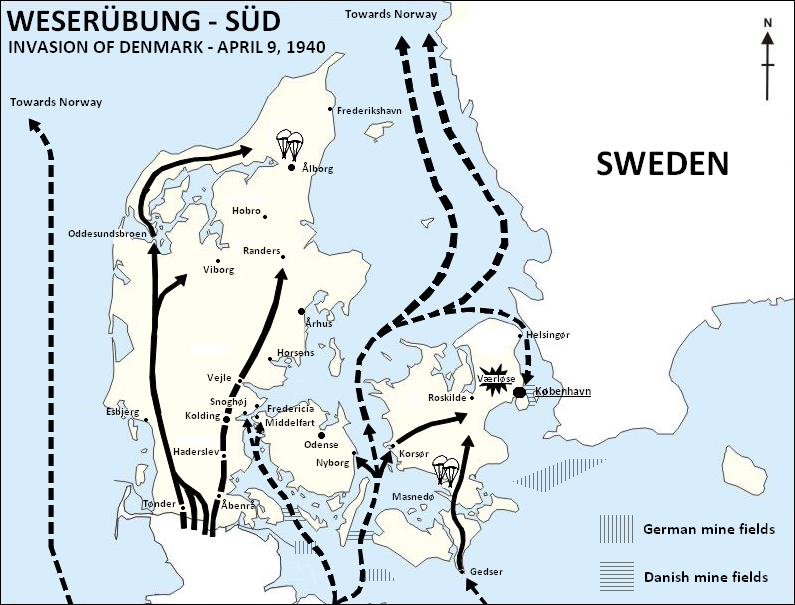
The Invasion of Denmark 1940 (Weserübung Süd)


Panzerkampfwagen I of the 11th Schützenbrigade, 9 April 1940

The conquest of Denmark was the quickest campaign in German military history. In the course of one day, actually in a few hours, the German Wehrmacht was able to secure an entire country. This campaign is interesting for many reasons, but before I get into that a bit of history . . .

Denmark once controlled a vast empire, but declined in power over a long period of time. During the 16th Century Denmark fought a series of devastating wars with Sweden and by the 1700s Denmark was lucky to have escaped Swedish hegemony.

In 1866 Denmark lost a short, but decisive war against the German Confederation losing the southern province of Schleswig which was predominately German, but with a Danish majority in its northern part. The treaty of Prague had promised the Danes of Schleswig a plebiscite as to which kingdom they would belong, but the Franco-Prussian War of 1870 removed France as the patron of the Schleswig Danes and a revised treaty did away with this requirement. Between 1870-1920, Schleswig was part of Prussia and thousands of ethnic Danes served in the German Army in World War I. Prussian policy in northern Schleswig, as in Alsace-Lorraine and the Polish areas in the east was harsh in the cultural sense - German as the official language, children required to attend German schools, Lutheran pastors required to make a pledge to the Kaiser among other measures. Essentially the same as being Welsh, Irish or Scottish under the English imo.

With the defeat of Germany in 1918, Schleswig's position came once more under question. Although neutral during the war, Denmark petitioned the Allies with their claims to Schleswig to the extent that the status of the province was addressed in the formal 1919 Treaty of Versailles, Section XII Articles 109-114. This required the German authorities to vacate the province and a plebicite to be held under Allied supervision. To ensure the desired outcome the Allies stipulated that two votes be carried out, one in the predominately German south and a second in the predominately Danish north. This against German protests that the province be treated as a whole entity, which it had been for centuries. Unsurprisingly the Danes voted to return to Denmark and the German/Danish border moved south.

I add this bit of history to indicate the connection between this frontier and the hated Treaty of Versailles, particularly for Hitler and the Nazis who had promised to overturn every element of the hated document, including of course designated borders. While there was nothing like the drive to regain the former German areas of 1919-1939 Poland, the history of the plebiscite and the memory of Danish moves against a prostrate Germany were clearly in the minds of the Nazis in 1940. This history made the decision to invade and occupy Denmark all the easier.

The invasion of Denmark does not rate a lot of study in terms of military history, for the obvious reason that the combat actions were all tactical - at the most basic level - and short, measured in minutes. However for strategic theory Weserübung Süd it is extremely interesting. The Germans (basically under Hitler's orders) carried out perhaps the most bloodless victory in history. In one day they took complete control of not only the territory of Denmark, but more importantly the Danish state. The campaign includes the full spectrum of negotiation, coercion and military force, from economic incentives to destroying the Danish Air Force in a surprise attack. Denmark was necessary to conquer quickly since the much more ambitious invasion of Norway (Weserübung Nord carried out starting the same day) required German control of Danish airfields and sea ports. Effective Danish resistance, including sabotage could have compromised the Norwegian campaign from the start. As it was the Germans were successful in capturing Denmark intact, while the submission of Norway was in the balance for some time and only concluded after two months of hard fighting. From this perspective, the invasion of Norway is roughly the opposite of the Danish operation, given the conditions of 1940.

Background on the Danish Army's stand on April 9, 1940 is available for review on the net.

The Germans of course made newsreels . . . and domestic propaganda . . .

The Danish operation was conducted by General der Flieger Leonhard Kaupisch's XXXI Corps headquartered in Hamburg. The XXXI Corps comprising the 170th and 198th Infantry Divisions. The other major unit involved was the 11th Schützenbrigade (later the 11th Panzer Division) which is usually translated as the 11th Motorized Rifle Brigade but included Mark I and II tanks. Additional German Army units included a battalion of the 69th Infantry Division and unidentified Brandenburg elements, and the Luftwaffe provided a company of paratroopers, a motorcycle company from the Hermann Göring Regiment and FLAK units.

The 11th Schützenbrigade and the 170th Infantry Division crossed the border on a broad front at 05:15 on 9 April 1940. At 07:30 the paratroopers were in control of the northernmost and most important airfield in Denmark, that at Aalborg. By 08:00 the Danish Army had ceased resistance. The railroads were captured intact and the 11th Brigade was able to reach Aalborg in the course of the day. These are the military time lines.

The Luftwaffe essentially destroyed the Danish Army Air Corps on the ground at Vaerloese airfield outside of Copenhagen. The attack took place according to Danish accounts at 05:45 (the Germans put the time as later). Two squadrons of Me-110s destroyed or badly damaged 25 aircraft, mostly Fokker D-XXIs.

The naval actions started earlier when Naval Groups 7-11 left their ports in Germany and seized various important points during the hours after about 05:00 on 9 April. Group 8 which landed at Copenhagen reported the Citadel captured without resistance at 07:30. Group 8 consisted of the motorship Hansastadt Danzig carrying 1,000 troops, an icebreaker and two picket boats as escort. Earl Ziemke in The German Northern Theater of Operations, the Dept of Army "pamphlet", describes the mission of Group 8 as being "predominately political and psychological". The guns guarding the harbor had been unable even to get off a warning shot due to their barrels being too full of grease to be fired. The German Army commander of the landing force had arrived in Copenhagen on the 4th and had spent his time getting acquainted with his target. The officer, a major who was even was able to get an escorted tour of the Citadel days before its capture, met his men at the docks as they were coming ashore.

He was not alone, also Kaupisch's Chief of Staff, Major General Kurt Himer had arrived on the 7th and presented himself to the senior German representative in Denmark Cecil von Renthe-Fink at 23:00 on the 8th. Himer was able to keep open a direct telephone line with his headquarters in Hamburg and give up-to-date information of the course of early morning's actions. When the Danish government delayed in surrendering, Himer warned that the next wave of German He-111 bombers would be dropping bombs instead of the propaganda leaflets they had been dropping up to that point. The Danish government ordered a cease fire at 07:20 and surrender followed within an hour. Himer requested an audience with the Danish King Christian X right after the surrender. Kaupisch issued a proclamation that same day. The official Danish government's history of the occupation provides an accurate source of what happened afterwards. Denmark is rightly remembered for having rescued their Jewish citizens from the Holocaust.

The campaign is noteworthy for two different aspects today. First, the French especially, and later the British saw Scandinavia as a second front to distract Germany from attacking in the West. The initially effective Finnish resistance against Soviet aggression in the Winter War offered the Western Allies the opportunity of shifting the focus of the war away from France and towards a completely different theater. The British were at first adverse to confronting the Soviets, but after the strong showing of the Finns started to doubt Soviet military effectiveness (as did Hitler). The British promised 100,000 troops for the Scandinavian Front and the French 50,000. What precluded this was the Finnish surrender in March 1940. It is also interesting to note that the German Navy suggested offering the Soviets the area of northern Norway including Narvik to guarantee their participation as allies, but Hitler refused this.

The second aspect involves strategic theory rather than military history. The Danish campaign shows that the Germans in 1940 were very flexible in their use of power to achieve their political purposes, rather than instinctively reaching for the military option at every opportunity. Denmark offered a whole series of advantages to Germany, but she would have to be captured intact to achieve almost all of these, a devastated Denmark and a hostile population would not achieve German goals, not to mention would make the attack on Norway almost impossible to carry out. For this reason the full spectrum of economic incentives, assurances, coercion and force were utilized to demonstratable effect. In spite of Nazi memories of Danish exploitation of German weakness in 1920 (Christian X had been King of Denmark in 1920) there was no adjustment of Danish borders and the Danes were promised that they would retain control of their own internal affairs, a status which remained in effect until mid 1943. That the Germans were able to achieve this had much to do with their successes in Poland the previous fall which had surprised the world and awed the Danes. Coercion has to be credible to be effective, but at the same time force has its limits. Seventy years to the day after this campaign it is amazing to consider that the Nazis - of all people - were clear about this, whereas there is much to be learned by the politicians of today in the use of incentives, non-violent and violent coercion and force used together to achieve strategic goals.

In summary there are specific reasons for this remarkable German success. First, they were not adverse to taking casualties. German losses were approximately 200 KIA and WIA, whereas the Danes lost about 50 including civilians. The Germans were interested in speed and their armored cars were lightly protected and with nothing above 20mm, as were the Mark I and II tanks. The Danes had 37mm anti-tank guns which could have taken on anything the Germans had effectively. From the accounts, the Danes were not prepared for strafing by fighter aircraft and there were instances of Danish military resistance collapsing after having been strafed. The successful attack on the Danish Army Air Force was a stroke of luck. Had the Me-110s arrived 20 minutes later they would have found the Danish Fokker XXIs in the air and at an advantage against the Me-110s at low altitude. Had the artillery defenses of Copenhagen been prepared they could have wiped out the German invasion force, that is Group 8, as was witnessed on the approaches to Oslo. Had the Danes resisted longer, the involvement of Sweden could not have been ruled out.

In Chapter 3 of the Art of War, the Chinese General Sun Tzu writes:

Generally, in war the best policy is to take a state intact; to ruin it is inferior to this. To capture the enemy's entire army is better than to destroy it; to take intact a regiment, a company, or a squad is better than to destroy them. For to win one hundred victories in one hundred battles is not the acme of skill. To subdue the enemy without fighting is the supreme excellence.


Oh, and a hearty thanks to Zenpundit for his kind post . . . yes, we're back!

Monday, September 21, 2009

Objective and Subjective Causes of War


German troops outside of Warsaw, approx 21 September 1939

In strategic theory we say that war is influenced by the political conditions which define its nature. While subordination to objective politics and subjective policy is the rational element of war, it also consists (following Clausewitz) of irrational passion and uncertainty. War is thus a very unstable social activity.

The subjective causes of the war in question, World War II, are not debated much (that is besides by Patrick Buchanan), but one doesn't find much on the objective causes, that is the long-term political situation which was set up years before the Nazis took power in 1933.

In general, the pursuit of negative goals, that is, fighting for the complete or partial maintenance of the status quo, requires less expediture of forces of resources than the pursuit of positive goals, namely fighting for conquest and forward movement. It is easier to keep what you have than get something new. The weaker side will naturally go on the defensive.
These principles are obvious in both politics and the art of war, but only on the condition that the sides have a certain amount of stability and defensive capability in the status quo. In the same way that ocean waves grind the rocks on the shore against one another, historical conflict rounds off amorphous political formation, erodes boundries which are too sinuous and gives rise to the stability required for defensive capabilities.
However, sometimes this condition is absent. The Treaty of Versailles has filled the map of Europe with historical oddities. The class struggle has created a layer cake of different interests and factions on this map. In these conditions the pursuit of the negative goal of maintaining the status quo may be the weakest rather than the strongest form of waging war: sometimes a superiority of forces will be required for a defense rather that for an offensive, depriving the defensive of any meaning. . .

For centuries since the time of Cardinal Richelieu, French diplomatic thinking has been nurtured on the idea of creating conditions of fragmentation, open fields, and weaknesses in Europe. As a result of the work of French policy, whose ideas are expressed in the Versailles "Peace" Treaty, all of Central Europe - Germany, Poland, Czechoslovakia and so forth has been placed ina situation which completely rules out the possibility of defense and positional warfare. The French vassals have been skillfully placed in the position of a squirrel compelled to turn the threadmill of militarism. The art of French policy lies in the skillful creation of unstable situations. This is the reason for the impermanence of this creation. The idea behind the Versailles Treaty, putting Germany in an indefensible position, has made it physically necessary for Germany to prepare for offensive operations. Poland will stiall have the opportunity to ponder how it should thank France for the gift of the Polish Corridor, which has put Poland first in line for a German attack.

Aleksander Svechin, Strategy, pp 250-1, 1927


I would only point out that originally the German High Command after the First World War toyed with the idea of using guerrilla warfare to lure in the attacking allies and defeat them inside Germany. This was quickly rejected as impractical and unsuited to the German character and General von Seeckt proceeded to build a highly mobile and professional offensive force which would be able to attack Germany's enemies one by one and defeat them before they had mobilized their mass armies. All this within the restrictions of the Versailles Treaty which having been signed by Germany was the law of the land. So the political situation required offensive war against a surrounding hostile alliance, but forbad Germany the military to carry it out.

This offensive policy was supported by every Weimar government till the collapse of the Weimar system in 1932.

With France the center of gravity for the allied effort, Germany would be required to neutralize each of France's allies which bordered Germany - Czechslovakia, Poland and Belgium - before attacking France. After that a armistice could be decided upon with Britain. This was in fact the line of approach that Hitler took, which was part of his own plan for a war of conquest, but also followed the objective political conditions established in 1919.

So why did France decide on such a policy at the end of the First World War? It required the maintenance of a strong system of alliances with the new Central European states promising France a high level of influence and it tied the hands of the military to a policy which limited their options. The crisis came with the change in political leadership during the late 1920s and the construction of the Maginot Line starting in 1930. France did not have the resources to maintain the Versailles offensive strategy, and attempted to switch to a defensive strategy with heavy defenses, but the unstable political reality which the original policy had established remained. For this original strategy to have worked, the French would have had to have declared war on Germany in 1936 for entering the de-militarized Rheinland. Even when Germany attacked Poland, there was a great opportunity for France to attack in the west and clear the western bank of the Rhine which would have been a massive shock to the German people, whose support for Hitler's war in 1939 was lukewarm at best. . .