Having posted about the sesquicentennial of one of the well-known events in the American Civil War I thought it only right to post this, another historically important but, I think, much lesser known event. And one that puts the events in Pennsylvania into a little more perspective...
New York City (Draft Riots) Dates: 13-17 JUL 1863
Forces Engaged: Military and Police - The forces deployed by the "government" (that is, the City of New York, New York State, and the United States government) included policemen and several varieties of soldiers, including New York state militiamen and federalized volunteer troops from New York and other states which by 1863 effectively meant the equivalent of "federal" or regular Army troops.
For the first three days the New York Police Department was the only effective body of "formed" forces. The NYPD available for the riots of July 1863 consisted of about 1,755 foot patrolmen and their sergeants and 39 mounted policemen, but were divided into 32 precincts spread all over hell's half-acre, from the 12th Precinct up at 136th Street and Third Avenue to the 24th Precinct down on the docks to the 1st at 29 Broad Street damn near in Battery Park. This meant that a lot of the fighting was usually between relatively small groups of civilians and relatively smaller groups of policemen spread all over Manhattan - as you can see from the map above.
A variety of small troop units were present in the New York area; the actual number is highly speculative, ranging from 500 to as many as 2,000.
But there appears to have been no effective command and control of these troop units, which prevented them from cooperating with the coppers, and many of them were militarily marginal outfits like the "
Invalid Corps" composed of men wounded badly enough to be incapable of the hard marching required of a combat infantry outfit but still able to perform limited military duties.
This outfit was stationed in New York City to act as the military police for the local Provost Marshall, BG Nugent, and the 1st Battalion (the less-handicapped element of the unit; the "2nd Battalion" was typically the armless or legless guys who were unable to do more than cook, clean, or pull interior guard) was engaged on 13 JUL, as we will see.
On Thursday (the fourth day) a variety of actual soldiers began to arrive, including three infantry regiments of state troops: the 7th New York Volunteer Infantry (NYVI, a state militia outfit which had been federalized for some time and were effectively regulars) and two militia units that had not been activated, the 65th and 74th, and an element from the 20th Independent Battery, New York Volunteer Artillery.
Regular troops from the Army of the Potomac included the 152nd NYVI, 26th Michigan VI, and 27th Indiana VI.
(
Note: the 20th Independent Battery, NYVA appears to be something of a mystery. It is
listed as "light artillery" in the New York State Division of Military Affairs website. The unit seems to have been formed from a failed attempt to recruit an artillery battalion that ended up as two batteries, this one and the 21st NYVA. The NY Military History page says that the 20th was "...recruited in New York City, Brooklyn, Hounds-field, Orange and Watertown..." but - and this is the oddity - was stationed at Fort Schuyler and Governor's Island, two masonry fortifications, in July 1863.
So I'm not sure whether this unit had any fieldpieces in July of '63 or was serving as gunners for fixed batteries in the forts. Certainly we know that several units employed cannon against the rioters, but I can't find any solid evidence of the 20th NYVA employed as such. It may well be that the New York redlegs suffered the fate of their modern-day counterparts in Iraq and were deployed as galvanized infantrymen...)
By 17 JUL approximately 6,000 to 10,000 federal or state troops were present in NYC, including the above units and the 5th NYVI, 9th NYVI, 11th NYVI, 47th NYVI, the 14th NY Volunteer Cavalry, and two more NY militia regiments, the 8th and 22nd; all under the command of the Assistant Provost Marshall for the 9th District, COL (brevet BG) Harvey Brown.
Civilian Forces - It is impossible to get any sort of real estimate on how many people turned out in the streets during the second week of July 1863. Accounts of the time speak of "mobs" of thousands. Bernstein (1990) quotes a news story that describes a Monday afternoon crowd on the Upper East Side as "A concourse of over twelve thousand", and this was only one group.
Vodrey (2010) states that
"In 1862, the year before the Draft Riots, nearly one-tenth of the city’s total population (of roughly 814,000)
had been arrested on one charge or another. The city had an estimated 70,000 to 80,000 criminals." It is not hard to imagine that at least this many people were out in the streets during the riots between the political protestors and the outright crooks looking for fun and loot. So let's guesstimate anywhere between 50,000 and 70,000 people armed with everything from sticks and stones to handguns and even, reportedly, a four-pound cannon used for celebratory salutes.
Who were these people?
Well, outside the ordinary, decent criminals (as the British like to call them) we know they were Caucasian; as we'll see, one of the most important "stories" from the Riots was the rapidity with which they degenerated into a fairly standard race riot.
Many of them were first-generation immigrants; German-, or more commonly, Irish-Americans. You probably know of the whole "No Irish Need Apply" story of the 1840-1860 period. The Irish were the "wretched refuse" of the teeming European shores to the native-born of the mid-Nineteenth Century.
Vodrey (2010) does a nice job of summarizing the sort of pressures that brought these people out into the streets in mid-July 1863:
"The riots began because of attempts to enforce the first Federal conscription act, and because of the economic hardships, political ideology and social pathologies of the city’s large Irish immigrant underclass. The great majority of them had welcomed neither the Emancipation Proclamation nor the draft. “They were furious,” wrote historian Philip B. Kunhardt Jr., “at being conscripted into a war [by then] dedicated to freeing slaves.”
Their loathing was exacerbated by the rhetoric of local politicians. Here's Vodrey (2010) again:
"The New York World, a newspaper partially controlled by Wood, criticized the draft as “profoundly repugnant to the American mind.” Wood’s brother Benjamin headed the Daily News, which wrote, “The people are notified that one out of about two and a half of our citizens are to be brought into Messrs. Lincoln & Company’s charnelhouse. God forbid!” The proslavery Journal of Commerce insisted that the war had become a means for “evil-minded men to accomplish their aims.” The Daily News charged that the Federal draft was a deliberate attempt to reduce the number of Democratic voters in the city. On June 3, 1863, Wood chaired a massive “Peace Convention” at the Cooper Union where, as Burrows and Wallace wrote, “...orators pounded home the ideas that the war was a rich man’s fight, that it was undermining the Constitution, and that it would flood the North with Southern blacks.”
Of course, nothing in NYC in midcentury could happen without the involvement of Tammany Hall, and the Democratic pols there were instrumental in whipping up hates and fears of abolition and the draft they saw as supporting it.
Many of the rioters were originally associated with others through a local institution; a workplace (the longshoremen were said to have featured prominently in the riots) or an organization (one of the first acts of the Riots was the destruction of the draft office at Third Avenue and 47th Street - the crowd there was led by an outfit from "New York's Bravest", volunteers of the "Black Joke" Engine Co. No. 33)
We'll talk about why these folks were so unhappy about the war and the U.S. in general circa 1863, but suffice to say they were and the fact that they chose to show it right after the twin Union victories of Vicksburg and Gettysburg was not a coincidence.
So; 50,000 to 70,000 people with a multitude of leaders, a primal force that horrified the gentlefolk of the metropolis, one of whom described them as
“thousands of infuriated creatures, yelling, screaming and swearing... the rush and roar grew every moment more terrific. Up came fresh hordes faster and more furious: bare-headed men, with red, swollen faces, brandishing sticks and clubs...and boys, women and children hurrying on and joining with them in this mad chase up the avenue like a company of raving fiends.”
So you didn't care for them, is that it, ma'am?
Sources: Numerous, as might be expected from such a critical event occurring in a major city during a literate time. New York City had no less than three daily newspapers; the
Times, the
Herald, and the
Tribune that all had reporters out in the streets. There's a
nice on-line repository of PDFs of the New York papers' editions for the week of the riots (along with copy from the Boston
Evening Transcript).
The U.S. of 1863 also had the equivalent of the modern
USA Today in
Frank Leslie's Illustrated Newspaper and
Harper's Weekly, also headquartered in New York. Both of these covered the Riots and provide useful first-hand accounts of the actions of the time.
As always in a literate society, we have official records and private accounts, letters, diaries, and memoirs.
From all this primary material we have a plethora of secondary sources.
Iver Bernstein's 1990
The New York City Draft Riots: Their Significance for American Society and Politics in the Age of the Civil War appears to be an extremely useful printed reference marred by the author's mind-numbingly prolix style and poor editing. A man named James McCague published an account of the Riots entitled
The Second Rebellion: The Story of the New York City Draft Riots of 1863 in 1968. I tracked down several other published accounts as well; the field appears well represented.
On line I can recommend several worthwhile sites.
Blood in the Streets: The New York City Draft Riots (
Vodrey, 2010) provides an excellent overview of both the political and social background of the Riots as well as a daily chronicle of the riots themselves.
This website presents an excerpt of Leslie Harris' 2003 work
In the Shadow of Slavery: African Americans in New York City, 1626-1863 and is well worth a review for a personal perspective on the events of the Riots.
The City University of New York has a really
outstanding source here which particularly usefully provides an interactive map of Manhattan that lets you follow who did what to whom and when.
The
Wikipedia entry appears reliable, if no more than a compendium of the more detailed information you can find in the three websites above.
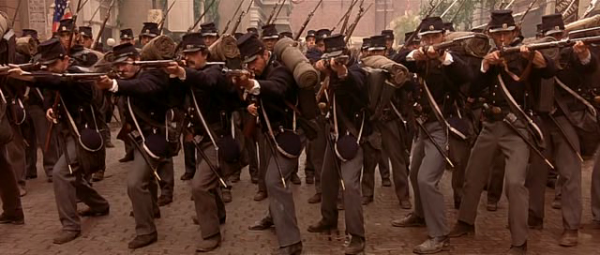
As a side note, I would be derelict if I didn't make a mention of the appalling Scorsese
Gangs of New York
The "source material", such as it is, is Herbert Asbury's 1928
The Gangs of New York: An Informal History of the Underworld, a supposed nonfiction account of the 19th Century street gangs and criminal superstars. It was reissued in 2002 in concert with the film and I glanced through it. It's genuinely awful; written in the worst purple dime-novel Nineteenth Century style and based on a hopeless mashup of tall tales and anecdotes there is no possible way to separate fact - if any - from fiction.
But the film is worse, at least regarding the Riots. Here's how the Wiki entry for Gangs of New York describes the scene from the film:
"As the gangs meet, they are hit by shells from naval ships in the harbor firing directly into Paradise Square. Many are killed, and an enormous cloud of dust and debris covers the area. Union soldiers then fire into the square, killing numerous people." This doesn't begin to describe this ludicrous scene which plays like the Siege of Leningrad meets the barricade scene from
Les Miserables. Its completely ridiculous as history, let alone in its complete divorce from the context of the time and place.
While not quite as bad relative to the history as the wretched Tom Cruise vehicle
The Last Samurai its pretty awful in its own right. Be advised.
The Campaign: I usually use this section to discuss the strategic and grand tactical background of the engagement under consideration. Here, I'd like to use it to talk a little about what produced this uprising, perhaps the worst urban riot in the U.S. until the 20th Century.
First, we need to understand how different U.S. society was in 1863. As, most of us, products of the Great Social Peace bought by the New Deal we lack a genuine visceral feeling for how poisonous the relationship between the classes was in mid-Victorian New York.
Vodrey (2010) sums it up nicely:
"Overcrowding, poor sanitation and deteriorating housing stock were endemic. Seepage from cemeteries and privies contaminated the water supply, and cholera often swept the city. In late 1832, an epidemic killed nearly 4,000. Those who could afford to, fled the inner city. Few remember that it was during the Panic of 1837, which led to a six-year recession which economically devastated New York City, that Horace Greeley wrote his timeless advice, “Go West, young man!” He wasn’t singing the praises of the American frontier as much as he was despairing of the city’s future. At the outbreak of the Civil War, the average New York City worker earned just 85 cents a day. The city suffered from another recession in early 1861 after Southern businessmen repudiated their debts, but within a year, as the industrial and production might of the city was unleashed, it was prospering like never before.
Yet it was a very uneven prosperity. Some profited enormously as Federal spending flooded into the city, but inflation, paper money, profiteering and economic upheaval made many of the poor even poorer. Rents went up by as much as 30%; food became more expensive. Prices rose, but wages lagged about 20% behind after 1861. Greeley noted that rents were already higher in the city than anywhere else in the world."
All this while in the elegant districts such as along lower Park Avenue and the Ladies' Mile (from roughly 18th Street to 24th Street and from Park Avenue South to west of Sixth Avenue) displayed the ostentatious wealth of the Victorian gentry.
Not surprisingly, the working men and women who got so little for their labor were angry and frustrated by their penury. Also not surprisingly this anger and frustration were as often as not directed not towards the people who profited most but those whose hopes of earning a little seemed to threaten what little their neighbors held.
“...the immigrant Irish of the ... slums... feared the blacks with whom they competed for the lowest-paying jobs, and for whose freedom they did not wish to fight.” (Ward, Burns, and Burns, 1990)
There was also a longstanding tradition of street violence, in New York as in other American cities. The major fracases included:
- The "Doctor's Riot" (1788): 5,000-odd attacked New York Hospital angry about supposed medical body-snatching
- Whorehouse riots (1793, 1799): aimed at suppressing brothels for some reason
- Sectarian violence (1806, 1857): Catholics vs Protestants
- Violent strikes (1825, 1829, 1837):
- Election riot (1834): “Many regard 1834 as the city’s worst year for riots because of election violence between Whigs and Democrats...and mob attacks on abolitionists and blacks.....Both these disturbances and several others in the 1830s were marked by intense physical violence.” (
Gilje, 1987)
- The Astor Place Riot (1849): "supporters of American actor Edwin Forrest interrupted a performance by his English rival, William C. Macready" (Vodrey, 2010). Police and NY militia fired into the crowd; 22 killed, and over 100 (policemen and rioters) wounded.
And that was just the "big" riots. New York in the Victorian Era was a dangerous place, for all that our boy Asbury probably exaggerated things. The Five Points district was well known for its gangsters and overall misery (the fact that the whole area was built over crappy fill tossed into an old pond known as "The Collect" probably didn't help) but was probably only worse in scale rather than overall nastiness.
Vodrey (2010) provides some of the more sensational stories of the Five Points from Asbury:
“...infamous Irish gangs, each several hundred strong,” included the Plug Uglies, the Dead Rabbits, the Short Tails, Shirt Tails, Daybreak Boys, Swamp Angels, Slaughter Housers, and the Roach Guards, but also anti-Irish, nativist gangs like the Bowery Boys. Among these gangs’ leaders were such colorful but dangerous men as Bill “the Butcher” Poole, “Red Rocks” Farrell, “Slobbery Jim,” “Sow” Madden, “Piggy” Noles, “Suds” Merrick, “Cowlegged Sam” McCarthy, “Eat ‘Em Up Jack” McManus, and even some women like “Hell-Cat Maggie,” last name unknown, who was said to have filed her front teeth into points and worn brass fingernails “to lacerate her adversaries,”
Lovely people, I'm sure, but not the sort to find friends among the Good People of New York City.
The social reality of 1863 was that if you were born within smelling distance of Five Points or one of the many other slums you weren't going to end up hobnobbing with the nice folks along Park Avenue. You would live a fairly miserable life and die - probably soon - a fairly miserable death. Why
not try and work up to be a gangster?
What did you stand to lose, your page in the Social Register?
Add to this overall and longstanding misery the recent economic miseries of the Civil War. New York City was a major embarkation port for Southern cotton, and an illegal slave trade had been run out of the city as well; the loss of these revenues helped put poor people out of work.
The loss of Southern income hurt the city's elite, too, though obviously not as hard. These wealthy included banksters who had as much as $150 million out in farm loans to Southern planters accepting slaves as collateral, shipping owners hauling cotton, financiers in Southern bonds, and commodities traders in Southern tobacco and rice. All these people had elected politicians that fought against and hated the anti-slavery faction and made sure that the local poor white folk knew that.
Not that they needed much encouragement.
Our modern notions of racial equality would have been considered either laughable or shocking to the New Yorkers of 1863.
In New York City, as across all of the northern states then in the union the law required segregation of races. Commercial and social institutions were barred to blacks; a white person would not have stood next to them in a store or a church. The public transportation of NYC (streetcars and trains) was off-limits to blacks until 1861 even though an
1855 New York Circuit Court ruling required access. Blacks could not vote even if they met the property requirements of the City.
And black men were exempt from the draft.
And the draft was at the heart of the troubles.
Those of us old enough - and I am barely in that group - to remember the last time the United States drafted men to fight can remember the trouble and unrest that caused. Part of the anger it provoked was simple because Vietnam was an unpopular war, but another part was that the system of exemptions was widely seen as unfair and skewed in favor of the wealthy and influential. From Dick Cheney to Bill Clinton and Rush Limbaugh to Muhammad Ali, draft-age men could find ways to dodge the draft without penalty, while those without fame or influence went into the infantry and earned the Vietnam Era draft its bad name.
The Civil War draft made the draft of the Sixties and Seventies look straighter than a Baptist missionary on Ladies Night.
Technically the "draft" we're talking about was the
Enrollment Act, 12 U.S.C. § 731, that stated that
"...all able-bodied male citizens of the United States, and persons of foreign birth who shall have declared on oath their intention to become citizens under and in pursuance of the laws thereof, between the ages of twenty and forty-five years, except as hereinafter excepted, are hereby declared to constitute the national forces, and shall be liable to perform military duty in the service of the United States when called out by the President for that purpose."
The real Easter egg was buried in Section 13:
"...any person drafted and notified to appear as aforesaid, may, on or before the day fixed for his appearance, furnish an acceptable substitute to take his place in the draft; or he may pay to such person as the Secretary of War may authorize to receive it, such sum, not exceeding three hundred dollars."
This was the "rich man's war" exemption; it meant that anyone wealthy enough to afford it (and keep in mind that $300 was far more than a full year's wages for someone making a less than a dollar a day) who could find someone else desperate enough could buy his way out of combat.
It ensured that the dirty work of warfare would be a "poor man's fight" unless the rich man chose not to make it so. Ironically, the intent was to prevent speculation and trading in substitute fees; in other wars and other nations where substitution had been allowed the cost of a warm body to take your place in front of the bullets had quickly skyrocketed. The $300 fee, for all that it was far out of reach for the ordinary working stiff, was reasonable for a gentleman's family.
$3,000; not so much.
Still, the exemption (since you could also simply pay the three hundred simoleons to the Secretary of War and get a "Get Out Of Battle Free" card) was perhaps the most hated part about the new law. Bad enough that "they" could come snatch you up and make you a soldier; the worst part was that the rich bastard driving by in his fancy carriage could just stroll off with his future secured for the cost of a couple of high-class whores and a fancy dinner at Delmonico's.
Then there was the butcher's bill from Chancellorsville, Vicksburg, and Gettysburg.
The double victories - as Union victories always did in that time - immediately raised hopes that the rebs were whipped and the war would soon be over. But the spring and summer of 1863 had been a bloody mess for the U.S. Army. 1,600 killed outright at Chancellorsville, more than 3,000 at Gettysburg, thousands more dying slowly of their wounds. The whole business just seemed like a mug's game for the white guy working a day job.
If the rebels were going down why be the last guy killed fighting for a bunch of niggers?
So the fuse was just waiting for the match when the first draft numbers were drawn on Saturday, 11 JUL 1863.
The Engagement: The New York metropolitan area - officially the "Southern Division of New York" - was covered by nine draft board offices. One on Long Island, one in Brooklyn (then a separate muncipality) and seven in Manhattan. Between the nine the NYC area was expected to provide no more than 1,500 bodies in July 1863. The process
was as simple as the Provost Marshall could make it:
"The names were gathered by assistant provost marshals who had visited homes and factories during the past month looking for eligible white men between the ages of 20 and 45. Now those names, written on slips of paper, rolled tightly and secured with rubber bands, were being drawn by a blindfolded clerk from what the New York Herald called the “wheel of misfortune.” (Wheeler, 2013)
The first drawing had been...let's just say not well received by the people it affected.
“It came like a thunderclap on the people, and as men read their names in the fatal list the feeling of indignation and resistance soon found vent in words, and a spirit of resistance spread fast and far. The number of poor men exceeded, as a matter of course, that of the rich, their number to draw being so much greater, but this was viewed as a proof of the dishonesty of the whole proceeding.” (Vodrey, 2010)
Public meetings and church services Sunday were full of anger against the draft, and on Monday 13 JUL a crowd began to assemble in the poor areas of the Lower East Side around dawn and marched uptown to the 9th District office at 677 Third Avenue.
In front of the group was the "Black Joke" crew; one of their company had been drafted Saturday and they had no intention of letting him go without a fight. By midmorning a pretty big crowd - maybe 500 or 600 - was milling around outside the draft office at the corner of Third and 47th Street. A line of policemen had been posted outside the building.
The cops had been alerted by telegraph at 8:35 that morning:
"From Central Office to Seventeenth, Eighteenth and Twenty-first Precincts: Send ten men and a sergeant forthwith to No. 677 Third Avenue, and report to Captain Porter of Nineteenth Precinct for duty."
Either way, the early morning hours were a tense standoff between cops and protesters.
You can picture the scene at the corner as it developed that morning. The crowd begins to get bolder as its numbers grow. The big boys from the Black Joke company are all up in the faces of the 40 or 50 coppers, promising mayhem if they don't get their buddy's name off the list.
The cops try and look badass, shouting, glaring, occasionally pushing and shoving to get the smelly proles out of their faces. Clubs come out on both sides; the sergeant and Captain Porter, posted at the back of the line, fiddle with their revolvers to loosen them in their holsters in case real trouble starts.
And it does, supposedly around 10:30.
Somebody, either one of the cops or one of the crowd, fires a shot. The street dissolves into bloody chaos; the coppers are overrun and the area outside Number 677 is a Brownian motion of cops in ones and threes being pushed and pulled by the people around them. Here and there someone goes down, and the random arm movements become a smashing rhythm as someone gets clubbed senseless.
The crowd forced its way into the draft office as the provost marshal's officers fled out the back. The office was torched - in fact, the whole block between 46th and 47th burnt down - and the happy crew then turned on a detachment from the sorry Invalid Corps heading north along Third;
"A first volley of blanks only seemed to incite the mob, and a second volley of live rounds killed or wounded six men and a woman. The mob went wild, killing several soldiers - some estimate as many as 20. The Invalid Corps troops fled, leaving behind their wounded, some of whom were then mutilated by the mob." (Vodrey, 2010)
Here's where we do get a sort of
Les Miz scene. The reports of the time claim that this single incident sparked general rioting all over the city. But there was no electronic media to get people off the couch and out into the street. What must have happened is that people in the original crowd - probably young men and boys, dozens of
Gavroches, ran off through the lower end of Manhattan shouting that the People had Risen and
aux armes, citoyens!
And to arms they came.
Here's a description of the early hours of the Riots on Monday:
"When the fire department responded, rioters broke up their vehicles. Others killed horses pulling streetcars and smashed the cars. To prevent other parts of the city being notified of the riot, they cut telegraph lines. The police superintendent, John A. Kennedy, arrived at the (draft office) site...was recognised by people in the mob ...(and) left nearly unconscious, having had his face bruised and cut, his eye injured, lips swollen, and his hand cut with a knife; he was beaten to a mass of bruises and blood all over his body. The police forces were badly outnumbered and unable to quell the riots; but they kept the rioting out of Lower Manhattan below Union Square. (The) Bull's Head Hotel on 44th Street...which refused to provide alcohol to the mob, was burned. The mayor's residence on Fifth Avenue, the Eighth and Fifth District police stations, and other buildings were attacked and set on fire. Other targets included the office of the New York Times (which was defended) by staff manning Gatling guns, including Times founder Henry Jarvis Raymond. The Armory at Second Avenue and 21st Street was pelted with paving stones." (Wiki, 2013)
The War Department and official Washington was notified by about noon Monday and the response was immediate:
The draft was halted.
That's correct. The mob ruled; the draft was suspended and the draft offices closed. But by this time the Riots were beyond any sort of civil control.
A big part of that was that the original Riots had been overwhelmed by a pure furious rage of hate and loot. The looting included Brooks Brothers' store and probably many humbler merchants. The hate rapidly turned on anyone darker than a dusky shade of pink.
"But by afternoon of the first day, some of the rioters had turned to attacks on black people, and on things symbolic of black political, economic, and social power. Rioters attacked a black fruit vendor and a nine-year-old boy at the corner of Broadway and Chambers Street before moving to the Colored Orphan Asylum on Fifth Avenue between Forty-Third and Forty-Fourth Streets. At 4 P.M. on July 13...an infuriated mob, consisting of several thousand men, women and children...advanced upon the Institution...took as much of the bedding, clothing, food, and other transportable articles as they could and set fire to the building." (Harris, 2003)
It is difficult to be sure but at least a dozen or so individual black New Yorkers were murdered by the rioters, many of them in spectacularly gruesome ways:
"A group of white men and boys mortally attacked black sailor William Williams—jumping on his chest, plunging a knife into him, smashing his body with stones—while a crowd of men, women, and children watched. None intervened, and when the mob was done with Williams, they cheered, pledging "vengeance on every nigger in New York." A white laborer, George Glass, rousted black coachman Abraham Franklin from his apartment and dragged him through the streets. A crowd gathered and hanged Franklin from a lamppost as they cheered for Jefferson Davis, the Confederate president. After the mob pulled Franklin's body from the lamppost, a sixteen-year-old Irish man, Patrick Butler, dragged the body through the streets by its genitals. Black men who tried to defend themselves fared no better. The crowds were pitiless. After James Costello shot at and fled from a white attacker, six white men beat, stomped, kicked, and stoned him before hanging him from a lamppost." (Harris, 2003)
Other mobs trashed or burned places where they knew blacks, or white people associated with blacks, lived, worked, or hung out.
The rich fared better than the blacks, but only because they lived further away and could afford to flee. An entire block of fine houses along Lexington Avenue and 46th Street was torched. Well-to-do families bolted; by nightfall on 13 JUL you couldn't hire a horse or carriage for any amount of money.
Police Headquarters, the symbol of the law which in its impartial majesty forbade rich and poor alike to steal bread and sleep under bridges, was attacked by a group of some 10,000 and defended by hundreds of coppers. It was bricks and paving stones and firearms against pistols and riot batons; the police beat down the attackers and held their HQ, one of the handful of official wins that day.
At City Hall the Mayor of New York and MG Wool, the commander of the Eastern Military District dithered about declaring martial law. Finally Mayor Opdyke wired Washington pleading for federal troops and Albany for state militia.
By nightfall almost everyone who had observed the first day's fighting agreed that the city had no government other than the crowds in the streets. Shortly before midnight a drenching summer storm broke over the city.
In the torch-flaring darkness rioters were seen dancing in the rain beneath the corpse of a black man hanging from a lamppost on Clarkson Street.
The Second Day: 14 JUL 1863 Rioting of the sort that had characterized Monday afternoon continued throughout the day; largely the victims were the wealthy and the black. The rioting crowds also built barricades, one on the West Side along Ninth Avenue in the Thirties and Forties and another nearly a mile long around the Union Steam Works (an arms works) on Second Avenue. The police lost the 18th Precinct House on 22nd Street to arson. The Governor of New York, one Horatio Seymour, showed up.
This mook was a so-called "Peace Democrat" who was on record as against the war and against not the draft but the large quota allotted New York State (in which he was probably justified - the NY number
was high and was later reduced). He is reported to have
"...addressed a huge crowd near City Hall, some of whom were almost certainly rioters and murderers, calling himself their “friend,” informing them that the draft had been suspended in the city, and that the state would meet its military enlistment quota by volunteers alone. The governor urged everyone to peacefully go home and obey the law." (Vodrey, 2010)
On Tuesday one of those fucking weird incidents occurred that seem to happen when people get busy killing and beating the shit out of other people.
The
11th NYVI had been a early-war unit; the so-called "
Fire Zouaves" raised in 1861 from the rough boys in the city's volunteer fire companies. These yoyos were all about the romance of soldiering which consisted of wearing sexy Frenchified uniforms ("zouaves" were originally North African troops) and looking spiffy on parade. Their war record was spotty and they stuck to their original one-year enlistment meaning that they were all done in June 1862. They marched back to New York and took off the fancy zouave suits.
Well, New York tried to re-raise this outfit in 1863 with pretty damn poor results. A couple of companies were all that had been assembled by July 1863, and these were led into the fighting around Oliver's Livery Stable near East River and then near 34th Street and Second Avenue by the "regimental" commander, one COL O'Brien.
Some sort of fighting took place there: Vodery (2010) says that O'Brien's unit
"...used a howitzer to clear Second Avenue, killing a female bystander and her child." although where a tag-end of infantry managed to get a hold of and use an artillery piece is hard to explain. Whatever happened apparently the people the 11th was shooting at ran off.
At this point the weird shit starts. The colonel proceeds to leave his outfit and wander up Second Avenue to a drugstore. Whether he was looking for a root beer float or an aspirin we'll never know, because he ran into some of the people he'd just been shooting at who appear to still have been pissed off about that whole "using artillery to blow my friends and relatives to pieces" thing. According to his
Wiki entry:
"...after a few moments, he was attacked by a group of rioters which had reorganized as he left the building. Severely beaten and mutilated by the crowd, he was kicked and hit with stones as he lay on the street. After an hour, he continued to be harassed with rioters putting a stick down his throat. Although local residents attempted to help, rioters attacked bystanders attempting to bring him food and water. He was eventually taken by rioters to his nearby home where he was tortured to death and mutilated beyond recognition."
Yeah, I know;
WTF, right?
I have no idea, either.
O'Brien was either the world's most clueless goof or he had no idea how bad things really were in his hometown. Either way, you have to feel thankful that he didn't manage to get his unit into actual combat; if you can't survive in a drugstore how the hell do you lead your troops through the Wilderness or safely through the trenches around Petersburg?
Weird, I tell you.
Anyway, just to keep their hand in the rioters attacked several whorehouses later that night and beat, raped, or beat and raped the women they found there.
The Third Day: 15 JUL 1863 Another downpour soaked the streets in the early hours of Wednesday, but in the typical fashion of East Coast summer storms did little to break the heat; Wednesday was described as the hottest and muggiest day of a hot, muggy week. More fighting went on in Manhattan and was reported from Brooklyn as well, where
"...a mob set fire to grain elevators and displayed a banner reading, “No $300 Arrangements With Us.” (Vodrey, 2010)
Three black men were lynched at the corner of Thirty-Second Street and Eighth Avenue.
Mayor Opdyke finally rounded enough city councilmen for a quorum of the Council (these worthies had been too busy running and hiding earlier in the week). They met at City Hall and promptly produced a thundering condemnation of the draft and voted to appropriate two and a half million dollars to pay the $300 exemption fee for any New Yorker who wanted it. Then these plucky heroes adjourned
sin die.
At about 6:00 pm a group of rioters fought it out with one of the troop units down on the Lower East Side around 19th Street and First Avenue and won. Reportedly the troops left their wounded behind to be clubbed to death.
Things were about to change, however.
About 10:00 pm the first real troop units came off the line of march onto Manhattan Island; first the 74th and 65th NY militia regiments and six hours later, in the twilight of Thursday morning, the combat soldiers of the 7th NYVI.
The Fourth Day 16 JUL 1863: By Thursday combat units were massing into NYC. The 8th and 152nd NYVI deployed between 8:00 and noon. These soldiers took over from the NYPD, any of whom left standing by this time must have been damn near whipped.
If you're interested, there's a nice little account of the doings of The NYPD during Riot Week
here. It was about as ugly as you'd think. Almost 100 were injured, four killed.
The Federal soldiers proceeded to go through NYC like a dose of salts.
"The veterans of the Army of the Potomac imposed a hard peace. Burrows and Wallace wrote, “Troops assaulted ‘infected’ districts, using howitzers loaded with grapeshot and canister...to mow down rioters, and engaged in fierce building-by-building firefights. Rioters defended their barricaded domains with mad desperation. Faced with tenement snipers and brick hurlers, soldiers broke down doors, bayoneted all who interfered, and drove occupants to the roof, from which many jumped to certain death below.” (Vodrey, 2010)
By midnight these Roman methods had effectively ended the Riots. The army and police began a
ratissage through tenements of the Lower East and West Sides that turned up something like 11,000 assorted weapons as well as all sorts of other people's stuff that seems to have been just lying around. The
New York Times commented acidly
“Every person in whose possession these articles are found disclaims all knowledge of the same, except to say they found them in the street, and took them in to prevent them being burned...”
Perhaps the most intriguing part of the story of the Riots was where they
didn't happen.
One of the most irking things about the irking film I mentioned earlier,
Gangs of New York, was the association of those gangsters with the riots.
Historically, however, the Five Points district was among the most peaceful in the City.
"Mobs neither attacked the brothels there nor killed black people within its borders. There were also instances of interracial cooperation. When a mob threatened black drugstore owner Philip White in his store at the corner of Gold and Frankfurt Street, his Irish neighbors drove the mob away, for he had often extended them credit. And when rioters invaded Hart's Alley and became trapped at its dead end, the black and white residents of the alley together leaned out of their windows and poured hot starch on them, driving them from the neighborhood." (Harris, 2003)
My guess is that being used to violence as a way of life the hardcases of Five Points knew damn well the difference between the kind of violence they could use and the sort that real soldiers could use against them, and made the sensible choice to lie low. Unlike Scorsese, they knew damned well that no matter how individually badass no urban gangster could fight combat troops and win.
The Outcome: Decisive tactical victory for the government forces.
The Impact: Some 6,000 troops remained in NYC for months to enforce the victor's peace, although the Federal government never did declare martial law. Draft rioting in Boston and Troy, New York that week was suppressed quickly and no more serious rioting followed the resumption of the draft in August.
As mentioned above, one of the impacts of the riots was a reduction of the New York quota of draftees by more than half, from 26,000 a year to 12,000. The August draft was also run through Tammany Hall, ensuring that a local proxy would take the heat from anyone who felt screwed over in the process. Knowing "Boss" Tweed I'm sure there was money made in the deal somehow.
Four draft lotteries were held between 1863 and 1864. A total of 776,829 names were drawn. Of this total only 46,347 actually served. New York State provided 158,000 names; 3,210 were actually drafted. The remainder either volunteered or paid for substitutes. Many of these payments were provided by the political machines in the cities, Tammany in NYC and similar outfits in places like Albany, Troy, and Brooklyn. This helped solidify the machine politicians' power in the cities.
Draft dodgers came up with all sorts of schemes; doctors whipped out fake flat feet and bad backs, “draft insurance societies” took payments in return for the $300 fee, and a whole cadre of bounty-jumpers emerged willing to take the cash and desert as soon as they could.
Historical studies of the relationship between social class and/or wealth and the ability to purchase an exemption to army service have found little or none; the $300 fee doesn't seem to have had any significant effect on whose war or whose fight the Civil War was.
How many people died?
The "official" figure is 119. Estimates range between that and about 1,000 (by comparison, the 1992 "Rodney King" riots left 52 dead and about 2,000 injured). Given the description of the fighting Monday and Tuesday, the lynchings, beatings, and other casual murders throughout the week, and the final whiff of grapeshot and house-to-house clearing on Thursday this figure seems almost certainly too low.
More than 100 buildings burned; certainly there must have been people who died inside who were never accounted for. The people living in the slums of Lower Manhattan were effectively "nonpersons"; many of them could have died in fires, or in the streets and been tossed away. Several of the officials who were present provided much higher numbers; Governor Seymour "more than a thousand" killed, Chief of Police Kennedy, 1,155.
We will probably never know.
Damage to the city was estimated at about $1 million, a number that today would mean roughly five times that.
Perhaps the worst hit was NYC's black people. More than two thousand (about a fifth of the prewar black population) simply left. Many of the remainder were largely driven out of integrated neighborhoods and forcibly relocated into the areas that became overwhelmingly black, such as the Harlem area on the Upper West Side. The Riots were a vicious reminder for black New Yorkers that the White was still Right. The racial problems that killed and burned so fiercely during the Riots remain with us today.
Almost nothing remains of the New York City of the draft riots. So far as I can tell there is no City marker or monument to remind passersby of the three days of rage that rocked the city and the United States in the summer of 1863.
The NYPD lost four officers killed in the riots. I cannot find any trace of an official memorial to the four officers killed in the line of duty. The NYPD Museum website says that the museum is closed because of damage from Hurricane Sandy, but reviews claim that it is largely devoted to memorializing the officers killed in 9/11/01.
The New York Army National Guard website does not have a page discussing the units engaged or their casualties. Total U.S. Army casualties are difficult to estimate, but I cannot find anything commemorating the losses of the Invalid Corps or any other unit involved in the fighting.
The location of the draft office at on Third Avenue at 47th Street is no longer #677; that intersection is now in the 700 block of Third. It is identical to most other cross streets in the East Midtown. A Wells Fargo branch office occupies the northeast corner and a Bank of America the southwest. A FedEx outlet is located on the southeast corner.
And on the northwest side Mark from Queens raves about the little Flora Louis handbag store:
"I recently purchased a nice clutch for my girlfriend, she loved it!! I would definitly shop here again. The qualit is great and the styles are very, very fashionable. Not to mention the stores interior design is immaculate."