Showing posts with label war. Show all posts

Thursday, March 5, 2026

...it was a mistake


So just the other day we were talking about the...whatever the fuck the Trumpkins are doing in the Persian Gulf that's not-a-war.

(Here's Mike "My Balls Are In A Drawer In The Resolute Desk" Johnson today: "We're not at war, we have no intention, we have no intention at being at war. The president and the Department of Defense have made it very clear, this is a limited operation.". So it's a "limited operation"? A "punitive expedition"? A cabinet war...no, it's not! It's not a war! IT'S NOT A WAR!

Not a war. Are we clear on that now?)

Sure. Okay.

Anyway, the historical examples we discussed as looking real similar to whatever-this-is included Libya and Syria because 1) the U.S. part of those wars was largely limited to airstrikes, and because of that 2) they largely just resulted in dead and maimed people and blown up buildings and destroyed military things like tanks and aircraft, leaving behind nothing but chaotic failed states that served principally to spread disorder and violence to nearby parts of North Africa and the Levant.

Now.

Just having soldiers to occupy the targeted polities doesn't promise success, either; Iraq is the test case for how you can send a bunch of guys to walk around with weapons and still have no fucking clue how to use them effectively.

But experience (and common sense) would suggest that if the actual end state for - let's us at least be honest and call it what it is- the Fourth Gulf War is something other than "chaotic failed state" someone's are going to have to actually go into Iran and make claim to the actual physical ground, buildings, animals, and people. In war, as in any tort, possession is nine-tenths of the Law, and infantry are the bailiff's men.

Do any of these wanna-be Iran filibusterers wandering around the blanket fort at Mar-a-Lago have a plan for that?

Well...supposedly the spooks at the CIA do:

"The CIA is working to arm Kurdish forces with the aim of fomenting a popular uprising in Iran, multiple people familiar with the plan told CNN. The Trump administration has been in active discussions with Iranian opposition groups and Kurdish leaders in Iraq about providing them with military support, the sources said."

If so, then we're out of Libyan territory and closer to Syria, where the anti-Assad rebellion included Kurdish soldiers aligned with the U.S. (who were then abandoned by the U.S. when they became inconvenient to U.S.-Turkish relations, so I'm not sure they'd be the right people to ask about this cunning CIA plan).

What this Kurdish Free Iranian Army idea reminds me more than anything else is the early stages of the Afghanistan incursion, when the idea was to "go in light", using only U.S. Special Forces to augment the "Northern Alliance", an outfit largely made up of - as the name says - the northern tribes in Afghanistan; Tajiks, Uzbeks, and Hazaras.

Which wouldn't have been a problem, except for that the largest, most influential, and traditionally most powerful group in Afghanistan has always been the traditional rivals of those groups, the Pashtun, who also comprised the bulk of the Taliban that were the target of the 2001 invasion.

Enlisting the northern tribes meant that even after the Taliban was driven out of the major cities into the mountains of the Afghan southeast the locals who remained behind, the population that the U.S.-led occupying force and the Afghan regime it supported, were mostly Pashtun and were unlikely to cozy up to these damn outsiders. Afghanistan might be the most extreme form of "me and my brother against my cousin; me, my brother, and my cousin against the outsider" kind of clannishness.

So if the Pashtun didn't rally to the government in Kabul - and they largely didn't, for a number of reasons but tribal loyalties being a major part of them - the chance of getting far enough ahead of the Taliban counter-occupation insurgency was slim, at best.

We know how that worked out.

What's the story in Iran? What would sending a Kurdish proxy force into Tehran look like?

Here's a Reader's Digest version of the ethnic makeup of modern Iran: 

Pre-modern Iran was known a "Persia", and the people who lived and live there are Farsi-speaking Indo-Europeans (closely related to Afghanistan's Tajiks, in fact). "Persians" are about 60% of the population of the modern country.

The second-largest group of people are Azerbaijanis, a Turkic-related , that make somewhere between 15% and 20% of the country. The Kurds are about 10%, and there's a couple of percent of various smaller groups like "Lurs", Baluchis, Turks, and Arabs.

What does that mean for a Kurdish "Western Alliance" on the ground in Iran?

Not much good.

 A Iranian Kurdish-led ground force wouldn't be much different to the rest of Iran than an Iraqi or, for that matter, a Saudi or Jordanian army. Or how a bunch of Tajiks or Hazaras walking around Pashtun territory were in Afghanistan. 

They'd be outsiders.


And we've been there and done that, and seen how that fucking went.

"Ils n'ont rien appris, ni rien oublie'" 

Monday, March 2, 2026

Worse than a crime...

I don't really have much to add about the Fourth Gulf War to what all of you probably know by now.

Unless the U.S. and/or Israel can convince some sort of alliance of Middle Eastern allies - or, if they're really insane, on their own - to invade and occupy Iran there is...well, perhaps not "no chance", but a infinitesimally tiny chance that this latest round of killing people and breaking shit in Southwest Asia will leave the region more peaceful, less violent, and better governed that it was before the missiles and drones began exploding.

Remember "we" (in the sense of "the Bush claque of imperialists, isolationists, filibusterers, and nitwits") already tried that in Iraq, a much smaller and less turbulent polity. 

It was an utter, bloodyhanded failure.

Afghanistan?

Same.

How about the other Middle Eastern countries that Israeli, or some mixture of the U.S/Israeli/Western Europe has tried to bomb (or at least claimed to be bombing) into liberal democracy?

Libya?

That's enough to make a cat laugh. 

From a post right here seven years ago:

"Well...that didn't work out very well. Libya has, since 2011, devolved into a semi- (or completely, depending on your definition) failed state. So far as I can tell there is a "government" in the old capital of Tripoli, but this "government" is, in most parts of the country, purely notional and those parts are in the best post-colonial, post-dictatorial tradition swarming with outlaws, rebels, armed insurgents, rustlers, cut throats, murderers, bounty hunters, desperados, mugs, pugs, thugs, nitwits, halfwits, dimwits, vipers, snipers, con men, Indian agents, Mexican bandits, muggers, buggerers, bushwhackers, hornswogglers, horse thieves, bull dykes, train robbers, bank robbers, ass-kickers, shit-kickers and Methodists."

Syria?

G'wan. Pull the other one. 

From this post, also seven years ago:

 "Update 10/14: What a fucking shitshow:

"Rarely has a presidential decision resulted so immediately in what his own party leaders have described as disastrous consequences for American allies and interests. How this decision happened — springing from an “off-script moment” with President Recep Tayyip Erdogan of Turkey, in the words of a senior American diplomat — likely will be debated for years by historians, Middle East experts and conspiracy theorists.

But this much already is clear: Mr. Trump ignored months of warnings from his advisers about what calamities likely would ensue if he followed his instincts to pull back from Syria and abandon America’s longtime allies, the Kurds. He had no Plan B, other than to leave. The only surprise is how swiftly it all collapsed around the president and his depleted, inexperienced foreign policy team."
Stable genius!

Update 10/16:
Sweet Holy Jesus Fucking Roosevelt Christ, get the fucking net!
"Syria may have some help with Russia, and that’s fine. It’s a lot of sand. They’ve got a lot of sand over there. So there’s a lot of sand that they can play with."

What the...what the actual fuck..?

One thing I think is important is not to overestimate the rock-bottom level of Orange Foolius' actual understanding. I don't know much about the topography and geography of Syria, but right off the top of my head I don't think there really IS a "lot of sand over there". The deserty parts of eastern Syria are mostly rocky desert (the Hamad) or bare soil (the Homs desert).

But here's the thing; when this simple fucker hears "Arab" he probably really does think "Ahab, the A-rab, Sheik of the Burnin' Sands".

Seriously.

It's like having a really simple ten-year-old as a president.

Jesus wept."

So far as I know there has never been a successful internal "regime change" from a use of military force that didn't include physical invasion and occupation of the targeted nation. 

The closest anyone has come might be the 1954 Guatemala coup which was primarily accomplished by psyops and an almost-comic air "campaign" which included bizarro stuff like lobbing pop bottles from the aircraft because they made a loud noise when they broke.

But even that mess - which, remember, resulted in the assassination of the U.S.-installed caudillo and a decades-long, savage civil war - required a notional opposition invasion army to make it stick. 

And, as the specific Libya and Syria and Guatemala coup examples make the case in general, the usual result of the flyby shootings is just more chaos. Civil war, as often as not. Often dragging in neighboring states and factions.

Just as in Iraq, Iran is a polity with little or no experience, and little or no internal frameworks, for peaceful democratic governance. There's no Washington, or even a Mandela or Gandhi, to walk the people and nation from autocracy to democracy and the rule of law. There's not even a U.S.-backed potential caudillo in the wings. Not even one of the sad-act Chalabi variety.

But that's kind of the point here, at least from the U.S. citizen's view.

It's difficult to tell from the outside whether the pointlessness of the death and destruction in Iran and the surrounding area is because the Trumpkins don't actually understand this, or whether they just don't care.

Many of the people now in power in D.C. - Republicans, and particularly the Trump clique - are deeply stupid. Many of them, although not always the same people, are profoundly ignorant. A large number are implacably captive to irrational, illogical, or magical thinking, ranging from supply-side economics to Christiantist theocracy to pure Trump-Love Derangement Syndrome.

So it's entirely possible that there literally is no reason for all this beyond gullibility, short-term anger, greed, and stupidity.

Or it's possible that there's a "plan", but one, since it almost has to have been devised by the combination of ambition, distraction, uglification, and derision that drives damn near all that passes for "policy" in the Second Trump Administration, that is based on nothing but some bizarre combination of credulity and ignorance. 

It's worse than a crime. It's a mistake.

I hope I'm wrong. I hope that somewhere in the U.S. government there's an actual cunning plan for this war. I'm not real hopeful, mind you; these are the same idiots who keep insisting that what the U.S. domestic economy needs is more 1890-style McKinleynomics. The bar is pretty fucking low for these goobers.

But that's all the hope I've got.

Short of a successful decapitation strike on Mar-a-Lago, We the People are stuck in the audience for this Trumpian GOP shitshow, replaying all the Dick n' Dubya's Greatest Hits only without the attempt to make them sound sensible to the normies.

In the words of a different Frenchman:

"Ils n'ont rien appris, ni rien oublie'"

 "They have learned nothing and forgotten nothing."


"That's what we're talking about. We're not talking about vast wealth. We're talking about sand and death."
~ Donald Trump on the Middle East, 2019.

Sunday, March 20, 2022

Lessons learned in blood and fire

I've been kicking this around for a while, and wanted to get it down before I wander away from it.

What have we learned from what's been happening in Eastern Europe over the past month or so?

 
1. Thucydides is still correct: the strong do what they can and the weak suffer what they must.

We like to think, we pampered wealthy white Americans, that there is a "justice" that transcends simple brute force. If we're Christian we like to think that there's a "God" (and his kid) who cares about people and sort of wants them to do justly and love mercy.

And then comes something like Ukraine, where the ugly reality is impossible to hide.

So no. There's no arc of history that bends towards justice. If people want justice, they need to defend it, by force at times, with their lives if they must.

That lesson is bolded by the actions of Russia in Ukraine. But it should resonate with us here, since we have steadfastly refused to take action against those who have already attempted once to use force to "do what they can" thinking that they were the strong and we are the weak. If we do not, then we ARE the weak, and they will do with us what they can.

Putin isn't the only leader of authoritarian goons in the northern hemisphere.


2. When someone tells you what they are, believe them.

Vladimir Putin has said one thing consistently since loooong before he was Donald Trump's mancrush; that the devolution of the USSR was the Worst Thing EVAH and that if he could he would get the band back together.

Well, because the successor state to the Soviet Union looked like a shitshow and its' dictator seemed full of shit like many other dictators, a lot of us got complacent about how serious he was.

Ask the resident of Kyiv how serious.

If I was a Latvian or and Estonian right now I'd be hugging everyone who insisted that the Baltics scurry into NATO as soon as the Сове́тский флаг came down.

Now the NATO countries - including the U.S. - need to accept that those former Soviet republics are all on Putin's list. That means taking Article 5 seriously. Is Riga worth Manhattan? We might find out sooner than we like, because...

 
3. The Russian military is proving what a bad fucking idea personal autocracy is.

We in the Western militaries listened to and, often, believed the tales the Russian media and government told about the modernization and professionalization they'd done with the successor to the old Soviet Red Army.

I'm not sure if they were fooling us, or themselves, or both, but boy fucking howdy were they full of shit.

Turns out that the Russian conventional forces are bad. Reeeeally bad. "Iraqi Army" bad.

It's hard to imagine that Putin kicked off this war knowing that Saddam's Republican Guard made his regulars look like an anime goon squad. So I suspect he's been fed the diet of bullshit and flattery that people who can kill you whenever they please tend to get. His military advisors told him what he wanted to hear, not what he needed to hear.

"Dictatorships foster oppression, dictatorships foster servitude, dictatorships foster cruelty; more abominable is the fact that they foster idiocy." ~ Jorge Luis Borges

But the bottom line is that modern warfare is goddamned hard to do, and the Russians are no better at it than you'd think given the open kleptocracy and brutal autocracy that permeates Russia the country.

That's...actually kind of a Bad Thing for us as well as for them.

Because if the Russian armed forces would get waxed in the first 48 hours of combat with a Western military?

All Putin has to swing is his nukes.

And that should worry all of us at least a little bit.

Update 3/21: Someone named "Kamil Galeev" has an interesting thread discussing one of the main reasons that the Russian ground force is so damn bad; it's designed that way. It's a feature, not a bug. Long read but worth a look to think about why a putative Great Power would want to handicap its military in the way we've seen in Ukraine.


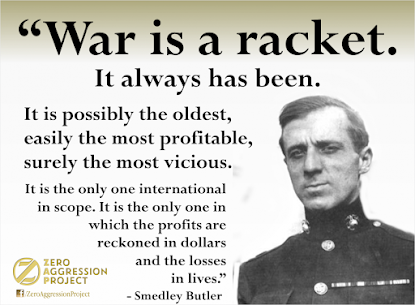
4. Smedley Butler is still right, too; war was a racket and still is.

No matter the outcome in Ukraine, everyone involved is likely to be the worse for it. Obviously the dead, but those wounded, or homeless, the refugees, the prisoners, those impoverished by war or sanctions or economic collapse. Those who have lost family, friends. The citizens of Russia's "near abroad", who must now fear that success in Ukraine will make them next in line for death and mayhem.

Of course, the Russian leadership is likely to be insulated from all that. War "leaders"  -unless they make the mistake of losing war and being captured by the victors - are seldom punished, no more than the "leaders" here that committed the identical war crime of waging aggressive war in 2003 were punished. 

It's always the "ordinary" people who suffer when the Great and the Good amongst us choose to use force to get - or try and get - what they want.

So, like most rackets, it's the bosses that profit and the footsoldiers - military and civilian - that die.

I wish I had a happier conclusion.

But, just like Ukraine today, there is no lightness; only ruin and hatred, the strong doing what they can and the weak, well, suffering.

Sunday, February 20, 2022

The lights are going out...

 It appears that it's extremely likely that there will be war in Eastern Europe for the first time since 1944. While there is obviously no "legal" grounds for Russia's decision, it appears that the Russian leadership has decided that the strong do what they can and the weak suffer what they must. It seems clear that Moscow has decided that to use the mere threat of force to win political gain will not achieve their political aims.

How - or if - the rest of Europe, and the world, responds will have a great deal to do with the way this plays out

Consider this an open thread to discuss.

Update 2/21: Fred Kaplan has some ideas about why the attack didn't happen Sunday.

Interesting political note; in case you're wondering why the response from the U.S. Right seems so peculiar, consider that while Putin polls at about 75% negative amongst self-identified Republicans, Biden polls at minus-90%.

Hmmm.

Update 2/21pm: Max Seddon (Financial Times Moscow bureau chief) live-tweeting Putin's speech:

Not promising. Worth a scan of the whole thing; sounds like Putin is taking his "I alone can fix Russia by making it the old USSR again!" for a long walk.

Update 2/21 p.m.: I'm reading that Russian maneuver forces are moving into the two eastern oblasts, and particularly towards the city of Donetsk. This is consistent with Putin's speech identifying the eastern regions as part of Russia. Presumably these will complete the takeover of the entire Donetsk and Luhansk oblasts from the Ukraine government.

The real crux of the biscuit will be if the forces along the southern border of Belarus strike towards Kyiv. The distance between the border and the Ukraine capital is relatively short, and the lure for Putin and the Russian Army leadership of a "decapitation strike" must be very strong...


Update 2/24: It now appears that Putin's goal is full-on subjugation of Ukraine. 

I'm not sure if this will involve prolonged Russian occupation; if Putin doesn't, I'll bet his military chiefs remember both the Chechen and Afghan nightmares as well as the post-WW2 Ukrainian resistance. But the actual conquest is pretty much guaranteed; the relative strengths of the two militaries all but ensures that T-90s will be parked in the Maidan fairly soon.

My guess is that after a brief occupation and ratissage of Ukrainian nationalists the Russians will leave behind a Quisling government including a mini-KGB/FSB and antipartisan militia to hunt the resistance. I could see this working at least well-enough to get by in the eastern regions.

How well this will work in Ruthenia is anyone's guess. But "not so well" would be mine.

Now...my further, and more worried, question is whether the success of this move will embolden Putin to go after his other lust-objects, the pieces of the former USSR. 

The Baltics? Georgia? One of the lessons of the fascist 1930s is that once a fascist dictator is on a roll he's often unwilling or unable to stop himself. 

For a long time I thought that Putin was too canny to go full-on Hitler.

Now? I'm not convinced he has. 

But I'm not so sure he hasn't, either.

And...it's worth noting that if there are any "good options" here I don't see them. 

Sanctions on Russia? Ask the Cuban government how well that works. Military action? Against a nuclear power run by what increasingly appears to be an aggressive dictator who DGAF? 

The brutal reality that young Mr. Putin is reminding us is that in international relations the strong CAN do what they please and the weak WILL suffer what they must.

I don't have to like that and neither do you.

But that changes this atrocity not a whit.

Update 2/25: Juan Cole observes that Dick n' Dubya's Excellent Iraqi Adventure "enabled" the Russian invasion of Ukraine. Over here our reliable commentor Sven makes pretty much the same point.

I have a fair amount of respect for Cole's opinions on the Middle East, and Sven's opinions overall, but I think they overstate the case.

Reassembling the old Soviet Union has been an obsession of Putin's for as long as I've known about Putin. I can't believe that some sort of move to re-absorb Ukraine wasn't on his bucket list for a loooong time; the recent Ukrainian move to try and become more closely integrated with its western neighbors rather than Russia probably moved it up the list as well as making armed force more plausible.

(and, while we're on the subject, who the hell would WANT to be a "Russian" given the current conditions in Russia? Life as an American wage-slave sucks pretty big ass. Throw in open kleptocracy for the discreet American version along with shittier living conditions? Ugh. Our return-to-the-Gilded-Age economy may make life pretty grinding for the 99%, but I can't see voluntarily wanting to swap that for life in the post-Soviet Russia. There's frying pans and there's fires.)

Anyway, I agree with Cole that American foreign policy makes it harder for the U.S. to oppose other's military fucktardry. I agree with Sven that the U.S. and the West has done badly, both in general and in Eastern Europe.

But I disagree that Putin needed any help to decide to kill Ukrainians, or that anyone else deserves to go directly to Hell for that decision.

The U.S. was wrong in Iraq, just as it's been wrong all over the world in places like Nicaragua and Vietnam. Iraq is and was a war crime, making aggressive war, the crime for which the victorious Allies hung Nazi leaders. Dick and Dubya should be in jail, not enjoying a comfy elder statesmen's retirement.

But that simply makes Putin just as guilty. 

They all should be sharing a cell in SuperMax, and We the People of the United States should be ashamed for letting them do otherwise.

To those Russians who are trying to stop Putin...I have no words, and doubt I have that kind of bravery. I wish I thought you could succeed. I hate what I know will happen to you

And I'm just sorry, sorry for this sorry world that has so much wrong in it.

Update 2/26: The fighting continues in Ukraine, with the Russian forces doing surprisingly poorly (relative to the preponderance of weight-of-metal on the Russian side...). I still doubt the outcome is in play - poor or not, quantity has a quality all it's own (just hard on the people in the "quantity"...).

My opinion remains unchanged. As much as the U.S. has been a bad actor globally that doesn't excuse this. In the last words of the guys on Snake Island, "Russian warship, go fuck yourself."

Krugman has a column that makes a good point, though; for all that fingers are pointing at Putin and Russia right now, there's a mote/beam problem related to our own plutocratic/kleptocratic economies and the malefactors of great wealth therein that emphasizes the degree to which We the People have casually let the very sort of corruption endemic in Putin's Russia become less blatant but almost as endemic all over the West. 

That makes even economic war problematic.

"There are two uncomfortable facts here. First, a number of influential people, both in business and in politics, are deeply financially enmeshed with Russian kleptocrats. This is especially true in Britain. Second, it will be hard to go after laundered Russian money without making life harder for all money launderers, wherever they come from — and while Russian plutocrats may be the world champions in that sport, they’re hardly unique: Ultrawealthy people all over the world have money hidden in offshore accounts.

What this means is that taking effective action against Putin’s greatest vulnerability will require facing up to and overcoming the West’s own corruption.

Can the democratic world rise to this challenge? We’ll find out over the next few months."

Remember the "Panama Papers"? The revelation of the vast coterie of Western vulture capitalists that were thieving and cheating right alongside the cartoon Latin caudillos, African "strongmen", and Russian oligarchs? Remember how many of them we prosecuted, convicted, mulcted of their stolen lucre, and sent to the Crossbar Hotel?

Yeah, me neither.

I'm not saying "Oh, we're just as bad as Russia, so we can't point fingers."  Sure we can - we just need to be willing to point fingers at our own when they go wrong. We haven't done that. The fact that people like Dubya and Paul Wolfowitz and Dick Cheney and a gajillion Wall Street thieves and, yes, Trump are still walking around free is living testimony to the degree we've failed.

Putin is still a sonofabitch.

We really need to use this occasion of naked kleptocratic criminality, though, to think hard about how much rope we want to give our own oligarchs.

Monday, November 11, 2019

The Guns Below

I had an incandescent rant all ready to go for today.

I wrote it out. I looked at it, and I just couldn't find the heart to publish it.

What's the point?

You all know as well as I do what I was going to say. War is a racket. We - me, everyone I served with, the people serving now, the veterans of tomorrow and next week and next year - are just the bailiff's men, serving our country's liens in places and on people all over the world. No, we don't do sweet fuck all to "defend your freedoms". We kill people and break shit that our "leaders" have designated as inimical to our national interests. This year we're the button men and women for Donnie "Five-Deferment" Trump and his crew of racketeers - just as we have been for every President and every Congress since about 1945. Maybe 1953, if you want to be nice about it.

Now there's some honor and decency serving as an imperial legionary. Not all empires are Evil.

But to pretend that we're still the Arsenal of Democracy of Remember Pearl Harbor? To tell ourselves that the people who wore the uniforms in the 1980's and 1990's and Oughts and now the Teens are somehow like the Greatest Generation that saw off Hitler and Tojo?

That's just foolish, the self-deluding mumbling of an idiot child afraid of the dark and needing the comfort of a kindly lie.

I won't pretend that I didn't enjoy my Army days. I won't pretend that I'm not proud that I was a good soldier and then a good sergeant. When my days are done I'll gladly slope off for a pint in Hell with my old pals from Division, from my Reserve and Guard outfits, and maybe if we're lucky with the hard boys of the Legio X Fretensis, and the 3rd Company of the 1st Battalion of the Légion étrangère. Here's to us. Who's like us. Damn few, and they're all dead.

I know who I am, and what I did. I'm not ashamed of it, but I'm not vauntingly proud, either. I didn't hold Bastogne or Guadalcanal. I did the dirty work of geopolitics and I'm okay with that. I served with good people, had a laugh, and came home sound, and no legionary can ask more than that.

No, it is you and I, my friends, my fellow Americans, my fellow citizens and civilians, who need to look into our hearts and souls and ask why we have been happy - or, at least, not incandescently furious - to be lied to, gleeful to parrot - or willing to let it pass without clamor - the nonsense hurled at us about "freedom" and "fighting them there", eager to pretend - or willing to let others pretend - that we have not sent, or been willing to let others send in our name, young men and women into harm's way for nothing more than a handful of dollars, or a passing bit of geopolitics, or some fancy of "national honor", or some fantasy about dangerous enemies, where there is nothing but ruin and impotent anger that our own nation has grown from the seeds of our own ignorant hate and fear while pretending to be the victims ourselves.

I just don't have the heart to rant about this. I am just tired, and a little grieved, for the foolish waste of it all.

On this day I offer only the cold comfort that our nation's ideals promise that We the People can choose to honor our veterans by choosing not to make more of them unless it's for a truly fucking good reason.


For those of you who have come here seeking grave words hymning this day, weighted with honor and glory of the service I and mine have done and do, I have none.

Thursday, June 13, 2019

What's Arabic for "C. Turner Joy"?

Here's the problem.
It may very well be possible that Iranian assets are striking oil tankers in the Gulf of Oman.

It is definitely likely that the Trump Administration would lie about whether that is possible or probable, or both, or neither.

That's the drawback of letting your system foist an incorrigible liar and a coterie of New Gilded Age grifters into the highest executive offices; you then don't know whether you can trust them not to lie you into a shooting war.

If the administrations of Kennedy and Johnson - that were staffed with genuinely intelligent and experienced foreign policy players - lied us into Vietnam, and the Lesser Bush administration - that was crock-full of wingnuts, imperial fantasists, outright kooks, as well as the Stupidest Man on the Face of the Earth - lied us into Iraq, I sure as hell don't trust THESE gomers not to lie us into some sort of idiotic whack-a-Persian blood hunt based on some sort of moron idea that it'd take normal humans smoking a full ounce of prime weed then drinking two cans of sterno and a half-rack of Old English 800 to come up with.

I sure as hell hope the rest of my countrymen aren't stupid enough to let the Trumpkins play this game.

And goddamn if it's not time to repeal that #@!%$!#! AUMF.

Update 6/14: The lies have already begun:
"The Japanese owner of the Kokuka Courageous, one of two oil tankers targeted near the Strait of Hormuz, said Friday that sailors on board saw "flying objects" just before it was hit, suggesting the vessel wasn't damaged by mines. That account contradicts what the U.S. military said as it released a video Friday it said shows Iranian forces removing an unexploded limpet mine from one of the two ships that were hit. Company president Yutaka Katada said Friday he believes the flying objects seen by the sailors could have been bullets. He denied any possibility of mines or torpedoes because the damage was above the ship's waterline. He called reports of a mine attack "false."
As Sven points out in the comments, The U.S. hasn't been an honest player in the field of foreign policy for a long time, and this administration is a more prolific and consistent liar than most of the previous ones.

IMO this is a patently crude attempt between the Trumpkins and their Saudi pals to gin up a casus belli. If the US public and Congress falls for it, well, as a well-known foreign policy expert once said: "Fool me once, shame on you. Fool me twice...won't get fooled again!"

And Jim Wright, as he often does, is asking the question that EVERY news agency should be asking: "Cui bono?".

Who would benefit from a US-Iran dustup? Especially one that would, as it inevitably would, raise the price of petroleum?

Hmmm.

Update 6/26:

"Strategy? I don't need no steenkin' strategy? I have guns! I take YOUR strategy!"

What a fucking maroon.

Tuesday, May 28, 2019

Down Among the Dead Men

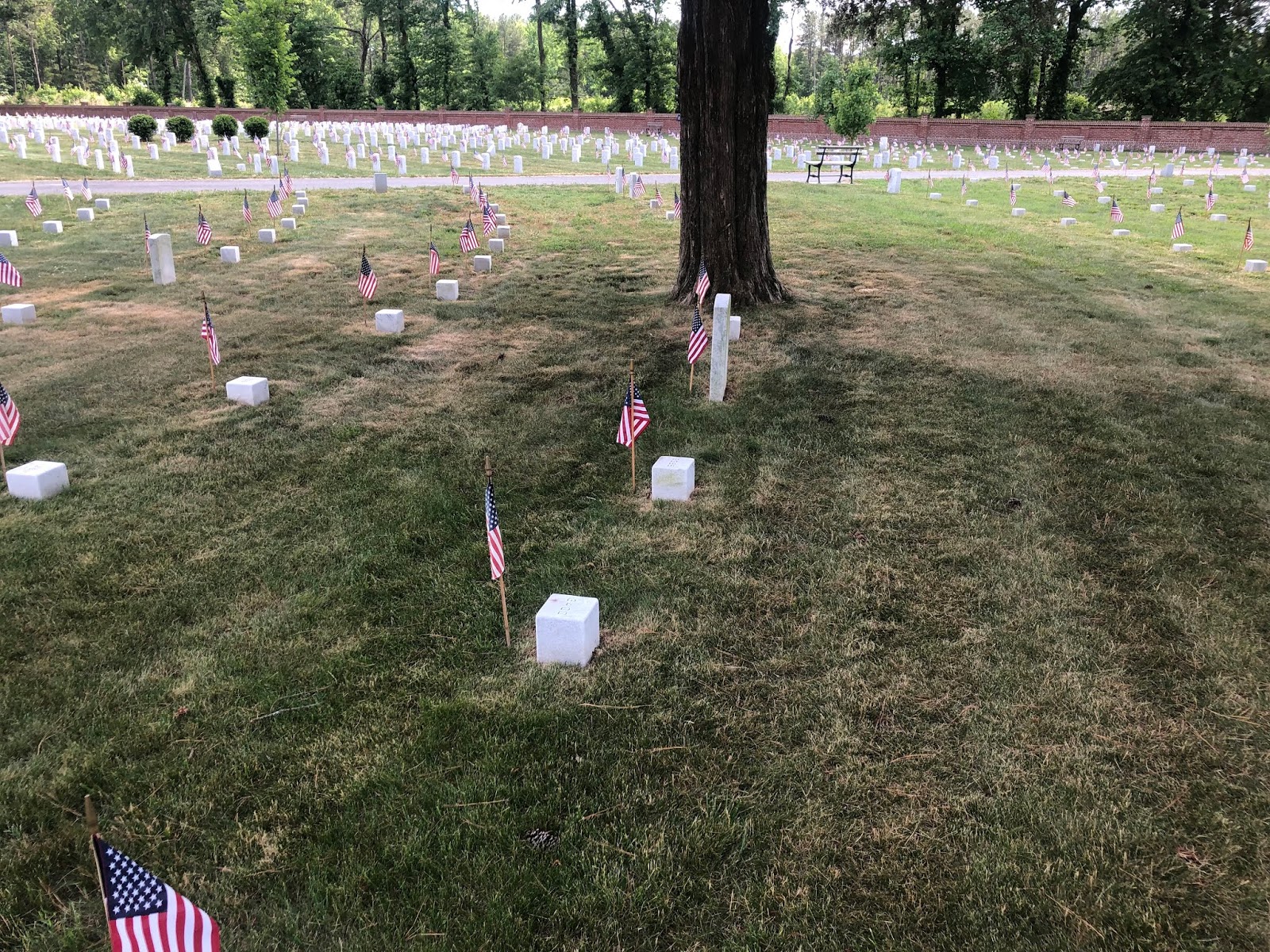
So on Memorial Day I ended up in the old Civil War cemetery at Poplar Grove.
It's peaceful and pretty and very manicured, very much in the tradition of the more modern military cemeteries, a sort of pocket-Arlington.

Until you look at the rows of stones, and realize that way more than half of them aren't "headstones" at all but simply stone blocks with a number carved on them.
These were the remnants of soldiers that lacked any sort of identity; nothing marked their original grave - or, it it had, was gone by the time the graves registration parties reached it - and nothing was left, if there had been anything, of a tag or scrap of paper with a name on it.

There was just some bone, and scraps of cloth, and probably some less savory remnants, to be gathered up and put back in a hole with a stone with a number on it for the following hundred-plus years. An empty chair at a table, an empty peg on a wall where no coat was hung, an empty house to which the scraps of bone and cloth never returned.
Perhaps even more grim were the separate files where the men of the U.S. Colored Troops were buried, still put apart from the white soldiers, still separate and unequal in death as in life.
All in all a very unsettling sort of day, one that raised more spectres than laid them.

Monday, May 27, 2019

Forgiveness of the Dead

On this day, 64 years ago, Americans gathered at the cemetery at Nettuno, near what had been the terrible charnel-house beachhead of Anzio, to dedicate what would become the Sicily-Rome American Cemetery and to "honor" those killed in the war that had just ended.
You know how I loathe all the flag-waving, pontificating, self-justifying “memorial” dog-and-pony shows that serve only to make the living feel better about themselves and their willingness – or, worse, eagerness – to cheer on others to die for their country if it wasn’t for those dang bone spurs.

The closest to fitting "memorial day" act I’ve ever read of was LTG Truscott’s address that day.

Truscott had commanded the VI Corps at Anzio, and a lot of the dead guys there were from his outfits. And he was a hard man, known to be kind of salty, and was probably more sick of hearing the pious patriotic platitudes than I am.

So when the opening caprioling was done he looked out over the rows of “dignitaries” and reporters and guests, turned, and faced the rows of silent markers behind the rostrum.

Nobody knows exactly what he said – probably because there was either no plan to record his words or because he couldn’t be heard – but based on Bill Mauldin's account the gist was that Truscott didn’t see how there was anything particularly good or heroic about getting killed in your teens or 20s or 30s, and that while generals and politicians would tell you that all your dying was noble and sacrificial that most generals, anyway, kinda suspected that was pretty much bullshit.

He agreed that lots of them had died because somebody, maybe he, had fucked up and if that had happened he was grievously sorry and apologized to them. That he knew that was a big ask, but that he owed it to them to ask their forgiveness anyway.

And that he promised that if, in the coming years, he ever ran into anyone tubthumping a line of guff about the glory of war and heroic death that he, Truscott, would tighten the joker's shot group damn quick smart.

So as far as I’m concerned it'd be great if every damn politician and talking head can stay the hell away and leave those haunted graves to the grass, and the sky, and the dead, and those who knew and loved and lost them.
They won't, because that's not how we do "Memorial Day". But I wish they would.

But I will be in that cemetery today, sharing a drink with my Army brothers. I hope you will, too.

And, as always today, this.

Monday, December 12, 2016

Adios, Fidel!

In memory of the old caudillo, this month's "battles" post at GFT is the twin engagements of Yaguajay and Santa Clara, December 1958; the end of the Batista Era and the final military acts of the Cuban Revolution.

Bearded revolutionaries, rum and coke, sugarcane, makeshift tanks and mountains and sinister secret policemen...
"In his triumphant entry to Havana on 8 JAN, Fidel spoke to the nation. "We can not become dictators." he said "We shall never need to use force because we have the people, and because the people shall judge, and because the day the people want, I shall leave."

One of the many "war criminals" given a show trial and executed was COL Rojas, the badass copper of the Santa Clara police station. He insisted on giving the final words of command to his firing squad in the tradition of firing-squad-heroics everywhere. Here he is, poor sod, his hat flying off as the bullets rip into him.

The good colonel wouldn't be the last man to die "for the revolution" and, as we now know, Fidel left, feet-first, just this autumn, long after I suspect the Cuban people would have been pleased to see the back of him.

For all the good that he may have done - and he DID do good, in his autocratic manner - Caastro's legacy is in the main part no less dictatorial and no less unjust than the man he replaced this month fifty-eight years ago.

Supposedly COL Rojas is said to have given his killers a warning of this, on that day he faced the line of rifles, that sounds in retrospect, frighteningly prescient.

The last words he said - before giving the command to fire - were: "Muchachos, ahora tienes tu revolución. No la pierda."

"Boys, now you have your revolution. Don't lose it."

Tuesday, March 22, 2016

Strategic Bombing


For the record; Brussels is the EU capital, and the EU is and has been deeply involved in fighting in North Africa and the Middle East. The Belgian "air component" (the air arm of the Belgian armed forces) has been bombing the Islamic State in Iraq and Syria. Obviously, none of that "justifies" blowing up women and kids in train stations and airports.

But at the same time let's be adults; if you're part of fighting a "war on terror" you shouldn't be surprised when terror fights you back.

I thought we learned that sixty-odd years ago. The people who died under the bombers in London and Berlin and Tokyo were "innocent civilians", too, and they died in their job lots for their leaders' policies. For American politicians to act outraged about this is an insult to We the People's intelligence. This is war, the war our politicians have argued for and supported for years now. This is as expected and expectable thing in a war as the sun rising.

Innocents die in war. If you don't like that, your only real option is not to fight one.

Wednesday, June 3, 2015

That's All Folks


 The blundering history of the human race
is always given coherence by power elites
and their courtiers in the press and academia
who endow it with a meaning and coherence it lacks.
They need to manufacture national myths
to hide the greed, violence and stupidity
that characterize the march of most human societies. 
--Our Mania for Hope is a Curse
 Chris Hedges 

I shouted out,
"Who killed the Kennedy's?"
When after all
It was you and me 
--Sympathy for the Devil,
 The Rolling Stones 

The people who burned witches at the stake
never for one moment thought of their act as violence;
rather they thought of it as an act
of divinely mandated righteousness.
The same can be said of most of the violence 
humans have ever committed 
--Violence Unveiled, Gil Bailie 
 _____________________

For the Ralph Peter's crowd, the Phony War on Terror (PWOT ©) is a legitimate given, not to be questioned or deconstructed. As he said with the manly swagger of the armchair FOX warrior in a recent NY Post piece, "Sorry folks, but that's war (it's not dainty)." His view complements that of people like Mr. Rumsfeld who saw democracy in the rubble (war smells like democracy in the morning?)

But the United State's actions in Afghanistan and Iraq defy the logic of war. The actions of ISIS in the region make more military and political sense than anything exhibited by U.S. policy to date.

The purpose of war is to achieve a peace. The PWOT © has not in any instance led to peace. Military violence -- whether theirs or ours -- is not war, but simply violence unrestrained, unjustified and lacking an achievable strategic military goal. This violence is merely criminal activity.

The media shovels us the "Good News" when the Iraqi forces (or some semblance of them) "regain territory previously held by ISIS," as though the conflict was about terrain. What it is about is a millennial struggle within Islam for hegemony of the combatants, the different stripes of Islam.

The violence in Iraq and Afghanistan is not about terrain or body counts [though body counts are de rigueur again, thank you Mr. McNamara.] It is about which side is the true and divine representatives of their god here on earth. 

That is pretty simple and, if true, U.S. participation in the rodeo violates our core belief in separation of church and state for as members of Western society we are not supposed to kill for religious reasons. That behavior is so Middle and Dark Ages.

So why is the U.S. funding and conducting military violence to support sectarian violence?

If we fail to confront this basic reality, we are doomed to live our military and political lives as if they were violent video games, which is but a poor simulacrum of real life.

[cross-posted @ RangerAgainstWar.]

Saturday, May 25, 2013

Dies Irae

I post this every Memorial Day. I don't feel quite the same level of suppressed anger this year as I did in the "Support the Troops" Dubya Years when this weekend became a pep-rally for wars that most U.S. citizens were utterly indifferent to other than as entertainment. But, still.

I have little or no hope that I can ever change the way this "holiday" is celebrated. There will be parades and movie festivals. Warplanes will flyover baseball stadiums. Flags will wave. People will "thank" someone in a uniform for service that was neither done for them nor has profited the serviceman or the civilian.

Few, very few, will visit a war cemetery and ponder the reasons we seem incapable of not making more war dead.

But I will continue to post this every year and hope.


It seems to me that the VERY best thing for the majority of Americans would be to think of this Memorial Day not as time reserved for barbeques and softball in the park, but as the time it took a 19-year-old private to bleed out, alone amid the dying crowd in the grass before the wall at Fredricksburg.The time it took a husband and father to convulse his way into death from typhus in the tent hospital outside Santiago de Cuba.

The time that the battalion runner, a former mill hand from Utica, New York, spent in a shell hole in the Argonne staring at the rest of his life drizzling out of his shattered legs.

The time it took for the jolting trip down the Apennines to the CCP, unfelt by the father of three because of the jagged rip in his gut wall that killed him that morning.The time required to freeze a high school kid from Corvallis, Oregon, to the parched, high ground above the Yalu River.

The time it took for the resupply bird to come to FSB Albany for the plastic bag that contained what had been a young man from the Bronx who would never see the Walt Frazier he loved play again.

The time taken up by the last day in the life of a professional officer whose fiance will never understand why she died in a "vehicular accident" in the middle of a street in Taji.I've been proud to be a soldier. But the modern view of war as video entertainment for the masses sickens me. Every single fucking human being needs to have it driven into his or her forehead with a 10-penny nail that every single day in every single war some person dies a stupid, meaningless death that snuffs out a world in a moment. That those empty eyes zipped inside a bag or covered by a bloody blanket were once the windows to an entire universe.

That the price we pay for "forging our national will" is paid in the unlived futures of those we kill and those of us who die to make it so.

Maybe then we'd be sure of what we want, and what we do, before we open the goddamn doors of the Temple of Janus.

Friday, January 4, 2013

Hoarse Whisperer?


A former head of the CIA is said to have believed that U.S. diplomatic signals may have helped kick off the 1982 Falklands War:
"Mr William Casey, the head of the CIA, who was closely concerned in Cabinet discussion on this subject, has implied to us privately that he thinks the Argentinians may well have been led up the wrong path.

'They may have believed that their support for the US in covert operations in Central America was more important to the US than in fact it was, and could be expected to earn them American acquiescence in forward policy elsewhere.'

Sir Nicholas also recalled handing US Secretary of State Alexander Haig a piece of paper detailing British evidence of Argentina's intention to invade on April 2, 1982.

He said: 'Mr Haig's reaction to the information I had given him was electric.'

Sir Nicholas added: 'He wanted us to win and would have been horrified if the Argentinians had got away with it."
Hardly solid evidence, but intriguing nontheless. Particularly when you think of this in the context of the supposed July 1990 meeting between Ambassador Glaspie and Saddam Hussein which may (or may not, or might have have been even more complex effect) have had the result of greenlighting the Kuwait coup in the mind of the Butcher of Baghdad.

Or the recent tragicomedy in Libya. Or all the other examples of international encounters - back to the war of Jenkin's Ear, it seems - where one side, or the other, or both, said one thing and the other, or the one, or both, heard something very different from the intention of the speaker.

Let me say that I'm not sure whether to put a tremendous amount of credence in this report itself; it appears to be the opinion of one man, albeit one that was a very experienced observer of the foreign policies of his time. And the internal politics of the Argentina of 1982 make it fairly clear that the junta was already deeply committed to the idea of using force to claim the "Malvinas".

But what this odd historical footnote does seem to point out is that for all that we often like to think of "foreign policy", "geopolitics", and "strategy", as sciences, as matters that people and nations can make into tools to use for their interests and both study and train on to improve they are often laden with what another U.S. recent foreign policy thinker used to call "unknown unknowns"; complexities and unintended consequences that even the sharpest wit and the most diligent student cannot anticipate.

Wednesday, October 31, 2012

Battles Long Ago: Dargai Heights 1897

Dargai Heights Date: 20 OCT 1897
Forces Engaged: British Imperial
Five battalions of infantry: one, the 2nd Bn The Derbyshire Regiment of 1st Brigade, First Division, one, the 3rd Regiment Sikh Infantry (Punjab Field Force) of 2nd Brigade, First Division, and three; 1st Bn The Dorsetshire Regiment, 1st Bn, 2nd Gurkha Rifle Regiment, and 1st Bn Gordon Highlanders from 3rd Brigade, Second Division.

Each battalion probably at or near full strength of ten companies of 70 for a total of roughly 3,500 infantrymen.
Four batteries of mountain howitzers (No. 8 and No. 9 Mountain Battery, Royal Artillery, No. 1 (Kohat) Mountain Battery and No. 5 (Bombay) Mountain Battery) firing RML 2.5" Mountain Guns (often referred to by the British troops as "Screw Guns") I have had a difficult time establishing the MTO&E for these units. A typical battery appears to have six cannon, and each cannon appears to have had a crew of between six and eight; note the photograph below:
But the battery itself must have had at least another half-dozen or so troopers acting as ammunition numbers, extra crewmen, odds-and-sods, as well as at least a battery sergeant-major and an officer. So probably about 50-70 redlegs per battery for a force of 24 cannons and 200-250 artillerymen,

At least one source reports the presence of a machinegun detachment but does not identify the unit as such. By 1897 British (that is, Imperial) infantry battalions carried an MG detachment of 2 x 0.45 calibre Maxim machinegun and 20 troops on strength. However, in the order of battle for the Tirah Expedition among the Divisional Troops for Second Division is list a "Maxim Detachment, 16th Lancers", so this may have been the machinegun unit present at Dargai.

So roughly 3,500 infantry, 250 artillerymen, 24 cannon and two machineguns. The commander on the scene was MG A. G. Yeatman-Biggs, Second Division commander; the entire Tirah Expedition force was commanded by MG Sir William Lockhart, GCB KCSI, and isn't he a wonderful picture of late Victorian generality;
Orakzai (اورکزی‎) and Afridi (اپريدي) Tribal Forces
An undetermined number of Afghan tribal warriors drawn from the two tribes then fighting the British Indian forces. The most likely composition of the defending forces, however, was from one or more of the Orakzai clans, since that tribe then controlled the high ground in the Tirah area. Several sources mention Afridis, and Afghans being Afghans it's hard to believe that with killing in the offing that the eager young men of the tribe could have been held back.

The numbers of defenders are usually simply described as "hundreds" to "thousands". The British attackers, who ended up in control of the Heights, probably had no real idea how many Afghans they were fighting; the tribesmen, no fools they, ran off when it became obvious that the mad invaders weren't going to stop coming on.

But there must have been at least several hundred; anything less than that wouldn't have been able to produce a sufficient volume of fire to have had the effects as described on the attackers.

While as many as 10-12,000 fighters manned the crest of the heights altogether the area of the British assault appears to be a fairly small area - indeed, a single narrow path; more an a couple of thousand guys would have been tumbling out of their sangars like ripe fruit off a plum tree; the British wouldn't have been able to leave their start line without being riddled like Swiss cheese.

So the force actively defending the path up the heights on 20 OCT probably numbered somewhere between 1,000 and 2,500. We have no idea who the "commanders" were; in typical tribal fashion the guys probably coalesced in lashkars around a local hardcase, a religious leader, or a cunning planner in little knots of five to fifty.
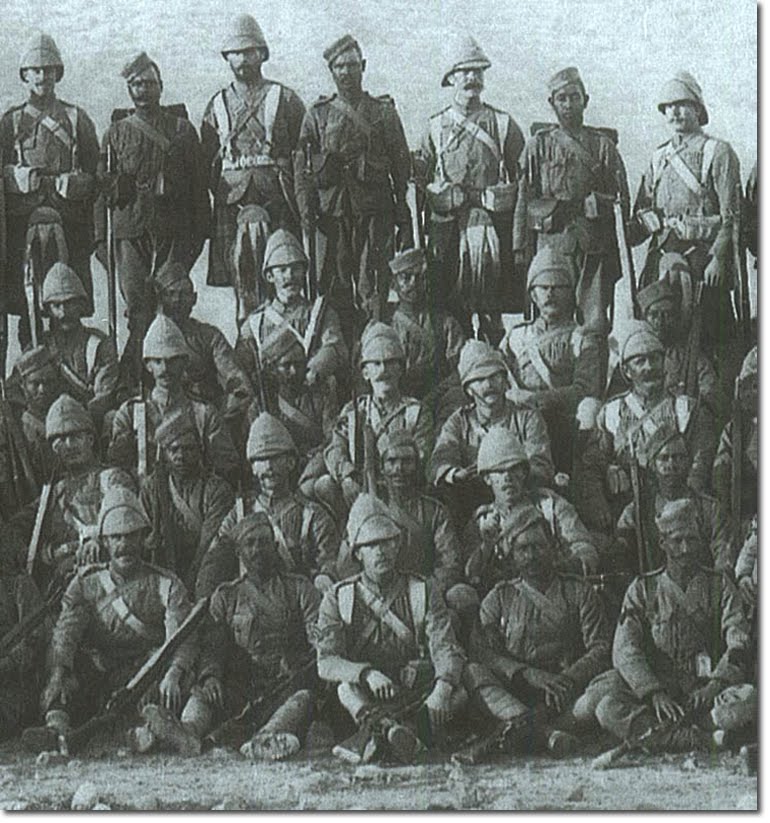
A Note On Armaments: At Dargai the British and Indian troopers were armed with issue rifles; the British with the relatively new .303 Lee-Metford bolt action rifle (shown above), the Indian troops with the older Martini-Henry lever-action breechloader.
Many of the Afghans must have been armed with the traditional jezail, the long rifled musket of the high hills around the Durand Line. But one of the nastiest shocks of Dargai, and the Tirah campaign as a whole, was the presence on the battlefield of modern rifles in Afghan hands.

The combination of the Afghan hillman and the modern rifle was a deadly natural. The British found that wog-bashing in 1897 wasn't nearly as much fun as it had been earlier now that the bashees had their hands on modern weaponry.

After the Tirah Expedition concluded the surprise and displeasure at the lack of fun to be had in the Kurrum Valley is evident in the plaintive tone of Queen Victoria's letter to her Viceroy of India: "As we did not wish to retain any part of the country, is the continuation and indefinite prolongation of these punitive expeditions really justifiable at the cost of many valuable lives?"

Sadly, this simple lesson had to be relearned over and over again.

The Sources: Military actions taken by literate industrial nations tend to be well documented, and Dargai is no exception. Written accounts of the actions of the Tirah Expedition and its Afghan opponents appeared almost before the rigor passed off the dead guys; one of the most complete is found here: The Campaign In Tirah 1897-1898 An Account Of The Expedition Against The Orakzais And Afridis Under General Sir William Lockhart, G.C.B., K.C.S.I. based (by permission) on letters contributed to "The Times", written by one COL H. D. Hutchinson in 1898.

Other contemporary British sources include The Indian frontier war being an account of the Mohmund and Tirah expeditions, 1897 (James, L. 1898) and Lockhart's Advance Through Tirah (Shadwell, L.J. 1898)

Secondary accounts include The 1897 Revolt and Tirah Valley Operations from the Pashtun Perspective (Johnson R.A. 2009), an invaluable view from the "other side of the hill", unusual in colonial war, and Michael Barthorp's 1996 The Frontier Ablaze: The North-West Frontier Rising, 1897-98.

Byron Farwell's 1985 Queen Victoria's Little Wars tells the old savage-and-soldier tales with gusto, while perhaps the most entertaining version of the engagement is told in George McDonald Fraser's little story "The Whisky and the Music" told in The General Danced At Dawn, his volume of tales about his times in the Gordons.

More of that later. First, the fighting.

The Campaign: I can't really do a better job of explaining why 60-some thousand British and Indian troops set off into the highlands around the Khyber Pass in the autumn of 1897 that Rob Johnson can, so, here:
"The largest and most serious outbreak of fighting on the North West Frontier during the colonial era was the Pathan Uprising of 1897-8. The revolt was actually a series of local insurrections involving over 200,000 fighters, including Afghan volunteers, and it required over 59,000 regular troops and 4,000 Imperial Service Troops to deal with it; the largest deployment in India since the Mutiny-Rebellion of 1857-8. Its outbreak proved such an unexpected and significant shock to the British that they conducted detailed enquiries after the event.
Various explanations were offered but it is generally accepted that recent encroachments into tribal territory, with fears that the British meant to permanently occupy the region as a prelude to the destruction of their independence and way of life, led to the initial fighting. There were other contributory factors: a perception that the Amir of Afghanistan, Abdur Rahman Khan, would support an anti-British Jihad; rumours that the Christian Greeks had been defeated by the Muslim Turks and that the Christian world was finally in retreat, and local anxieties about women, money-lenders and road-building."
But the money was always on the British and the Afghans to fight. They both loved to fight, and they both wanted the other to get the fuck out of their crib. I used Farwell's book to dredge up a list of Afghan Wars for this post over at MilPub back in March of last year. Turns out that there was about one "expedition" or "column" or "punitive action" or "field force" every year or so beginning in the 1830s and running well into the 20th Century; the Third Afghan War was fought in 1919!

So while this was a big one, it was not a new one, or even a really surprising one other than it's size.

The actual fighting of the 1897 "rising" began on 10 JUN, with an ambush of a smal force near Maizar. During this engagement something occurred of the sort of ridiculous criticality that distinguished truth from fiction; fiction would never be this incredible. I'll let Johnson (2009) describe it again:
"The British artillery soon ran out of ammunition in the engagement and was forced to use blank rounds in the hope that this would deter a pursuit. Ironically, this fulfilled a prediction by the more enthusiastic mullahs: they had assured the tribesmen that the British shells would turn to stone and their bullets would turn to water the moment they hit the breast of a true believer. They demanded a Jihad to save the religion and condemned those they appeared to be profiting by association with infidels."

The rising exploded, and in August all the forts along the Khyber Pass fell, lending immense prestige, as well as lots of modern weapons and ammunition, to the Afridi tribesmen who pulled off that raid. Many of the Orakzai and Afridi clans rushed to join up, either with view of a full-scale victory over the infidels or just hopes of a bit of plunder on the side.
But it's important to see that the tribes weren't just mooks looking for loot. There was an actual plan. The Afridis wanted to push the Brits out of the Khyber Pass and Tirah Valley region, while the Orakzais wanted to drive the British off the Samana Ridge that was the key to their territory.
The Khyber plan worked, but the attacks on Samana weren't as successful. One fort, at Sarigari, did fall, but British reinforcements and, as or more importantly, their artillery held the Samana.

The tribes also hoped for support from Kabul, but the Amir Rahman Khan, while offering some rousing anti-British orations to the tribal delegations, did nothing but talk.

His tepid response was designed to prevent looking like a foreign stooge (always dangerous for an Afghan ruler) while finding a pretext for doing nothing. Eventually he "...admonished the tribesmen and ordered them to settle their differences with the British, claiming he had made agreements he could not break...(and that) the tribes had not informed him of their intentions
before the outbreak of violence."
(Johnson, 2009)

Although the Amir refused active support he did not prevent the tribes from using eastern Afghanistan to maneuver in and retreat to.

While the Afghan troopers knew the Brits would come at them - they always had before - the real question was how. The Khyber Pass was a high-prestige target and would undoubtedly be attacked, but how would the British approach the home territories of the tribes in arms?

They could attack due west from Kohat along the Khanki Valley.

Or they could strike north up the Mastura River from Peshawar.

But there was another problem; the late summer was upon them, and men had to go home to bring in the harvest. Crops wouldn't wait for the damn Brits. Many of the Afghans left...and for two months the British didn't come.
What the Afghans couldn't know is that the British WERE on their way but were having the devil's own time with logistics. To carry the bag and baggage the British concluded they'd need a baggage animal for every six white troops, every eight native troopers, and every ten camp-followers; something like 20,000 horses and mules and 15,000 camels. Shadwell (1898) has some delightful details on the allocation of pack animals to the force on pages 113 and 114; general officers got a pack mule and a pony, in case you were wondering.

But finally the first Indian pioneers - what we'd call combat engineers - turned up near the Shinwari fort south of the Samana Ridge in October gave the game away; the British were coming, horse, foot and artillery.
At this the tribes convened a jirga in the cillage of Bagh where the leading lights roared for war and jihad against the infidel. That didn't stop a mob from the Orakzai out of Kanki Valley to try and surrender to MG Yeatman Biggs. The general told them that he couldn't take their submission while their buddies were still out looting and raping, so (presumably with heavy hearts) that went back to join the revolt.

The road up from Samana Ridge was overlooked by high ground to the north; the Dargai Heights.

Johnson (2009) quotes "one British officer" (in this case, Callwell 1911) saying that "the natural defile at Dargai not only made a defensive stance far easier, it also afforded ‘excellent cover, naturally provided by the rocks and improved by walls, etc, built up by [the tribesmen]’. Shadwell (1898) gives an even more vivid description:
"The village of Dargai lies on the northern side of a small plateau. The eastern edge of this table-land breaks off, at first, in an almost abrupt cliff...but...lower down...shelves away less precipitously. This slope is thrown out from the bottom of the cliff in the form of a narrow and razor-like spur, with the path or track lying along its northern side, well within...range of the cliff-head."
The picture from Shadwell's book is shown below.
He describes the photo above, noting that "The narrow ridge at the right-hand bottom corner is the saddle over which the rush had to be made on the 18th and 20th..."

Connecting the crest of the spur...and the foot of the cliff there is a narrow neck or saddle one hundred yards long by thirty broad...devoid of all cover and completely exposed to the heights above, this ridge had to be crossed to reach the path ascending to the summit..."
On 18 OCT a force from the Second Division assaulted the heights; the movements of the British troops are in blue on the map above.

The 4th Brigade attacked from the village of Chagru Kotal while the 3rd Brigade swung around to the west. Afghan resistance was light, and the attackers easily took the crest of the ridge, the Afghan defenders falling back before them.

At this time GEN Lockhart made what has to be considered a mistake; he withdrew the force from the heights. In his tame reporter's letter to the London Times he says that the force was too isolated and unsupportable as well as difficult to supply.

All of that may have been true. We have no idea what would have happened if the British had tried to hold the heights.

But the problems that would come of the decision to withdraw were immediate and should have been evident before the last soldier came down off the hills.

The firing of the day's engagement had drawn a crowd; Shadwell (1898) says about 8,000 mixed Afridis and Orakzais were arriving from the nearby Khanki Valley as well as the original defenders of Dargai village returning to snipe at the invaders.

On the way downhill the British force suffered worse than in the attack from this converging force; finally dark and the artillery halted the Afghan pursuit but the Second Division lost 10 dead and 53 wounded in the operation for no tangible gain.

And, then, worse.

Late the following day (19 OCT) MG Yeatman-Biggs sent his commander a telegram from his position at Shinawari. He reported a "large gathering of tribesmen was visible on the Dargai position, and...proposed moving on Karappa, via Gulistan Fort, instead of down the Chagru defile." (Shadwell, 1898).

This move would have effectively turned the Dargai position, but GEN Lockhart "ordered the original route to be adhered to, remarking that, while it would probably be necessary to clear the enemy off the Dargai heights, they would very likely retire, to prevent their line of retreat from being threatened..." (Shadwell, 1898)

MG Yeatman-Biggs shook out his force to recapture the heights of Dargai.

The Engagement: Note - There are several sources for the attack on 20 OCT but the following account is primarily from Shadwell (1898) supplemented by Johnson (2009) for observations from the Afghan side.

The British attack force was organized in three waves. The first unit to assault was the 1/2 Gurkhas, the second "wave" was the Dorsets, with the Derbyshire Regiment third. The Gordons were originally tasked with supporting fire.
The defense was spread all along the crest and military crest of the Dargai ridge. Shadwell (1898) notes that the defenders didn't make the same mistake as on 18 OCT; the defensive perimeter extended well to the west, where MG Kempster's flanking attack had climbed the cliffs. In the Shadwell account this is supposed to have been due to a cunning ploy by the Second Division intel officer - or "political officer" as they were called at the time - who fed the tribes a false plan, but there is no way to be sure that this was not merely a tactical adjustment to the British attack of the 18th.

Artillery prep began at 1000 hours. The Gurkha attack went forward soon after - Shadwell (1898) is not specific about the time, and the assault appears to have been effectively halted by fire along the saddle or at the base of the steep cliff within a short time of leaving the line of departure.

"Many a brave little Ghoorka bit the dust" is how Shadwell puts it.

Really. No shit. That's what he wrote.
Apparently some time soon after the two British units attempted to reinforce the Gurkha battalion. Both were shot to pieces as they tried to rush the saddle. Most of the British troops were killed in the open space. Neither unit, nor the Gurkha Rifles, could manage to advance up the steep path to the crest.

Johnson (2009) describes it thusly: "As they tried to cross in small groups ‘each clump of men that dashed forward melted away under the converging and accurate fire, and after a time affairs practically came to standstill’. The Gurkhas were pinned down for three hours and 2 other British regiments fared little better."

At some time in the early afternoon - probably about 1500 - BG Kempster was tasked to bring up the division reserves; the Gordons and the 3rd Sikhs. These units were "shot across" the open saddle by an artillery mad minute in which all 24 cannons fired a three-minute rapid fire.

The Gordons and Sikhs managed to make the base of the cliff in a body, probably picking up odd lots of Gurkhas and British soldiers along the way. From there it must have been a mad scramble up the steep path into a nasty rain of rifle fire.
One of the Gordons pipers, a man named Findlater, was shot through both legs at the ankles on the way up. He hauled himself onto a rock and continued playing as his fellow tribesmen attacked. His was the sort of bizarre gallantry that transfixed Victorian audiences; he got a sort of nursery rhyme from the kiddies of Glasgow out of it:

"Piper Findlater, Piper Findlater,
Piped "The Cock 'o the North".
He piped it so loud,
He gathered a crowd,
And won the Victoria Cross."


And so he did, although just to remind us that life isn't like the stories we like to tell about it, he later remarked;
"I am told that the ‘Cock of the North’ was the tune ordered to be played, but I didn’t hear the order, and using my own judgment I thought that the charge would be better led by a quick strathspey, so I struck up ‘The Haughs o’ Cromdale’. The ‘Cock o’ the North’ is more of a march tune and the effort we had to make was a rush and a charge."
Ha! Take that, popular fiction...

The final rush carried the crest, again the Afghan defenders retired in good order, and the 1/2 Gurkhas and Dorsetshire Regiment were posted to hold the crest while the rest of the attack force sloped off back down to the valley below to police up the dead and wounded and reorganize for the move forward.

A total of 37 attacking infantrymen were killed, with the point element suffering the worst; 1/2 Gurkhas lost 18 officers and men. Another 156 British troops were wounded. The Afghan losses were not counted, but the defenders managed to remove all their dead and wounded before the attack force seized its objective. "Many bloodstains were found on the ground..." is all Shadwell (1898) can come up with, remarking that the women and children commonly dragged off both wounded and killed.

Johnson (2009) sums up the Afghan tactical moves and their effects:
"First, and most importantly, the new Pashtun deployments had compelled Lockhart to change his plan to by-pass Dargai. Second, the tribesmen carefully selected (the ground) and channelled them into a specific killing area. Almost all the British casualties occurred in a one small area that could be swept by small arms’ fire. The British had suffered 200 casualties, and, whilst the tribesmen were forced to abandon the Dargai position at the end, they could claim satisfaction at their achievements if not outright victory. The British force had been held up, they had managed to escape with their own forces largely intact and they had carried away most of their own dead and wounded."
I consider it unlikely that the Afghan defenders lost significantly more than the attack force, even with the effects of the artillery fire.

The Tirah Expedition continued on to the northeast the following day.

The Outcome: British tactical victory

The Impact: Minimal. The fiasco at Dargai didn't put a real dent in the Afghan resistance, and the British had other problems to worry about soon. As other military forces in the high hills around the Durand Line have discovered, it is usually the support elements that find it hard to cope with the Afghan and his mountains.

Constant and deadly harassment of supply and transport columns continued. Some of the more notable of these deadly little assaults included:

9 NOV 1897 Elements of the Northampton Regiment separated from supporting units and ambushed while burning some villages around Saran Sar. 20 killed, 48 wounded.

22 NOV 1897 One company Dorsets, one company Sikhs (unit unknown) ambushed while searching for troopers lost in contact. 29 killed, 44 wounded.

19 JAN 1898
36th Sikhs and the King's Own Yorkshire Light Infantry (KOYLI) ambushed while patrolling out of Mamanai. 32 killed, 37 wounded; some of the badly wounded are left behind when the KOYLI retreats and are mutilated.

Now you notice the little item about what happened on 9 NOV?

"Burning villages"?

Yep.

The Brits didn't play that "hearts and minds" bullshit. The way they saw it, counterinsurgency was all about grabbing the insurgents by the balls and twisting those rascals until the rapscallions begged for mercy.

So the primary "job" of the soldiers in the Tirah Expedition, like pretty much every other "column" the British sent into the tribal areas, wasn't fighting tribesmen.

It was burning people's homes and crops. It was throwing stones into their wells to make them useless, it was lifting their cattle, sheep, and goats, it was doing just what the U.S. Army did to the Sioux, and the Cheyenne, the Seminoles, and the Creeks.

It was killing their men, and turning their women and children out in the wilderness to starve.
And it worked; it usually does. Eventually British logistical and numerical strength overwhelmed the tribesmen. In June 1898 negotiation resulted in a payment of 800 rifles and 50,000 rupees from the Afridi. The tribe also committed to dealing only with the Raj, and leaving road- and railway construction unmolested.

A new unit, the Khyber Rifles, was formed to replace the Afridi levies that had guarded the Khyber Pass. The troopers were Afridi but the officers were British, and there would be no more question of who were the Kings of the Khyber.

The British agreed to pay the tribal leaders stipends to keep the agreement, and the peace.

As you probably know, that peace has been most notable by its absence from that day to this.

But in the short term both sides seemed to get what they wanted.

Britain had a brisk little fight that ended in the restoration of British power over the hills around Dargai. The Northwest Frontier was secure for another several years from the threat of Afghan tribesmen working with the Russian Bear. British "honor" had been satisfied, and the truculent tribes "punished" for their fractious behavior. The troops has performed well, even if their leaders had made several critical blunders on the battlefield itself (such as at Dargai) and had, overall, failed to understand and adjust to the new tactical conditions they faced in the Orakzai hills.
The tribes also had reason to be pleased. Johnson (2009) notes that:
"They had inflicted considerable losses on the British and exchanged blow for blow in a manner that would accrue them honour and credit. Individuals who had survived the campaign would have been recognised as having demonstrated courage in defence of their lands, peoples and religion.

The sense that the Pashtuns had actually enjoyed the campaign because it had offered them a chance to enhance their honour was confirmed by a bizarre epilogue to the Tirah Campaign. When General Lockhart set off to leave India in April 1898, a crowd of 500 Afridis including Zaka-Khels mobbed him with cheers and insisted on pulling his carriage to the station. Some vowed to fight alongside the British in the future and promised eternal friendship. To the Pashtuns, this campaign had not been a British victory, but a draw, and, more importantly, honour had been preserved for both sides."
The strange world in which Afghan and Briton alternated between fighting alongside and against each other continued for exactly another fifty years, until Independence in 1947.
The tribes of the high hills then passed into the portfolio of the new government of Pakistan, where they have remained a tumult and a shouting to this very day.

In Dorchester in the county of Dorset the monument to the dead men of Dargai goes largely unvisited and unremarked in the Borough Gardens, the names of the troopers killed on that chilly October day slowly fading from the stone.
The Gordon Highlanders ceased to be in 1994, forced into amalgamation with the other two remaining Highland regiments to form "the Highland Regiment". Currently the 4th Battalion of the Royal Regiment of Scotland preserves what remains of the lineage and battle honors of the old 92nd Regiment of Foot; "Ninety-twa, no' deid yet".
On 8 NOV 2006 a suicide bomber - probably related to one of the Tarkani Pashtuns killed in an aerial attack on Bajaur nine days earlier - killed 42 Pakistani soldiers in the village of Dargai.