Showing posts with label Russia. Show all posts

Sunday, May 5, 2024

Commo check

 It's been so long I'd almost forgotten this place, but what seems deeply ironic is that just as I thought we had nothing more to talk about - the Forever Wars in SW Asia were winding down - the Putin government of Russia decided to re-imagine the last years of WW2 by attacking westwards into the plains of Ukraine.

Whoodathunkit?

Plus the Netanyahu government of Israel decided to respond to a bloody provocation raid by going from apartheid to active ethnic cleansing.

Let's say that I didn't have this stuff on my foreign policy bingo card.

Is there any enthusiasm for discussion of any of this?

Not sure what I myself can add; I don't see anything hopeful coming out of either conflict. Instead it seems increasingly likely that all the parties involved will end up worse off, proving that the destructive nature of modern warfare has gone a long way to reducing its utility as "politics by other means". 

But if there IS any interest feel free to leave a suggestion in the comments.

Saturday, April 16, 2022

Naval makeover! (cruiser-to-submarine)

 The cruiser Москва has passed on.


He is no more. 

(Russian naval vessels are by tradition "he's" rather than the "she's" of English or American sailor tradition) 

He has ceased to be, expired and gone to meet his maker. Bereft of life, he rests in peace, has shuffled off his mortal coil, rung down the curtain and joined the choir invisible.

Okay.

Rule #1 of war is "Shit happens", and the fact that this vessel is now full of water is not in itself either shocking or particularly interesting. 

If one was in a snarky mood one might make the same sort of observation Bismarck might have made about continental powers like Germany or Russia wanting (let alone "needing") large capital ships: "...the fuck?" (only in the original German, of course...). 

If one was in a snarky mood.

To me there are two interesting parts about this, though.

The first is that the Russian official line is that the cruiser was lost "under tow in heavy seas after an internal ammunition explosion". 

Not because nasty enemy missiles turned him into a flaming pyre, no, no! Just your basic head-on-collision-twenty-car pileup of fucked-up munitions handling and/or storage, piss-poor damage control, and incompetent seamanship.

I kind of get the dictator-grade level of "not wanting to admit that your enemy hurt you" propaganda. But to want to make the story "our sailors are lethally incompetent" seems...a bit louche' at best. Tell me...how does that make things in your navy sound...better?

Now, that said; damage control at sea is goddamn hard. It requires constant, repetitive, realistic training led by good petty officers and planned and overseen by competent and demanding officers.

Even the best navies have their bad days; we saw that back in 2015 when we talked about the loss of HIJMS Taiho during the Battle of the Philippine Sea

The 日本海軍 Nippon Kaigun - the Imperial Japanese Navy - was one of the best-led (at the tactical level, at least...) and best-trained in the world in 1944. But that didn't prevent the sinking of one of their newest carriers because of poor damage control after a single torpedo strike.

On the other end of the military scale, though? Damage control is one of those massive-training-fail issues that seems to be endemic in "gangster" military organizations. Think Idi Amin's or Saddam's "armies" if you want a model. 

If nothing else this Russo-Ukrainian War has done a pretty good job of throwing a nastily bright light on exactly how fucking brutally bad the Russian armed services are. As bad as the Ugandans or the Iraqis.

Turns out that when your national model is "kleptocracy" your national military is just about as good as you'd expect based on that. 

When your soldiers and sailors are "led" by people - from petty officers and NCOs through general officers to their political masters - whose whole mode of thought is "steal what you can, neglect what you can't, and lie about everything to everyone both above and below you"  and those troops are either not trained for shit (or completely untrained) and their "leaders" are often incompetent, either because the system is designed to ensure the leaders are piss-poor, or unable to demand they aren't, to find that the entire organization those soldiers and sailors are part of ends up being criminally incompetent at the difficult business of war, including the difficult task of naval damage control, should hardly be shocking.

If you choose shitty crooks to "lead" you, you shouldn't be shocked when they "lead" you into shitty crookedness. 

Which leads me back from the shores of Ukraine to the shores of North America.

Because you'd think that this sort of military clusterfuckery would be a cautionary tale for those of us here on the sidelines in the United States about the whole business of being all enthusiastic for dictators because, say, they hate homosexuals and you do, too. That getting your dream of "leaders" hating on liberal soy-boys and darkies and uppity women isn't worth the sort of incompetent "leadership" that ends up getting your sailors killed and their capital ships sunk. 

Even for the most foaming-mouthed-rabid MAGAt groupies of Tubby and his crooked little weasel pals.

But, no.

They won't believe that.

Ever.

And that's a problem, a problem deeper than the bottom of the Black Sea, where the Москва now rests.


Sunday, March 20, 2022

Lessons learned in blood and fire

I've been kicking this around for a while, and wanted to get it down before I wander away from it.

What have we learned from what's been happening in Eastern Europe over the past month or so?

 
1. Thucydides is still correct: the strong do what they can and the weak suffer what they must.

We like to think, we pampered wealthy white Americans, that there is a "justice" that transcends simple brute force. If we're Christian we like to think that there's a "God" (and his kid) who cares about people and sort of wants them to do justly and love mercy.

And then comes something like Ukraine, where the ugly reality is impossible to hide.

So no. There's no arc of history that bends towards justice. If people want justice, they need to defend it, by force at times, with their lives if they must.

That lesson is bolded by the actions of Russia in Ukraine. But it should resonate with us here, since we have steadfastly refused to take action against those who have already attempted once to use force to "do what they can" thinking that they were the strong and we are the weak. If we do not, then we ARE the weak, and they will do with us what they can.

Putin isn't the only leader of authoritarian goons in the northern hemisphere.


2. When someone tells you what they are, believe them.

Vladimir Putin has said one thing consistently since loooong before he was Donald Trump's mancrush; that the devolution of the USSR was the Worst Thing EVAH and that if he could he would get the band back together.

Well, because the successor state to the Soviet Union looked like a shitshow and its' dictator seemed full of shit like many other dictators, a lot of us got complacent about how serious he was.

Ask the resident of Kyiv how serious.

If I was a Latvian or and Estonian right now I'd be hugging everyone who insisted that the Baltics scurry into NATO as soon as the Сове́тский флаг came down.

Now the NATO countries - including the U.S. - need to accept that those former Soviet republics are all on Putin's list. That means taking Article 5 seriously. Is Riga worth Manhattan? We might find out sooner than we like, because...

 
3. The Russian military is proving what a bad fucking idea personal autocracy is.

We in the Western militaries listened to and, often, believed the tales the Russian media and government told about the modernization and professionalization they'd done with the successor to the old Soviet Red Army.

I'm not sure if they were fooling us, or themselves, or both, but boy fucking howdy were they full of shit.

Turns out that the Russian conventional forces are bad. Reeeeally bad. "Iraqi Army" bad.

It's hard to imagine that Putin kicked off this war knowing that Saddam's Republican Guard made his regulars look like an anime goon squad. So I suspect he's been fed the diet of bullshit and flattery that people who can kill you whenever they please tend to get. His military advisors told him what he wanted to hear, not what he needed to hear.

"Dictatorships foster oppression, dictatorships foster servitude, dictatorships foster cruelty; more abominable is the fact that they foster idiocy." ~ Jorge Luis Borges

But the bottom line is that modern warfare is goddamned hard to do, and the Russians are no better at it than you'd think given the open kleptocracy and brutal autocracy that permeates Russia the country.

That's...actually kind of a Bad Thing for us as well as for them.

Because if the Russian armed forces would get waxed in the first 48 hours of combat with a Western military?

All Putin has to swing is his nukes.

And that should worry all of us at least a little bit.

Update 3/21: Someone named "Kamil Galeev" has an interesting thread discussing one of the main reasons that the Russian ground force is so damn bad; it's designed that way. It's a feature, not a bug. Long read but worth a look to think about why a putative Great Power would want to handicap its military in the way we've seen in Ukraine.


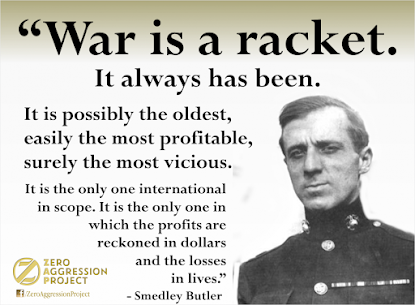
4. Smedley Butler is still right, too; war was a racket and still is.

No matter the outcome in Ukraine, everyone involved is likely to be the worse for it. Obviously the dead, but those wounded, or homeless, the refugees, the prisoners, those impoverished by war or sanctions or economic collapse. Those who have lost family, friends. The citizens of Russia's "near abroad", who must now fear that success in Ukraine will make them next in line for death and mayhem.

Of course, the Russian leadership is likely to be insulated from all that. War "leaders"  -unless they make the mistake of losing war and being captured by the victors - are seldom punished, no more than the "leaders" here that committed the identical war crime of waging aggressive war in 2003 were punished. 

It's always the "ordinary" people who suffer when the Great and the Good amongst us choose to use force to get - or try and get - what they want.

So, like most rackets, it's the bosses that profit and the footsoldiers - military and civilian - that die.

I wish I had a happier conclusion.

But, just like Ukraine today, there is no lightness; only ruin and hatred, the strong doing what they can and the weak, well, suffering.

Sunday, February 20, 2022

The lights are going out...

 It appears that it's extremely likely that there will be war in Eastern Europe for the first time since 1944. While there is obviously no "legal" grounds for Russia's decision, it appears that the Russian leadership has decided that the strong do what they can and the weak suffer what they must. It seems clear that Moscow has decided that to use the mere threat of force to win political gain will not achieve their political aims.

How - or if - the rest of Europe, and the world, responds will have a great deal to do with the way this plays out

Consider this an open thread to discuss.

Update 2/21: Fred Kaplan has some ideas about why the attack didn't happen Sunday.

Interesting political note; in case you're wondering why the response from the U.S. Right seems so peculiar, consider that while Putin polls at about 75% negative amongst self-identified Republicans, Biden polls at minus-90%.

Hmmm.

Update 2/21pm: Max Seddon (Financial Times Moscow bureau chief) live-tweeting Putin's speech:

Not promising. Worth a scan of the whole thing; sounds like Putin is taking his "I alone can fix Russia by making it the old USSR again!" for a long walk.

Update 2/21 p.m.: I'm reading that Russian maneuver forces are moving into the two eastern oblasts, and particularly towards the city of Donetsk. This is consistent with Putin's speech identifying the eastern regions as part of Russia. Presumably these will complete the takeover of the entire Donetsk and Luhansk oblasts from the Ukraine government.

The real crux of the biscuit will be if the forces along the southern border of Belarus strike towards Kyiv. The distance between the border and the Ukraine capital is relatively short, and the lure for Putin and the Russian Army leadership of a "decapitation strike" must be very strong...


Update 2/24: It now appears that Putin's goal is full-on subjugation of Ukraine. 

I'm not sure if this will involve prolonged Russian occupation; if Putin doesn't, I'll bet his military chiefs remember both the Chechen and Afghan nightmares as well as the post-WW2 Ukrainian resistance. But the actual conquest is pretty much guaranteed; the relative strengths of the two militaries all but ensures that T-90s will be parked in the Maidan fairly soon.

My guess is that after a brief occupation and ratissage of Ukrainian nationalists the Russians will leave behind a Quisling government including a mini-KGB/FSB and antipartisan militia to hunt the resistance. I could see this working at least well-enough to get by in the eastern regions.

How well this will work in Ruthenia is anyone's guess. But "not so well" would be mine.

Now...my further, and more worried, question is whether the success of this move will embolden Putin to go after his other lust-objects, the pieces of the former USSR. 

The Baltics? Georgia? One of the lessons of the fascist 1930s is that once a fascist dictator is on a roll he's often unwilling or unable to stop himself. 

For a long time I thought that Putin was too canny to go full-on Hitler.

Now? I'm not convinced he has. 

But I'm not so sure he hasn't, either.

And...it's worth noting that if there are any "good options" here I don't see them. 

Sanctions on Russia? Ask the Cuban government how well that works. Military action? Against a nuclear power run by what increasingly appears to be an aggressive dictator who DGAF? 

The brutal reality that young Mr. Putin is reminding us is that in international relations the strong CAN do what they please and the weak WILL suffer what they must.

I don't have to like that and neither do you.

But that changes this atrocity not a whit.

Update 2/25: Juan Cole observes that Dick n' Dubya's Excellent Iraqi Adventure "enabled" the Russian invasion of Ukraine. Over here our reliable commentor Sven makes pretty much the same point.

I have a fair amount of respect for Cole's opinions on the Middle East, and Sven's opinions overall, but I think they overstate the case.

Reassembling the old Soviet Union has been an obsession of Putin's for as long as I've known about Putin. I can't believe that some sort of move to re-absorb Ukraine wasn't on his bucket list for a loooong time; the recent Ukrainian move to try and become more closely integrated with its western neighbors rather than Russia probably moved it up the list as well as making armed force more plausible.

(and, while we're on the subject, who the hell would WANT to be a "Russian" given the current conditions in Russia? Life as an American wage-slave sucks pretty big ass. Throw in open kleptocracy for the discreet American version along with shittier living conditions? Ugh. Our return-to-the-Gilded-Age economy may make life pretty grinding for the 99%, but I can't see voluntarily wanting to swap that for life in the post-Soviet Russia. There's frying pans and there's fires.)

Anyway, I agree with Cole that American foreign policy makes it harder for the U.S. to oppose other's military fucktardry. I agree with Sven that the U.S. and the West has done badly, both in general and in Eastern Europe.

But I disagree that Putin needed any help to decide to kill Ukrainians, or that anyone else deserves to go directly to Hell for that decision.

The U.S. was wrong in Iraq, just as it's been wrong all over the world in places like Nicaragua and Vietnam. Iraq is and was a war crime, making aggressive war, the crime for which the victorious Allies hung Nazi leaders. Dick and Dubya should be in jail, not enjoying a comfy elder statesmen's retirement.

But that simply makes Putin just as guilty. 

They all should be sharing a cell in SuperMax, and We the People of the United States should be ashamed for letting them do otherwise.

To those Russians who are trying to stop Putin...I have no words, and doubt I have that kind of bravery. I wish I thought you could succeed. I hate what I know will happen to you

And I'm just sorry, sorry for this sorry world that has so much wrong in it.

Update 2/26: The fighting continues in Ukraine, with the Russian forces doing surprisingly poorly (relative to the preponderance of weight-of-metal on the Russian side...). I still doubt the outcome is in play - poor or not, quantity has a quality all it's own (just hard on the people in the "quantity"...).

My opinion remains unchanged. As much as the U.S. has been a bad actor globally that doesn't excuse this. In the last words of the guys on Snake Island, "Russian warship, go fuck yourself."

Krugman has a column that makes a good point, though; for all that fingers are pointing at Putin and Russia right now, there's a mote/beam problem related to our own plutocratic/kleptocratic economies and the malefactors of great wealth therein that emphasizes the degree to which We the People have casually let the very sort of corruption endemic in Putin's Russia become less blatant but almost as endemic all over the West. 

That makes even economic war problematic.

"There are two uncomfortable facts here. First, a number of influential people, both in business and in politics, are deeply financially enmeshed with Russian kleptocrats. This is especially true in Britain. Second, it will be hard to go after laundered Russian money without making life harder for all money launderers, wherever they come from — and while Russian plutocrats may be the world champions in that sport, they’re hardly unique: Ultrawealthy people all over the world have money hidden in offshore accounts.

What this means is that taking effective action against Putin’s greatest vulnerability will require facing up to and overcoming the West’s own corruption.

Can the democratic world rise to this challenge? We’ll find out over the next few months."

Remember the "Panama Papers"? The revelation of the vast coterie of Western vulture capitalists that were thieving and cheating right alongside the cartoon Latin caudillos, African "strongmen", and Russian oligarchs? Remember how many of them we prosecuted, convicted, mulcted of their stolen lucre, and sent to the Crossbar Hotel?

Yeah, me neither.

I'm not saying "Oh, we're just as bad as Russia, so we can't point fingers."  Sure we can - we just need to be willing to point fingers at our own when they go wrong. We haven't done that. The fact that people like Dubya and Paul Wolfowitz and Dick Cheney and a gajillion Wall Street thieves and, yes, Trump are still walking around free is living testimony to the degree we've failed.

Putin is still a sonofabitch.

We really need to use this occasion of naked kleptocratic criminality, though, to think hard about how much rope we want to give our own oligarchs.

Wednesday, December 8, 2021

New York for Kyiv? Boston for Taipei?

Now that the United States doesn't have bodies coming home from the lesser paved parts of the world (the bodies we're generating tend to be locals and remain where we drop them...) the U.S. public can go back to sleep regarding it's foreign policy doin's around the world whilst the foreign policy nabobs can go back to the sort of stuff they enjoy; pondering Great Power rivalries.

And current events have had a way of bringing those rivalries up in the nightly news. 

First back in October we had worries that the People's Republic of China was - at least - thinking about forcibly re-uniting the island of Taiwan with the Motherland.

Now the focus has shifted to eastern Europe, where Russian military moves appear to be directed against Ukraine.

The larger questions that arise from these potential conflicts are the same ones that have been in place since the end of WW2, namely that 1) as the Western hyperpower the United States is, effectively, the Western "big stick" in Great Power confrontation, but 2) there is always the question of the degree to which a United States would be and will be willing to risk escalation with the other big nuclear powers - Russia and China - over threats to the U.S.'s non-nuclear allies.

Some "allies" don't believe the U.S. is willing to do this at all; one of the prime drivers of the Israeli nuclear program was the desire to be independent of U.S. political will. France much the same (with a heaping helping of post-1940-defeat-shame). 

My understanding is that the U.K. was the only Western nuclear power who hung on to the "special relationship", developing their nukes purely as a way to avoid sitting at the geopolitical kid's table.

There's also the issue of diplomatic linkage.

The European nations are militarily bound up with the U.S. in NATO. You nuke Berlin, it's going to cost you. Israel, too, has always had a (in my personal opinion an unhealthily) close relationship with the U.S. 

In theory those polities can depend on U.S. military power to back their integrity if threatened. They can act as if they had a portion of that power, which gives them a certain degree of geopolitical freedom and international influence beyond their inherent military strength.

(At least that was the c.w. until Trump; now the GOP is full-on ethno-nationalist and "America First" and, frankly, if I was Berlin or London I'd be hesitant to make plans based on the notion that Uncle Sammy had my back 24/7/365. President Trump 47 (or Tom Cotton or Marjorie Taylor Greene) may very well be most unwilling to go to the mat for latte-sipping socialist Eurotrash.) 

Smaller states with relations short of full alliance like Ukraine and Taiwan don't have those options. They pretty much have to design their relationships with their larger neighbors based on their assessment of the willingness - or, particularly, potential unwillingness - of the Land of the Big PX to risk a bigger fight rather than give their rivals the win.

And that means that the U.S. itself has to - or, at least, should - think hard about the degree to which it's willing to risk that fight for those polities. 

After twenty years of lies, damned lies, and delusion the current U.S. administration finally admitted that there was nothing in Afghanistan worth the bones of a West Virginia grenadier. 

Will a non-America-First administration be willing to risk that, and more, to ensure that Taipei remains free of PRC occupation? To keep the Donbass as part of the Ukraine?

What frustrates me about this, and the only reason that I'm writing this post, is because of the combination of indifference, stupidity, and hubris that seems to characterize the U.S. public and most political discussion about these topics.

The U.S. press spends about five or six more times the amount of talking nonsense about "critical race theory" than it does these potential collisions. The degree of public literacy about the risk-versus-rewards of an aggressive Taiwan policy in the linked article above is appalling; if damn near 70% of the U.S. public want their government to recognize Taiwan as an independent nation? 

They've been face-down in the edible weed far too long.

There's discussion to be had - and, potentially, arguments to be made - for resisting Chinese and Russian aggression in places like the West Pacific and eastern Europe. 

Those discussions are difficult and complex...and are not going on

Instead the public and, it appears, most media and political talking heads, are trying to reduce the issues to simple us-versus-them jingoism.

Yes. I realize that's how a lot of "geopolitics" gets done here in the Land of the Freedumb.

But, frankly, after the twenty-year-long disaster that has been the Phony War on Terror?

It's really time that We the People grew up and started putting away these childish things.

A collision with China or Russia may, indeed, be inevitable (or, as Andy will remind you in the case of China, is already happening...)

But I'd like to think that if it happens it will happen for sound geopolitical reasons. For U.S. national interests. 

I'd like to think that the systems of supposed self-government - the "free press", the representatives of the People in Congress, the foreign specialists in the Departments of State and Defense - would have conducted a thorough discussion and analysis of the potential gains and risks before it happens.

But.

That would mean thinking geopolitical strategy and, as former friend of the blog Seydlitz would tell you, the United States don't do "strategy".

We do the shit out of "critical race theory", though, so there's that.

Jesus wept.

Friday, December 25, 2020

Brusilov and the question of Lessons Learned


My Bride (who is a terrific person for lots of other reasons, too...) was wonderful enough to gift me Tim Dowling's 2008 The Brusilov Offensive and I wasted no time curling up amid the wrapping debris to begin reading. 

In the opening chapter I came across something that intrigued me a bit, and thought I'd throw it out here for the patrons to swill along with their Christmas nog.

On page nine, Dowling recounts a general consensus among what he describes as "...a great many people - most notably the Russian general staff - that technological advances would play a minimal role." in the coming war of 1914. 

He then goes on to say that this "cult of the offensive" dominated most of the tactical to grand tactical thinking of the European powers. The paragraph concludes with a summary of the work of Austro-Hungarian GEN von Hötzendorf, as concluding that "Firepower was certainly beneficial, but its effectiveness was limited..."

I won't argue too hard against this; certainly there was a hell of an influential clique for the attaque à outrance idea in the French Army, and most of the other combatant army planners of WW1 seemed unwilling to abandon the notion that you could figure out some way to outrun a bullet or a shell and gain that elusive decisive victory if you just tried hard enough.

I get that part of that had to have been the lack of actual Great Power combat in the forty-odd years between the end of the Franco-Prussian War and 1914.

But, still...

You'd had the Russo-Japanese War just ten years earlier, and that had featured all the things that would kill all that "offensiveness" deader'n a Japanese rifleman hanging on the wire outside Port Arthur; deep entrenchment and obstacles behind machinegun beaten zones and heavy artillery. 

Pretty much every other European power had observers with the combatants, and it sounds like a ton of them reported all the same problems for the attackers facing these defensive measures, it sounds like none of them - particularly the Russians themselves, if Dowling is correct - learned anything from the lessons of others.

That, in turn, makes me wonder; how often in history have we soldiers (or the civilian leadership that directs us...) done that - learned from the experiences either of our predecessors or others - versus how many times we've failed to learn those lessons? It seems off the top of my head that the failures seem more common than the successes, that it seems more likely that military organizations will fail to recognize critical changes in technical or tactical conditions rather than anticipate or adjust to them.

Is that really the case, though? Or am I just being influenced by a sort of military "recency factor" that occurs because those failures tend to be more spectacular than the less catastrophic effects when an organization does react and adjust appropriately?

And is this something that tends to happen to all large military organizations at some point? Is there an example of an army (or navy, or air force...) tending to be uniformly decent at learning from the lessons around them rather than having to learn the hard way?

Friday, February 8, 2019

Ruling the waves..?

Rob Farley has a post up at the National Interest discussing the current expansion of the PRC's People's Liberation Army Navy (PLAN), comparing that to the Great Power navies of the past century.
He asks whether the PLAN can succeed in advancing the PRC's geopolitical ends compared to the Imperial German, Russian (and Soviet), Imperial Japanese, and United States navies.

It's not a bad little article, but I think it asks the wrong question.

I'd start, rather, with the question "Does (fill in the blank nation) need a blue-water navy?"

Two of the four examples Farley picks - Germany and Russia/the Soviet Union - were primarily continental powers and as such the answer seems obviously "No".

As such their fleets were superfluous at best and, for Germany, disastrous at worst; dragging Wilhelmine Germany into a naval arms race with Great Britain that diverted resources that the Reich could have put to better use.

The "good cases" would seem to be the maritime empires, Japan and the U.S.; both depend on overseas trade, both are isolated by oceans, at least partially in the case of the U.S., both had, or have, imperial ambitions.

Oddly, Farley chooses to ignore two other great maritime empires.

The "success" is, obviously, the British. Britain obviously needed a blue-water navy, and, in general, did pretty well with it. Unsurprisingly that naval power disappeared with the Empire, but it had a hell of a good 400-odd-year run.

Spain, on the other hand, needed a fleet but always seemed to find its ambitions were greater than its capabilities.

Someday I should really find a good Spanish naval history to understand why the Dons never managed to figure out what the British seemed to manage so effortlessly. Whatever the reason, lacking a fleet capable of long-range power projection surely helped doom the Spanish colonial empire, whether from foreign enemies like the U.S. or from colonial revolt.
So.

Looking at the historical examples, and the current geopolitical needs of China, I can't really see how putting time, money, and effort into a big fleet helps them.

Anyone willing to take the counterpoint?

Let's discuss.

Friday, February 1, 2019

Taking our nukes and going home

I'm a bit baffled at the tactics in play here.
"For far too long, Russia has violated the Intermediate-Range Nuclear Forces (INF) Treaty with impunity, covertly developing and fielding a prohibited missile system that poses a direct threat to our allies and troops abroad. Tomorrow, the United States will suspend its obligations under the INF Treaty and begin the process of withdrawing from the INF Treaty, which will be completed in 6 months unless Russia comes back into compliance by destroying all of its violating missiles, launchers, and associated equipment."
There's no question that the Russian Federation has been playing fast-and-loose; the 9M729 GLCM violates the 1987 INF Treaty's definition of banned weapons; "...all land-based ballistic and cruise missiles with ranges between 500 and 5,500 kilometers..."

My understanding is that one thing that worries the Russians is China, which isn't bound by the INF and has some intermediate-range missiles that the Russians would like to counter. The USN has similar concerns about the tricksy Chinese, too, and may have been pushing for this. Our old pal Bolton hates arms control treaties - ALL arms control treaties - with a hate as huge as his mustache.

So there's no shortage of players who wanted this to happen.

But, as Kaplan points out, there's a huge difference between "...Bolton go(ing) to Moscow, formally declare the Russians in breach of the treaty, and give them a certain span of time to rectify matters, warning of consequences if they don’t." and reneging on the treaty ourselves.

For one thing, how does this "punish" the Russians? I mean, unless it means that the US is going to begin a GLCM arms race in Europe, which, I'm sure, will thrill the living shit out of the EU.

If China's the US's problem, as Kaplan points out:
"...we have plenty of other weapons, nuclear and conventional, that would deter a sensible Chinese leader from aggression against vital U.S. interests. (If the Chinese leader isn’t sensible, then all principles of deterrence are null and void anyway.)"
The other point is that this treaty bans LAND-based intermediate range missiles. Ships and aircraft? Not limited.

And the biggest thing about this is that it gives away the game to the Kremlin, largely because of Trump's preceding treaty fucktardry. The guy who spiked the Iran deal, the Paris accords, NAFTA can't realistically whine about other people breaking treaties.

This simply give the Russians a free hand to do what they were doing sneakily anyway.

That doesn't sound much like the Art of a Very Smart Deal to me.

Wednesday, December 19, 2018

Declaring victory!


Al Jazeera reports that the U.S. ground forces in Syria are going to be gone within 60 to 100 days. Apparently this is because the chances that the Islamic State Navy will appear off New York Harbor to land jihadi marines have become very, very slim:
"Trump tweeted, "We have defeated ISIS in Syria, my only reason for being there during the Trump Presidency."
The "winners" here are clearly the GIs, who get the hell out of a civil war they should never have been inserted into.

Other "winners" include Erdogan's Turkey, which is now free to mop up the Kurdish areas of northern Syria that have been giving the Turks the collywobbles worrying about a Kurdistan in eastern Turkey, Putin's Russia, which now has a free hand to help the third "winner", the Assad government, without worrying about the pesky possibility of a shooting war with the U.S.

The bottom line is that anything that gets my country out of boneheaded land wars in Asia is a good thing, so, frankly, if "Donald the Dove" wants to declare victory and grab a hat from Syria, I'm pretty much okay with that.

But...the losers?

The Kurds, of course. Who, having apparently failed to learn the lessons of 1991, threw their hand in with the Yanquis only to find that spoken promises aren't worth the paper they're not written on. Once again a foreign ally learns the hard lesson that Uncle Sammy is no more trustworthy than any other guy one's he's gotten what he wants off of you.

All together now:

"There's so many times I've let you down
So many times I've played around
I tell you now, they don't mean a thing
Ev'ry place I go, I'll think of you
Ev'ry song I sing, I'll sing for you
When I come back, I'll bring your wedding ring.

So kiss me and smile for me
Tell me that you'll wait for me
Hold me like you'll never let me go
'Cause I'm leavin' on a jet plane
Don't know when I'll be back again..."


Update 12/19 p.m.: While as a sergeant I'm still fine with just declaring victory and getting the hell out of Syria, at least one individual who was deeply involved in the mission is less thrilled:
"We have not, no matter what the President has said, defeated ISIS. While it is true that ISIS has lost its physical holdings – the self declared caliphate – this actually makes them more dangerous, not less...as counterintuitive as it may seem, it actually increases ISIS’s lethality within and without the Levant in the short term. This is not something that US policymakers, as well as the senior military and civilian leaders tasked with reducing ISIS were unaware of. As is always the case when pursuing strategic objectives, achieving one creates new problems that require new, or at least adjusted, strategies to resolve."
I still tend to think that this is an overall positive for the U.S., but I'm willing to be persuaded otherwise.

Discuss.

Update 12/20:


Update 12/31: Sooo...maybe the GIs aren't going anywhere soon.
"Graham previewed his arguments to Trump for reconsidering the Syria pullout.

"I'm going to ask him to sit down with his generals and reconsider how to do this. Slow this down. Make sure that we get it right. Make sure ISIS never comes back. Don't turn Syria over to the Iranians. That's a nightmare for Israel," Graham said.

“And, at the end of the day, if we leave the Kurds and abandon them and they get slaughtered, who’s going to help you in the future?” he said. “I want to fight the war in the enemy’s backyard, not ours. That’s why we need a forward-deployed force in Iraq and Syria and Afghanistan for a while to come.”
This is why if you have Trump in the office pool it's always smart to bet the under. The sonofabitch is never going to make a deal and stick to it; it's always about whoever talked to him last.

Update 1/7/19: What I said about "Trump and whoever talked to him last"? Well, I'm guessing that it was either Bolton or Bibi, because now the money seems to be on the GIs staying in Syria for...well, who the hell knows? If it's until the IS is destroyed, Iran is defenestrated, and The Turks give up on smashing the Syrian Kurds? Shit, the sun will go nova before the guys in Syria DEROS.

The story is that Casey Stengal was surveying the field where the 1962 Mets were "practicing" and was heard to mutter "Can't anybody here play this game?"

Case, you had NO idea; these jokers make your boys look like the freaking 2917 New York Yankees...

Wednesday, September 19, 2018

Syrian Air Defense Force

How did a country that used to have one of the better air defense systems in the Mideast turn into such a clown-show?  How do they manage to shoot down a Russian aircraft, their ally, with Russian SAMs?


The reason has to be the civil war.  This forced a major change in the organization of the Syrian Armed Forces and the share of resources.   The primary threat to Syria became jihadi militants and irregulars.  Ergo, the Syrian Air Defense Force ended up at the scheisse end of the priority queue.  Plus the rebels captured several airfields and air defense installations and destroyed or damaged a number of AD systems and killed, captured or converted their crews.  Many of those bases have now been recaptured and are starting to be re-manned with new or upgraded systems received form Uncle Vlad.  But they are still a low priority for a country that is only saved from bankruptcy by the charity of Tehran and Moscow.   Then there is the Israeli Air Force.  They have years of experience going up against Syrian SAMs and seem to be able to take them out easily, which make the SAM crews extremely nervous.  There must be a lot of pressure on them to live up to the propaganda.  And how well trained are they?  There is also a rumor that some of the crews are partially manned by Hezbollah, supposedly to train them for a possible future transfer of systems to Lebanon.

The Russians, after first blaming the French Navy, have finally admitted it was their own allies that 'inadvertently' shot down their ELINT & RADINT capable IL-20M with 15 souls aboard.  But they maintain it was Israel's fault for using the IL-20 to mask their approach.  Maybe so, or not?  We'll see if the radar tracks and timing are ever published.  The S-200VE, 'Vega-E, SAM system that brought down the IL-20 was supposed to have been upgraded with IFF capabilities.  They obviously did not work.  Perhaps due to an ill-trained crew, or perhaps due to Israeli jamming, or perhaps the aircraft IFF transponder was broken or turned off or deliberately using a ghost signal.  I am more inclined to think the SAM crews were in a panic and fired off some missiles on a 'ballistic trajectory' and 'without guidance' like they did back in April for the US/UK/FR missile strike.   The warhead on the S-200 is 217 kilos (478 pounds), approximately half the weight in HE and the other half in 37,000 fragmentation pellets.  It is triggered by either radar proximity fuse or command signal.   I have no clue as to the blast radius.

I am neither a fan of Putin nor Netanyahu.  But I do admire the Russian and the Israeli people, with the exception of the vicious right wing in both of those countries, and in my own country.  Let's hope those yahoos don't get the US into a shooting war with Russia, if Putin or Shoigu decides to retaliate against the IAF with their S-400s they have in Syria and it escalates.  Maybe 'moderate dog' Mattis can keep Trumpkin out of it, but the Congress would want in on it, both parties. 

Friday, August 24, 2018

Russia's Mil Games (Update)

Mark Galeotti has an article at Foreign Policy magazine regarding Russia's tank biathlon and other military games.   Galeotti was at Alabino to witness the games, or at least those that were held there, as some were held in other Russian cities or overseas in some events.   Galeotti has written several books on the Russian politics, the Russian underworld, and the Russian military.  He has written articles for Jane's Intelligence Review, for War On The Rocks, for The Moscow Times and others.   He has a blog titled In Moscow's Shadows, and is on twitter at @MarkGaleotti.

His trip was sponsored by HBO Sports.  So will HBO broadcast a special? 
A little out of their line I would think, but then the quest for ratings overrules all else no matter the network.  They have been branching out away from their traditional shows on basketball, baseball, boxing, football (both American football and soccer).  They have been doing specials on Trump-hating Scotsmen, wing-suiting, deep sea free diving by poor Austronesian fishermen, child camel jockeys some starting as young as two, crossword biathlons, etc.  So why not tank biathlons.


I don't agree with the title of Galeotti's article in FP.  He, or his FP editor calls the games "Decadent and Depraved".   Makes it sound like the the gladitorial combat in the Colosseum of the Roman Empire.   Yeah, they are a public spectacle, bread and circus for Ivan and Katyusha, but I would not call them depraved.  But the article is worth a read.  Galeotti was there and witnessed it.  He has some insights that never occurred to me in the 26 July post on the biathlon here on this blog.  But I note that Galeotti agrees that one of the key reasons for staging the Russian Mil Games is for arms sales.

The link to Galeotti's article is here:  the-international-army-games-are-decadent-and-depraved


Thursday, July 26, 2018

Tank Biathlon


Having just finished up the Elbrus Ring military mountaineering competition, the focus of Russia’s international military olympics is now on the tank biathlon.  It stresses live fire over rough terrain giving marks for speed and accurate, rapid fire.  “Participating tanks drive a three-lap route of 6–10 km.  During the first lap, crews fire (the main gun) at targets positioned 1,800, 1,700 and 1,500 m distant.  In the second lap, different targets imitating an anti-tank squad and an infantry unit are fired upon.  These targets are at a distance of 600–700 m, and must be engaged with 7.62 mm coaxial machine gun.  In the third lap the tank crews target an anti-tank gun and ATGM unit by use of the turret-mounted heavy machine gun at a distance of 1,200 m.  One or more misses leads to an extra penalty lap of 500 m.  On the final lap tanks have to go through various terrain obstacles; an obstacle missed or improperly traversed adds 10 seconds to the final timing.”
 
It is held at the Alabino Proving Grounds just southwest of Moscow.  23 countries are reported to be sending tanks and crew to compete this year (five years ago when this event started only four competed).  The US Army and NATO have been invited in the past but have not accepted.

Iran is sending an entry again this year.  Two years ago Iran took last, 12th place out of 12 contestants.  Last year they did better placing seventh.  


Russia has taken the gold medal every year.  That is fitting for the home team, they undoubtedly get to practice on that particular course for months beforehand. Plus they have the latest and greatest gear, for which the biathlon provides a perfect marketing opportunity.   Overseas sales are a big part of these games.

The Strong Europe Tank Challenge hosted by the German Heer and USAREUR just held at Grafenwoehr is somewhat similar.  But at two years junior it seems to have been started in reaction to the one in Russia.  And it is smaller, only eight countries participating vice the 23 at Alabino.  This year there were six NATO countries plus Sweden and the Ukraine in the competition.  Germany won twice, Austria once – Leopards seem to dominate the competition.  And long in the past the Canadian Army used to host a NATO-wide tank competition but that hasn’t been done for two or three decades to my knowledge.