Showing posts with label Great Britain. Show all posts

Friday, December 10, 2021

End of an Era

Some eighty years ago the Battleship Era ended in a flurry of bombs and torpedoes that sank the two capital ships of the Royal Navy's Force Z.

Yes, aircraft had been involved in sinking the most capital of capital ships prior to December 10, 1941. But the circumstances allowed battleship fans to temporize. 

An aerial torpedo ensured the doom of Bismarck, but the actual sinking occurred during a surface gun action. Battleships were sunk by aircraft at Taranto and Pearl Harbor, but those were surprise attacks on unsuspecting moored warships.

There was no gray area on December 10. Aircraft found and sank two of the Royal Navy's heavy units, one, Prince of Wales, one of the newest and most powerful British battleships extant.

The "moral" I've always been told that this story taught was that in the 90 minutes it took the air attack to sink both Prince of Wales and Repulse the battleship era ended and any naval organization that pursued heavy gunpower rather than carrier airpower was foolishly incompetent. 

What's kind of intriguing about one "counterfactual" is that Force Z had come within five miles of an IJN task force consisting of "six cruisers" - I've been unable to discover which six these were, but at least one was Chōkai (鳥海), a Takao-class heavy cruiser.

Neither task force was using radar effectively. The Japanese because IJN radar technology was crippled throughout the Second World War, the British because Prince of Wales' radar had gone down earlier in the mission, supposedly through overheating in the tropical heat and humidity.

(Worth noting that in this the PoW lived up to her reputation as a "hard-luck ship"...)

Let's assume that at least three or four of the other "six cruisers" out that night were also heavies. The Japanese heavy cruisers were beasts, especially heavily armed with the big 24-inch torpedoes, and the IJN trained extensively in night gun and torpedo action as the encounters off Guadalcanal the following year proved.

 
Let's suppose that the two task forces had, instead, bumped into each other in the night.

The British weight of metal would probably have torn the Japanese cruisers apart, but the IJN night fighting and torpedo tactics might well have either sunk or badly damaged the British capital ships to the point where their sinking by aircraft the following morning could be written off the same way that the battleship aficionados wrote off Bismarck, Taranto, and Pearl Harbor.

The "end of the battleship era" might now be attributed to the naval and naval air actions off the Philippines in 1944.

No real point here other than to consider how things we take for received wisdom often turn on small, nearly insignificant events, like the failure of the British radar the night of December 9/10.

Thoughts?

Friday, February 8, 2019

Ruling the waves..?

Rob Farley has a post up at the National Interest discussing the current expansion of the PRC's People's Liberation Army Navy (PLAN), comparing that to the Great Power navies of the past century.
He asks whether the PLAN can succeed in advancing the PRC's geopolitical ends compared to the Imperial German, Russian (and Soviet), Imperial Japanese, and United States navies.

It's not a bad little article, but I think it asks the wrong question.

I'd start, rather, with the question "Does (fill in the blank nation) need a blue-water navy?"

Two of the four examples Farley picks - Germany and Russia/the Soviet Union - were primarily continental powers and as such the answer seems obviously "No".

As such their fleets were superfluous at best and, for Germany, disastrous at worst; dragging Wilhelmine Germany into a naval arms race with Great Britain that diverted resources that the Reich could have put to better use.

The "good cases" would seem to be the maritime empires, Japan and the U.S.; both depend on overseas trade, both are isolated by oceans, at least partially in the case of the U.S., both had, or have, imperial ambitions.

Oddly, Farley chooses to ignore two other great maritime empires.

The "success" is, obviously, the British. Britain obviously needed a blue-water navy, and, in general, did pretty well with it. Unsurprisingly that naval power disappeared with the Empire, but it had a hell of a good 400-odd-year run.

Spain, on the other hand, needed a fleet but always seemed to find its ambitions were greater than its capabilities.

Someday I should really find a good Spanish naval history to understand why the Dons never managed to figure out what the British seemed to manage so effortlessly. Whatever the reason, lacking a fleet capable of long-range power projection surely helped doom the Spanish colonial empire, whether from foreign enemies like the U.S. or from colonial revolt.
So.

Looking at the historical examples, and the current geopolitical needs of China, I can't really see how putting time, money, and effort into a big fleet helps them.

Anyone willing to take the counterpoint?

Let's discuss.

Friday, January 4, 2013

Hoarse Whisperer?


A former head of the CIA is said to have believed that U.S. diplomatic signals may have helped kick off the 1982 Falklands War:
"Mr William Casey, the head of the CIA, who was closely concerned in Cabinet discussion on this subject, has implied to us privately that he thinks the Argentinians may well have been led up the wrong path.

'They may have believed that their support for the US in covert operations in Central America was more important to the US than in fact it was, and could be expected to earn them American acquiescence in forward policy elsewhere.'

Sir Nicholas also recalled handing US Secretary of State Alexander Haig a piece of paper detailing British evidence of Argentina's intention to invade on April 2, 1982.

He said: 'Mr Haig's reaction to the information I had given him was electric.'

Sir Nicholas added: 'He wanted us to win and would have been horrified if the Argentinians had got away with it."
Hardly solid evidence, but intriguing nontheless. Particularly when you think of this in the context of the supposed July 1990 meeting between Ambassador Glaspie and Saddam Hussein which may (or may not, or might have have been even more complex effect) have had the result of greenlighting the Kuwait coup in the mind of the Butcher of Baghdad.

Or the recent tragicomedy in Libya. Or all the other examples of international encounters - back to the war of Jenkin's Ear, it seems - where one side, or the other, or both, said one thing and the other, or the one, or both, heard something very different from the intention of the speaker.

Let me say that I'm not sure whether to put a tremendous amount of credence in this report itself; it appears to be the opinion of one man, albeit one that was a very experienced observer of the foreign policies of his time. And the internal politics of the Argentina of 1982 make it fairly clear that the junta was already deeply committed to the idea of using force to claim the "Malvinas".

But what this odd historical footnote does seem to point out is that for all that we often like to think of "foreign policy", "geopolitics", and "strategy", as sciences, as matters that people and nations can make into tools to use for their interests and both study and train on to improve they are often laden with what another U.S. recent foreign policy thinker used to call "unknown unknowns"; complexities and unintended consequences that even the sharpest wit and the most diligent student cannot anticipate.

Wednesday, January 2, 2013

Soft Power, A Strategic Theory Perspective

Not too surprisingly, soft power as an academic concept has gotten a lot of press almost since Prof. Joseph Nye first coined the term back in 1990. Since that time Nye has traveled the world giving lectures on soft power including one he gave back in 2010 for the organization I work for. The concept is easily misunderstood and sometimes intentionally so, especially by government bureaucracies engaged in budget/turf battles with other rival government bureaucracies. From a Clausewitzian strategic theory perspective, the concept has merit and a clear understanding of it can assist us in seeing the advantages to promoting soft power approaches and understanding what can be achieved by this approach and what cannot. Also, soft power fits within the larger spectrum of conflict which is part of a more extensive on-going project of mine. Finally, there are inherent tensions in the concept as I see it, so while the definition of soft power is clearly Nye's, this analysis of the concept is clearly mine, based on a strategic theory perspective.
I will start with a definition of terms and how they interact followed by my own views on the practical application of soft power from a strategic theory perspective. While I have been employed as an English language teacher for almost 15 years by perhaps the leading soft power state institution, which as Nye states "has been practicing it effectively since 1934", the views expressed here are my own and do not necessarily reflect those of any particular organization.
Let's start with the concept of power itself. Nye's definition agrees with the realist Weberian definition of power, that being "the probability that one actor within a social relationship will be able to carry out their own will despite resistance". It is important to stress here that for me power is a social relationship of varied degree, not a state of existence, nor a physical entity. Power can exist at various levels and involve individuals or whole nations. Force, coercion, economic incentives and "attraction" or soft power, are all types of power relationships. Power is also contingent, in that that each power relationship is unique involving the history, culture and personalities of the different actors.
At this point a quick diversion . . . consider Hannah Arendt's concept of violence . . . Violence will remain the unmentioned reality throughout this essay, since violence alone defines the political, the willingness to use violence in pursuit of strategic aims . . . While soft power is the opposite of force, it still retains its political character which exists as a sort of tension within the concept.
Soft Power is defined by Nye as:
"the ability to get what you want through attraction rather than coercion or payments. It arises from the attractiveness of a country's culture, political ideals, and policies. When our policies are seen as legitimate in the eyes of others, our soft power is enhanced."
Notice the link of soft power with policy and legitimacy. Here is where a whole series of tensions are introduced to the overall concept, which are not apparent with a casual reading. Power can involve simply two individuals, whereas policy involves distinct political communities, policy being simply seen as the collective interests of the political community (see On War, Book VIII, Chapter 6B). Legitimacy would require the targeted political community seeing the actions of the soft power wielding political community as "legitimate", which is obviously a difficult goal to achieve. This assuming of course that the policy actually reflects the national interests of the political community involved. Let's look at the source of this tension more closely.
Power is related to "domination" another Weberian concept, which is defined as "the probability that a command with a given specific content will be obeyed by a given group of persons". Power can involve individuals, whereas domination is always about groups. Domination also has more the nature of a "state of existence" involving a larger group, whereas power remains a specific relationship between two or more individuals. The distinction is important, since too often people talk of exercising "soft power" when what they really mean is attempting to secure domination. For domination to be secure over the longer term, Max Weber argued that legitimacy was required. Brute force would not ensure compliance in the long run, the people obeying the dictates of the leadership had to believe that what they were doing was correct or "legitimate". Like power and domination, legitimacy is also something of a sliding scale. When a ruling elite loses all legitimacy, they are said to be "dead" from a social action theory/strategic theory perspective since it is only force against their own subjects which will ensure their continued existence as rulers.
So, there is my introduction of the various terms/concepts. At the level of praxis, what can I say about soft power? Here is a list of six points:
First, a government has to decide whether they need this type of institution or not. Do the level of national interests exist such that a long-term commitment to establishing and maintaining this type of institution? For Luxembourg, this is probably unnecessary, but for the United States? Then there is the question as to where to have these representations? Obviously, not every country in the world would merit one, whereas other highly influential countries would merit an extensive commitment. I would add here the establishment requirement of a national government being able to formulate policy which reflects long-term national interests. This would also require bi-partisan support since the project is decidedly long-term, taking place over generations. If these basic internal political requirements do not exist, a country is probably better off not even attempting this sort of thing, and essentially writing off the application of soft power in any sort of consistent fashion.
Second, to exercise soft power effectively over generations, and it takes a very long period of time to achieve the type of influence I'm talking about, a political community/nation state is best advised to have a specific institution to attempt this. Relying on commercial interests (defined somehow as "national") or the military to carry out this function is short-sighted and actually impossible/self-defeating. Commercial interest are simply that, they have their own interests and goals, which are primarily associated with profit making. The "profits" associated with soft power are not going to show up on a quarterly balance sheet, in fact the actual success is almost impossible to qualify in terms of money or even statistics. Rather what defines successful application of soft power is the presence of a positive attitude over the long term, that is over generations.
While the military talks about applying soft power, especially the navy, which is the best suited branch of the military to carry this out, it is not something that can be done consistently. The task of the military is to act as an instrument of potential violence to achieve national policy goals, which is not going to be seen as positive by the those who are the target of that violence. Nor will this be seen as positive by outsiders who almost inevitably see military action as "unwarranted" or "extreme". Relying on the military exclusively to exercise soft power consistently is thus irrational.
Having a dedicated soft power institution avoids this problem. They act essentially as the sock puppet on the left hand to the mailed fist of the right. Having the military carry out soft power operations is like painting a smily face on the mailed fist. Sure it looks cute and might gain some temporary soft power success, but it is still a mailed fist.
In line with this argument, I would simply point out that Britain, France, Germany, Spain and other advanced countries have such institutions in place. In fact the USA is almost unique among the major powers for not having one.
Third, the skill set required by those working for the soft power institution is in some ways the opposite of those required by commercial enterprises and the military. The soft power institution sells "culture" which is why they also inevitably offer language courses as well. I will talk more about language teaching below, so let's look at the type of people we need in these organizations. We need people who easily fit in to and respect the target culture, who are knowledgeable of their own culture, who are open to new ideas and able to separate easily from their native culture, who are empathetic and enjoy dealing with people, who are "artistically" inclined (this broadly defined), who are critically minded (especially of their own country's policies), who are hard-working, dependable, not money-oriented, and of above average intelligence. If we label the ideal commercial person as a "business manager" and the ideal military person as a "soldier", we would label the ideal soft power institution employee as a "hippie" without the negative stereotypical characteristics.
What we need is essentially ambassadors who do not even realize they are acting as ambassadors and are not seen by the target audience as so acting. Their critical attitude towards their own country's policies pays extra dividends during war time, because the target audience sees that the institution is able to question the policies of the country it represents, sending a very strong message in terms of the target audience's experience with their own country. The artistic inclination will appeal to a large spectrum of the target people as well and will be linked to the country of origin somewhat free of additional, that is controversial policy, connections. To expand on the sock puppet analogy above, the sock puppet is always friendly, witty, entertaining, and never a threat, and offers something of a distraction while the mailed fist does its work. Even if the sock puppet complains, cries, or makes funny faces in response to what the mailed fist is doing, you still have the audience paying attention and in many cases marveling at the whole spectacle. Finally, since your "ambassadors" are not money-oriented, the target audience picks up on this positively as well.
Fourth, soft power requires a dual approach utilizing two models. Nye's two models of how soft power works are the direct and the indirect. The direct is when one leader does a favor for another because of cultural affinity/attraction. Say, the President of China offers a lucrative government contract to a US enterprise (via the US President) because he thinks America is a really cool place. The indirect model is when you attempt to influence the target country's government through public opinion, or rather elite public opinion. This brings up language education. This institution is not a commercial enterprise per say, but functions to sell your country's culture. The price of your language courses is going to be high-end, since you want especially the local elite attending. For the prestige of studying at your institute, the local people need to feel that they are getting extras including especially a cultural program. This could include visiting artists, musicians, poets, exhibitions, and the like, all of course associated with the institution's country's culture. In this regard, the last thing you wish the target audience to feel is that the language courses offered are simply a commercial transaction, which makes your institution the same as any commercial school. Rather you wish them to leave feeling that they have experienced something that only your institution could provide in the sense of an intense association with the "foreign", that is our, culture. Through consistent positive experience the students prize this experience and wish to not only maintain it, but share it. In this regard, alumni associations of some type, comprising former students (and current movers and shakers of the target country) are to be encouraged and financed. This will help to ensure participation in the institution's operations over generations.
Fifth, how does the type of institution we are talking about diverge from the activities of the usual diplomatic representation? Cannot the embassy perform this function? Nye talks about three dimensions of public diplomacy. The first two clearly fall in the realm of the embassy/consulate staff: daily communications and rapid reaction, and strategic communication, which is providing a consistent message regarding foreign policy objectives. These are essentially propaganda targeting the local population.
The third "circle is the most encompassing", according to Nye. This is everyday personal contact between the locals and our "representatives" and here is where the soft power institution functions best because this is its prime function. Who/what the locals are communicating with/being exposed to is our culture, not our political interests per say, nor commercial interests (since that would belong to the embassy staff as well). Recall the sock puppet and mailed fist metaphor above. The diplomatic representation is the fine frock coat that actually unites to two approaches, the left sleeve exposes the sock puppet while the right exposes the mailed fist. The coat unites, but does not dominate either, all three elements remain distinct since they have distinct functions, while all sharing in the achievement of the same set of goals.
Sixth, and finally, there is a need to separate this institution from the embassy, commercial interests, and our military. Flying the national flag out front is a good idea, but the association has to stress the cultural over all else. Access should be open to the public and security as light as possible. Obviously should the local security situation deteriorate to a certain extent, this institution would be the first to reduce activity or even close its doors. This sends an important message to the locals, that being that the institution is not seen by our country as any sort of legitimate target, having as it does officially a solely cultural function.
To conclude, history has shown that much can be achieved by the institutional application of soft power. This is by definition long-term with all the positive and negative aspects that implies. During the Cold War, the attraction the West enjoyed, much of which was centered on the US, did much to end that struggle. The application of soft power had begun with the Berlin Airlift in 1948 and continued ceaselessly beyond the fall of the Berlin Wall in 1989. Here is an obvious example of a US soft power success. An example of a failure is the invasion of Iraq in 2003, where it was assumed, essentially as an afterthought by President Bush and his advisors, that the Iraqi people would welcome the implementation of a US-styled form of government and economy. That was not the case, nor could it have been absent the existence of a long-standing US soft power commitment to Iraq. While soft power could not have assured success, its absence indicated the certainty of the failure of such extensive and radical goals.
Postscript-
I would like to thank all those who commented. It is a difficult task to combine theory with personal experience. Thanks especially to those colleagues who read this post and commented to me personally.
To my six points above I would like to add two more. Let's label them seven and eight for consistency's sake.
Seven, it would seem that the establishment of a soft power institution is the best way to plod the long road to rehabilitation after a political/cultural catastrophe. Luckily these are few and far between, but they do happen, as in the case of Germany in the 20th Century. The establishment of Germany's soft power institution has provided that country with a "way back" to attaining what I would see as it's rightful place among nations.
There are various advantages that a country achieves through a soft power institution including, but not limited to, recruiting skilled foreigners to work in the institution's country. Undoubtedly offering German courses overseas allows an opening for locals to consider working in Germany. This would be the same with other countries whose institutions have the same offerings.
Along with this goes the Westphalian element I've mentioned in the comments. The country operating the institution has to trust the local government to physically protect their soft power location/establishment. This subordination of actual physical security to the local political community is necessary to rebuild the image of the soft power wielding country as "just another country", rather than one which sees itself as above others. A point that Americans should carefully consider imo.
Eight, the subject of TV and mass media has been brought up. I've heard stories of people who essentially taught themselves English in isolated situations due to a very strong attraction to US or perhaps UK culture. While this is impressive on the individual level, it hardly amounts to strategic or even operational effect, which is no reflection on their individual achievements. TV and the mass media remain passive influences. The strength of the soft power institution following Nye is "the last three feet", the personal contract, the establishment of a dialogue which is what needs to be emphasized. This is after all why countries establish and maintain these institutions.
So, what about the future of these institutions? Provided that the institutions can avoid the pitfall of commercialization, I think they have a future, especially when the prospect of a political/cultural catastrophe is always possible.

Monday, December 31, 2012

New Year's Eve 1942

and the Battle of the Barents Sea
At GFT.

Here's hoping that you all are enjoying a happier, healthier, and, above, all, WARMER runup to 2013 than the guys were at the fringe of the Arctic on this day seventy years ago!

Wednesday, October 31, 2012

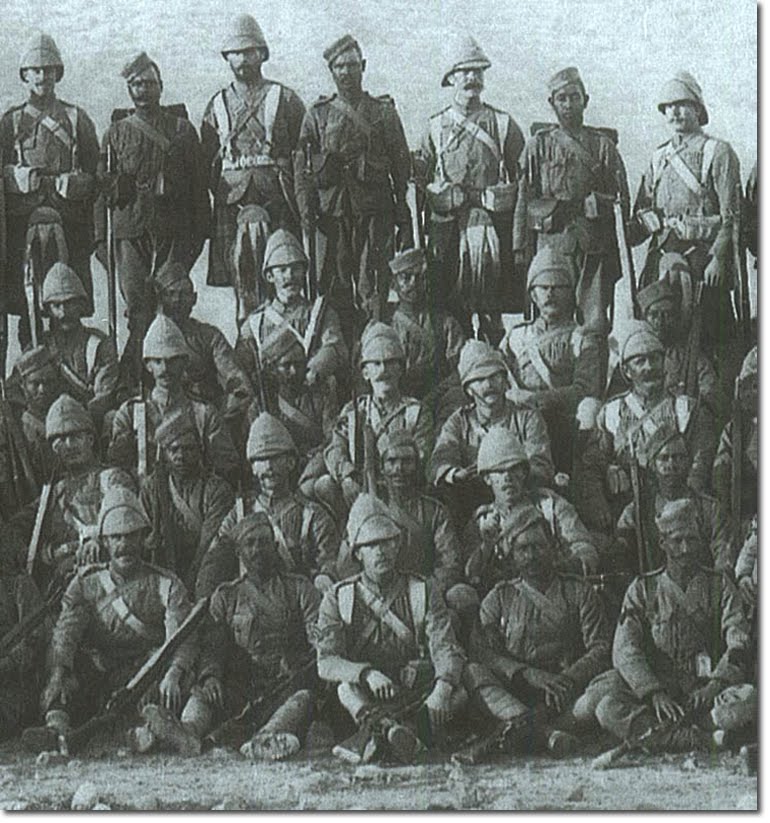
Battles Long Ago: Dargai Heights 1897

Dargai Heights Date: 20 OCT 1897
Forces Engaged: British Imperial
Five battalions of infantry: one, the 2nd Bn The Derbyshire Regiment of 1st Brigade, First Division, one, the 3rd Regiment Sikh Infantry (Punjab Field Force) of 2nd Brigade, First Division, and three; 1st Bn The Dorsetshire Regiment, 1st Bn, 2nd Gurkha Rifle Regiment, and 1st Bn Gordon Highlanders from 3rd Brigade, Second Division.

Each battalion probably at or near full strength of ten companies of 70 for a total of roughly 3,500 infantrymen.
Four batteries of mountain howitzers (No. 8 and No. 9 Mountain Battery, Royal Artillery, No. 1 (Kohat) Mountain Battery and No. 5 (Bombay) Mountain Battery) firing RML 2.5" Mountain Guns (often referred to by the British troops as "Screw Guns") I have had a difficult time establishing the MTO&E for these units. A typical battery appears to have six cannon, and each cannon appears to have had a crew of between six and eight; note the photograph below:
But the battery itself must have had at least another half-dozen or so troopers acting as ammunition numbers, extra crewmen, odds-and-sods, as well as at least a battery sergeant-major and an officer. So probably about 50-70 redlegs per battery for a force of 24 cannons and 200-250 artillerymen,

At least one source reports the presence of a machinegun detachment but does not identify the unit as such. By 1897 British (that is, Imperial) infantry battalions carried an MG detachment of 2 x 0.45 calibre Maxim machinegun and 20 troops on strength. However, in the order of battle for the Tirah Expedition among the Divisional Troops for Second Division is list a "Maxim Detachment, 16th Lancers", so this may have been the machinegun unit present at Dargai.

So roughly 3,500 infantry, 250 artillerymen, 24 cannon and two machineguns. The commander on the scene was MG A. G. Yeatman-Biggs, Second Division commander; the entire Tirah Expedition force was commanded by MG Sir William Lockhart, GCB KCSI, and isn't he a wonderful picture of late Victorian generality;
Orakzai (اورکزی‎) and Afridi (اپريدي) Tribal Forces
An undetermined number of Afghan tribal warriors drawn from the two tribes then fighting the British Indian forces. The most likely composition of the defending forces, however, was from one or more of the Orakzai clans, since that tribe then controlled the high ground in the Tirah area. Several sources mention Afridis, and Afghans being Afghans it's hard to believe that with killing in the offing that the eager young men of the tribe could have been held back.

The numbers of defenders are usually simply described as "hundreds" to "thousands". The British attackers, who ended up in control of the Heights, probably had no real idea how many Afghans they were fighting; the tribesmen, no fools they, ran off when it became obvious that the mad invaders weren't going to stop coming on.

But there must have been at least several hundred; anything less than that wouldn't have been able to produce a sufficient volume of fire to have had the effects as described on the attackers.

While as many as 10-12,000 fighters manned the crest of the heights altogether the area of the British assault appears to be a fairly small area - indeed, a single narrow path; more an a couple of thousand guys would have been tumbling out of their sangars like ripe fruit off a plum tree; the British wouldn't have been able to leave their start line without being riddled like Swiss cheese.

So the force actively defending the path up the heights on 20 OCT probably numbered somewhere between 1,000 and 2,500. We have no idea who the "commanders" were; in typical tribal fashion the guys probably coalesced in lashkars around a local hardcase, a religious leader, or a cunning planner in little knots of five to fifty.
A Note On Armaments: At Dargai the British and Indian troopers were armed with issue rifles; the British with the relatively new .303 Lee-Metford bolt action rifle (shown above), the Indian troops with the older Martini-Henry lever-action breechloader.
Many of the Afghans must have been armed with the traditional jezail, the long rifled musket of the high hills around the Durand Line. But one of the nastiest shocks of Dargai, and the Tirah campaign as a whole, was the presence on the battlefield of modern rifles in Afghan hands.

The combination of the Afghan hillman and the modern rifle was a deadly natural. The British found that wog-bashing in 1897 wasn't nearly as much fun as it had been earlier now that the bashees had their hands on modern weaponry.

After the Tirah Expedition concluded the surprise and displeasure at the lack of fun to be had in the Kurrum Valley is evident in the plaintive tone of Queen Victoria's letter to her Viceroy of India: "As we did not wish to retain any part of the country, is the continuation and indefinite prolongation of these punitive expeditions really justifiable at the cost of many valuable lives?"

Sadly, this simple lesson had to be relearned over and over again.

The Sources: Military actions taken by literate industrial nations tend to be well documented, and Dargai is no exception. Written accounts of the actions of the Tirah Expedition and its Afghan opponents appeared almost before the rigor passed off the dead guys; one of the most complete is found here: The Campaign In Tirah 1897-1898 An Account Of The Expedition Against The Orakzais And Afridis Under General Sir William Lockhart, G.C.B., K.C.S.I. based (by permission) on letters contributed to "The Times", written by one COL H. D. Hutchinson in 1898.

Other contemporary British sources include The Indian frontier war being an account of the Mohmund and Tirah expeditions, 1897 (James, L. 1898) and Lockhart's Advance Through Tirah (Shadwell, L.J. 1898)

Secondary accounts include The 1897 Revolt and Tirah Valley Operations from the Pashtun Perspective (Johnson R.A. 2009), an invaluable view from the "other side of the hill", unusual in colonial war, and Michael Barthorp's 1996 The Frontier Ablaze: The North-West Frontier Rising, 1897-98.

Byron Farwell's 1985 Queen Victoria's Little Wars tells the old savage-and-soldier tales with gusto, while perhaps the most entertaining version of the engagement is told in George McDonald Fraser's little story "The Whisky and the Music" told in The General Danced At Dawn, his volume of tales about his times in the Gordons.

More of that later. First, the fighting.

The Campaign: I can't really do a better job of explaining why 60-some thousand British and Indian troops set off into the highlands around the Khyber Pass in the autumn of 1897 that Rob Johnson can, so, here:
"The largest and most serious outbreak of fighting on the North West Frontier during the colonial era was the Pathan Uprising of 1897-8. The revolt was actually a series of local insurrections involving over 200,000 fighters, including Afghan volunteers, and it required over 59,000 regular troops and 4,000 Imperial Service Troops to deal with it; the largest deployment in India since the Mutiny-Rebellion of 1857-8. Its outbreak proved such an unexpected and significant shock to the British that they conducted detailed enquiries after the event.
Various explanations were offered but it is generally accepted that recent encroachments into tribal territory, with fears that the British meant to permanently occupy the region as a prelude to the destruction of their independence and way of life, led to the initial fighting. There were other contributory factors: a perception that the Amir of Afghanistan, Abdur Rahman Khan, would support an anti-British Jihad; rumours that the Christian Greeks had been defeated by the Muslim Turks and that the Christian world was finally in retreat, and local anxieties about women, money-lenders and road-building."
But the money was always on the British and the Afghans to fight. They both loved to fight, and they both wanted the other to get the fuck out of their crib. I used Farwell's book to dredge up a list of Afghan Wars for this post over at MilPub back in March of last year. Turns out that there was about one "expedition" or "column" or "punitive action" or "field force" every year or so beginning in the 1830s and running well into the 20th Century; the Third Afghan War was fought in 1919!

So while this was a big one, it was not a new one, or even a really surprising one other than it's size.

The actual fighting of the 1897 "rising" began on 10 JUN, with an ambush of a smal force near Maizar. During this engagement something occurred of the sort of ridiculous criticality that distinguished truth from fiction; fiction would never be this incredible. I'll let Johnson (2009) describe it again:
"The British artillery soon ran out of ammunition in the engagement and was forced to use blank rounds in the hope that this would deter a pursuit. Ironically, this fulfilled a prediction by the more enthusiastic mullahs: they had assured the tribesmen that the British shells would turn to stone and their bullets would turn to water the moment they hit the breast of a true believer. They demanded a Jihad to save the religion and condemned those they appeared to be profiting by association with infidels."

The rising exploded, and in August all the forts along the Khyber Pass fell, lending immense prestige, as well as lots of modern weapons and ammunition, to the Afridi tribesmen who pulled off that raid. Many of the Orakzai and Afridi clans rushed to join up, either with view of a full-scale victory over the infidels or just hopes of a bit of plunder on the side.
But it's important to see that the tribes weren't just mooks looking for loot. There was an actual plan. The Afridis wanted to push the Brits out of the Khyber Pass and Tirah Valley region, while the Orakzais wanted to drive the British off the Samana Ridge that was the key to their territory.
The Khyber plan worked, but the attacks on Samana weren't as successful. One fort, at Sarigari, did fall, but British reinforcements and, as or more importantly, their artillery held the Samana.

The tribes also hoped for support from Kabul, but the Amir Rahman Khan, while offering some rousing anti-British orations to the tribal delegations, did nothing but talk.

His tepid response was designed to prevent looking like a foreign stooge (always dangerous for an Afghan ruler) while finding a pretext for doing nothing. Eventually he "...admonished the tribesmen and ordered them to settle their differences with the British, claiming he had made agreements he could not break...(and that) the tribes had not informed him of their intentions
before the outbreak of violence."
(Johnson, 2009)

Although the Amir refused active support he did not prevent the tribes from using eastern Afghanistan to maneuver in and retreat to.

While the Afghan troopers knew the Brits would come at them - they always had before - the real question was how. The Khyber Pass was a high-prestige target and would undoubtedly be attacked, but how would the British approach the home territories of the tribes in arms?

They could attack due west from Kohat along the Khanki Valley.

Or they could strike north up the Mastura River from Peshawar.

But there was another problem; the late summer was upon them, and men had to go home to bring in the harvest. Crops wouldn't wait for the damn Brits. Many of the Afghans left...and for two months the British didn't come.
What the Afghans couldn't know is that the British WERE on their way but were having the devil's own time with logistics. To carry the bag and baggage the British concluded they'd need a baggage animal for every six white troops, every eight native troopers, and every ten camp-followers; something like 20,000 horses and mules and 15,000 camels. Shadwell (1898) has some delightful details on the allocation of pack animals to the force on pages 113 and 114; general officers got a pack mule and a pony, in case you were wondering.

But finally the first Indian pioneers - what we'd call combat engineers - turned up near the Shinwari fort south of the Samana Ridge in October gave the game away; the British were coming, horse, foot and artillery.
At this the tribes convened a jirga in the cillage of Bagh where the leading lights roared for war and jihad against the infidel. That didn't stop a mob from the Orakzai out of Kanki Valley to try and surrender to MG Yeatman Biggs. The general told them that he couldn't take their submission while their buddies were still out looting and raping, so (presumably with heavy hearts) that went back to join the revolt.

The road up from Samana Ridge was overlooked by high ground to the north; the Dargai Heights.

Johnson (2009) quotes "one British officer" (in this case, Callwell 1911) saying that "the natural defile at Dargai not only made a defensive stance far easier, it also afforded ‘excellent cover, naturally provided by the rocks and improved by walls, etc, built up by [the tribesmen]’. Shadwell (1898) gives an even more vivid description:
"The village of Dargai lies on the northern side of a small plateau. The eastern edge of this table-land breaks off, at first, in an almost abrupt cliff...but...lower down...shelves away less precipitously. This slope is thrown out from the bottom of the cliff in the form of a narrow and razor-like spur, with the path or track lying along its northern side, well within...range of the cliff-head."
The picture from Shadwell's book is shown below.
He describes the photo above, noting that "The narrow ridge at the right-hand bottom corner is the saddle over which the rush had to be made on the 18th and 20th..."

Connecting the crest of the spur...and the foot of the cliff there is a narrow neck or saddle one hundred yards long by thirty broad...devoid of all cover and completely exposed to the heights above, this ridge had to be crossed to reach the path ascending to the summit..."
On 18 OCT a force from the Second Division assaulted the heights; the movements of the British troops are in blue on the map above.

The 4th Brigade attacked from the village of Chagru Kotal while the 3rd Brigade swung around to the west. Afghan resistance was light, and the attackers easily took the crest of the ridge, the Afghan defenders falling back before them.

At this time GEN Lockhart made what has to be considered a mistake; he withdrew the force from the heights. In his tame reporter's letter to the London Times he says that the force was too isolated and unsupportable as well as difficult to supply.

All of that may have been true. We have no idea what would have happened if the British had tried to hold the heights.

But the problems that would come of the decision to withdraw were immediate and should have been evident before the last soldier came down off the hills.

The firing of the day's engagement had drawn a crowd; Shadwell (1898) says about 8,000 mixed Afridis and Orakzais were arriving from the nearby Khanki Valley as well as the original defenders of Dargai village returning to snipe at the invaders.

On the way downhill the British force suffered worse than in the attack from this converging force; finally dark and the artillery halted the Afghan pursuit but the Second Division lost 10 dead and 53 wounded in the operation for no tangible gain.

And, then, worse.

Late the following day (19 OCT) MG Yeatman-Biggs sent his commander a telegram from his position at Shinawari. He reported a "large gathering of tribesmen was visible on the Dargai position, and...proposed moving on Karappa, via Gulistan Fort, instead of down the Chagru defile." (Shadwell, 1898).

This move would have effectively turned the Dargai position, but GEN Lockhart "ordered the original route to be adhered to, remarking that, while it would probably be necessary to clear the enemy off the Dargai heights, they would very likely retire, to prevent their line of retreat from being threatened..." (Shadwell, 1898)

MG Yeatman-Biggs shook out his force to recapture the heights of Dargai.

The Engagement: Note - There are several sources for the attack on 20 OCT but the following account is primarily from Shadwell (1898) supplemented by Johnson (2009) for observations from the Afghan side.

The British attack force was organized in three waves. The first unit to assault was the 1/2 Gurkhas, the second "wave" was the Dorsets, with the Derbyshire Regiment third. The Gordons were originally tasked with supporting fire.
The defense was spread all along the crest and military crest of the Dargai ridge. Shadwell (1898) notes that the defenders didn't make the same mistake as on 18 OCT; the defensive perimeter extended well to the west, where MG Kempster's flanking attack had climbed the cliffs. In the Shadwell account this is supposed to have been due to a cunning ploy by the Second Division intel officer - or "political officer" as they were called at the time - who fed the tribes a false plan, but there is no way to be sure that this was not merely a tactical adjustment to the British attack of the 18th.

Artillery prep began at 1000 hours. The Gurkha attack went forward soon after - Shadwell (1898) is not specific about the time, and the assault appears to have been effectively halted by fire along the saddle or at the base of the steep cliff within a short time of leaving the line of departure.

"Many a brave little Ghoorka bit the dust" is how Shadwell puts it.

Really. No shit. That's what he wrote.
Apparently some time soon after the two British units attempted to reinforce the Gurkha battalion. Both were shot to pieces as they tried to rush the saddle. Most of the British troops were killed in the open space. Neither unit, nor the Gurkha Rifles, could manage to advance up the steep path to the crest.

Johnson (2009) describes it thusly: "As they tried to cross in small groups ‘each clump of men that dashed forward melted away under the converging and accurate fire, and after a time affairs practically came to standstill’. The Gurkhas were pinned down for three hours and 2 other British regiments fared little better."

At some time in the early afternoon - probably about 1500 - BG Kempster was tasked to bring up the division reserves; the Gordons and the 3rd Sikhs. These units were "shot across" the open saddle by an artillery mad minute in which all 24 cannons fired a three-minute rapid fire.

The Gordons and Sikhs managed to make the base of the cliff in a body, probably picking up odd lots of Gurkhas and British soldiers along the way. From there it must have been a mad scramble up the steep path into a nasty rain of rifle fire.
One of the Gordons pipers, a man named Findlater, was shot through both legs at the ankles on the way up. He hauled himself onto a rock and continued playing as his fellow tribesmen attacked. His was the sort of bizarre gallantry that transfixed Victorian audiences; he got a sort of nursery rhyme from the kiddies of Glasgow out of it:

"Piper Findlater, Piper Findlater,
Piped "The Cock 'o the North".
He piped it so loud,
He gathered a crowd,
And won the Victoria Cross."


And so he did, although just to remind us that life isn't like the stories we like to tell about it, he later remarked;
"I am told that the ‘Cock of the North’ was the tune ordered to be played, but I didn’t hear the order, and using my own judgment I thought that the charge would be better led by a quick strathspey, so I struck up ‘The Haughs o’ Cromdale’. The ‘Cock o’ the North’ is more of a march tune and the effort we had to make was a rush and a charge."
Ha! Take that, popular fiction...

The final rush carried the crest, again the Afghan defenders retired in good order, and the 1/2 Gurkhas and Dorsetshire Regiment were posted to hold the crest while the rest of the attack force sloped off back down to the valley below to police up the dead and wounded and reorganize for the move forward.

A total of 37 attacking infantrymen were killed, with the point element suffering the worst; 1/2 Gurkhas lost 18 officers and men. Another 156 British troops were wounded. The Afghan losses were not counted, but the defenders managed to remove all their dead and wounded before the attack force seized its objective. "Many bloodstains were found on the ground..." is all Shadwell (1898) can come up with, remarking that the women and children commonly dragged off both wounded and killed.

Johnson (2009) sums up the Afghan tactical moves and their effects:
"First, and most importantly, the new Pashtun deployments had compelled Lockhart to change his plan to by-pass Dargai. Second, the tribesmen carefully selected (the ground) and channelled them into a specific killing area. Almost all the British casualties occurred in a one small area that could be swept by small arms’ fire. The British had suffered 200 casualties, and, whilst the tribesmen were forced to abandon the Dargai position at the end, they could claim satisfaction at their achievements if not outright victory. The British force had been held up, they had managed to escape with their own forces largely intact and they had carried away most of their own dead and wounded."
I consider it unlikely that the Afghan defenders lost significantly more than the attack force, even with the effects of the artillery fire.

The Tirah Expedition continued on to the northeast the following day.

The Outcome: British tactical victory

The Impact: Minimal. The fiasco at Dargai didn't put a real dent in the Afghan resistance, and the British had other problems to worry about soon. As other military forces in the high hills around the Durand Line have discovered, it is usually the support elements that find it hard to cope with the Afghan and his mountains.

Constant and deadly harassment of supply and transport columns continued. Some of the more notable of these deadly little assaults included:

9 NOV 1897 Elements of the Northampton Regiment separated from supporting units and ambushed while burning some villages around Saran Sar. 20 killed, 48 wounded.

22 NOV 1897 One company Dorsets, one company Sikhs (unit unknown) ambushed while searching for troopers lost in contact. 29 killed, 44 wounded.

19 JAN 1898
36th Sikhs and the King's Own Yorkshire Light Infantry (KOYLI) ambushed while patrolling out of Mamanai. 32 killed, 37 wounded; some of the badly wounded are left behind when the KOYLI retreats and are mutilated.

Now you notice the little item about what happened on 9 NOV?

"Burning villages"?

Yep.

The Brits didn't play that "hearts and minds" bullshit. The way they saw it, counterinsurgency was all about grabbing the insurgents by the balls and twisting those rascals until the rapscallions begged for mercy.

So the primary "job" of the soldiers in the Tirah Expedition, like pretty much every other "column" the British sent into the tribal areas, wasn't fighting tribesmen.

It was burning people's homes and crops. It was throwing stones into their wells to make them useless, it was lifting their cattle, sheep, and goats, it was doing just what the U.S. Army did to the Sioux, and the Cheyenne, the Seminoles, and the Creeks.

It was killing their men, and turning their women and children out in the wilderness to starve.
And it worked; it usually does. Eventually British logistical and numerical strength overwhelmed the tribesmen. In June 1898 negotiation resulted in a payment of 800 rifles and 50,000 rupees from the Afridi. The tribe also committed to dealing only with the Raj, and leaving road- and railway construction unmolested.

A new unit, the Khyber Rifles, was formed to replace the Afridi levies that had guarded the Khyber Pass. The troopers were Afridi but the officers were British, and there would be no more question of who were the Kings of the Khyber.

The British agreed to pay the tribal leaders stipends to keep the agreement, and the peace.

As you probably know, that peace has been most notable by its absence from that day to this.

But in the short term both sides seemed to get what they wanted.

Britain had a brisk little fight that ended in the restoration of British power over the hills around Dargai. The Northwest Frontier was secure for another several years from the threat of Afghan tribesmen working with the Russian Bear. British "honor" had been satisfied, and the truculent tribes "punished" for their fractious behavior. The troops has performed well, even if their leaders had made several critical blunders on the battlefield itself (such as at Dargai) and had, overall, failed to understand and adjust to the new tactical conditions they faced in the Orakzai hills.
The tribes also had reason to be pleased. Johnson (2009) notes that:
"They had inflicted considerable losses on the British and exchanged blow for blow in a manner that would accrue them honour and credit. Individuals who had survived the campaign would have been recognised as having demonstrated courage in defence of their lands, peoples and religion.

The sense that the Pashtuns had actually enjoyed the campaign because it had offered them a chance to enhance their honour was confirmed by a bizarre epilogue to the Tirah Campaign. When General Lockhart set off to leave India in April 1898, a crowd of 500 Afridis including Zaka-Khels mobbed him with cheers and insisted on pulling his carriage to the station. Some vowed to fight alongside the British in the future and promised eternal friendship. To the Pashtuns, this campaign had not been a British victory, but a draw, and, more importantly, honour had been preserved for both sides."
The strange world in which Afghan and Briton alternated between fighting alongside and against each other continued for exactly another fifty years, until Independence in 1947.
The tribes of the high hills then passed into the portfolio of the new government of Pakistan, where they have remained a tumult and a shouting to this very day.

In Dorchester in the county of Dorset the monument to the dead men of Dargai goes largely unvisited and unremarked in the Borough Gardens, the names of the troopers killed on that chilly October day slowly fading from the stone.
The Gordon Highlanders ceased to be in 1994, forced into amalgamation with the other two remaining Highland regiments to form "the Highland Regiment". Currently the 4th Battalion of the Royal Regiment of Scotland preserves what remains of the lineage and battle honors of the old 92nd Regiment of Foot; "Ninety-twa, no' deid yet".
On 8 NOV 2006 a suicide bomber - probably related to one of the Tarkani Pashtuns killed in an aerial attack on Bajaur nine days earlier - killed 42 Pakistani soldiers in the village of Dargai.

Friday, May 11, 2012

Second Guangzhou 1841

This month's "battle that changed history" over at GFT.

Siege engines of love,
mad dogs, Englishmen, and no Chinese allowed.

Friday, November 18, 2011

Langemarck Day, The Other Event Associated with 11 November

Nonne Boschen, 11 November 1914

Say the 11th of November and you automatically think of Armistice Day, or Veterans Day, or Remembrance Day. There is another event associated with that particular day and in fact that particular war (the First World War of 1914-1918) which I would like to introduce should you not be aware of it.

Langemarck Day commemorates the "Battle of Langemarck" or the more extensive First Battle of Ypres or the battle of Bixchote, all which took place during October and November of 1914. This was part of the so-called "race to the sea" when both the German and Allied armies attempted to outflank each other after the German defeat at the Marne.

This First World War battle or series of battles developed a mythic quality for both the British and Germans during that war. For the British it was the death of the "old Contemptibles", the end of Britain's post-Boer War Army and the Army of the Haldane reforms.

C.S. Forester is his great war novel, The General, describes the battle in this way:

And as he stooped, he heard all the rifles in the line redouble their fire. Borthwick's two machine-guns began to stammer away on his left. The Germans were renewing their advance; once more there were solid masses of grey-clad figures pouring over the fields towards them. But one man with a rifle can stop two hundred advancing in a crowd - more still if he is helped by machine-guns. Curzon saw the columns reel under the fire, and marveled at their bravery as they strove to struggle on. They bore terrible losses before they fell back again over the crest.
page 41


The British Expeditionary Force landed in France with 85,000 infantry and by the end of the campaign had suffered 86,000 casualties, most of them from the infantry. From who had not fallen in Flanders or Mons, along with the British Army of India, and the mass of volunteers who came forward during 1914-15, Britain built a new army which in turn would be bled white at the Somme and Passendaele.

The German myth, however, was to be much more eventful.

First, let's consider General Erich Falkenhayn's comments written after the war. He wrote in his memoirs:

The enemy's offensive was completely broken. He was thrown back almost everywhere either to, or across, the Yser, and a firm connection was established between the coast at Nieuport and the previous German right wing near Lille, thus forming a front from the Swiss border to the sea. That which had to be attained under any circumstances, if the war was to be carried on with any hopeful prospects, was attained. Several times it seemed as though it only needed perseverance in the offensive to obtain a complete success - how near we actually were to it has since been made sufficiently plain. At the time, however, our movement came to a standstill.

Inundations, skillfully managed by the Belgians, put an end to the attack of the German right wing, which was making good progress and bore the main pressure. The young army corps further south fought with incomparable enthusiasm and unexcelled heroism. The disadvantages of their urgent and hasty formation and training, and the fact that they were led by older and for the most part retired officers, as others were not to be had, naturally made themselves felt. In particular there were deficiencies in the new field artillery formation, a fact that was emphasized all the more strongly by the shortage of ammunition. Nor was the leadership entirely satisfactory. At the beginning of November, GHQ could not conceal from itself that a further thorough going success was no longer to be obtained here, particularly in the inundated area, in the face of an opponent who was continually growing stronger.

General Headquarters 1914-16, pp 33-34


The last German attack was on 11 November and was repulsed by the British and French with heavy losses on both sides.

Perhaps there had been a chance to turn the Allied flank and seize the French ports, the British had no reserves left . . . But the French did, and the Germans were exhausted. Getting the infantry through was not the same as keeping them supplied, and artillery and shells were short. The Germans were far from their railheads and the British and French falling back towards theirs.

However, The German High Command (OHL) issued the following press release on 11 November 1914:

We made good progress yesterday in the Yser sector. West of Langemarck, young regiments charged forward singing "Deutschland, Deutschland, über alles" against the front line of enemy positions and took them. Approximately 2000 men of the French infantry and six machine guns were captured.


We now know this report was entirely fictitious. Most of the German troops engaged from mid October on were not student volunteers, there had been no mass singing (running across a sodden field with full equipment circa 1914 did not allow for one to sing), and the attacks in question had been poorly planned and coordinated. There were reports of the German infantry being shelled by their own artillery as they advanced. In all it was not so much a lost battle as a debacle and massacre, but the mental image of those young German students singing to their deaths had great resonance at the time, they came to symbolize all the losses of those first bloody months of war. And as time went on and the losses piled up, the heroes of Langemarck came to symbolize all those who had sacrificed themselves for Germany during the war.

Taping into this sentiment, a member of the Bavarian List regiment wrote:

. . . And then followed a damp, cold night in Flanders. We marched in silence throughout the night and as the morning sun came through the mist an iron greeting suddenly burst above our heads. Shrapnel exploded in our midst and spluttered in the damp ground. But before the smoke of the explosion disappeared a wild ‘Hurrah’ was shouted from two hundred throats, in response to this first greeting of Death. Then began the whistling of bullets and the booming of cannons, the shouting and singing of the combatants. With eyes straining feverishly, we pressed forward, quicker and quicker, until we finally came to close-quarter fighting, there beyond the beet-fields and the meadows. Soon the strains of a song reached us from afar. Nearer and nearer, from company to company, it came. And while Death began to make havoc in our ranks we passed the song on to those beside us: Deutschland, Deutschland über Alles, über Alles in der Welt.

After four days in the trenches we came back. Even our step was no longer what it had been. Boys of seventeen looked now like grown men. The rank and file of the List Regiment had not been properly trained in the art of warfare, but they knew how to die like old soldiers.


The author was Adolf Hitler and the book was Mein Kampf. He obviously understood the importance of myth, since this is the closest thing to a description of battle he provides in this chapter, which is mainly about attacking "politicians", "Social Democrats" and "Jews".

The legend of Langemarck brought together various German ideals: youth, nation and sacrifice, but also the notion that the old order had wasted the sacrifice of their own youth, had been even unworthy of it and that the next time this situation presented itself the national leadership would/could not falter, as the Kaiser, Falkenhayn and the OHL had done. Thus the dead lived on in the aspirations of the German nationalists to reverse the verdict of Versailles.

Already on the first anniversary of the OHL press release, November 11, 1915, there were numerous calls in the German press for a "Langemarck Day" to commemorate the students' sacrifice. Although no official recognition of the day was ever granted by the Kaiser, it became something of a nationalist day of patriotic celebration even before 1918. With the end of the war, the collapse of the monarchy and the founding of the first German Republic on 9 November 1918, Langemarck Day took on ever more importance. It became the counter-national holiday to the Republic's 9 November.

As Hitler's quote above indicates, the National Socialist movement was quick to recognize and adopt all the ideals and symbols associated with Langemarck to their own ends, this contrary to the actual fact that the German student volunteers had probably included a significant number of German Jewish volunteers. As with the original OHL press release, the intent was not to remember or honor the dead, but to cynically exploit them and/or cover up unwanted facts.

I remember seeing a high quality film of a speech Hitler gave before coming to power. He was in a suit and in a round room flanked by raised rows of wooden benches, as in university lecture hall. He was almost crying by the end, addressing the women especially, the mothers of those dead children most likely, essentially "here I am, I've returned to lead . . . "

If one looks a bit closer at all the various ideals and propaganda themes associated with what Langemarck had become by 1939, we see the original ideals of youth, nationalism and sacrifice combined with revengeful bloodlust, political/ideological fanaticism (which had never existed under the Kaiser) and a belief in modernity as a technological means to achieve extensive power political goals. It is interesting in this context to recall that the stated Nazi goal for the new Germany was to return to a mostly agrarian community, discarding the urban society which had risen in Germany after the 1870s. The conquest of the Soviet Union was to provide this land for the new generations of German farmers in the east . . .

The German war cemetery at Langemarck has an interesting history of its own. It is interesting to compare it to the near-by British war cemetery in terms of layout and architecture.

What does Langemarck tells us today? I think there are several lasting lessons we can learn from its history.

First, no matter how noble national ideals are they can be subverted and transformed into something unrecognizable by politics especially politics associated with wars and violence.

Second, it is always appealing for a military high command, or even the political leadership to dress up a military disaster in patriotic/heroic garb and try to pass off it off as something else.

Third, Langemarck is an example of thoughtless waste. If a country or political community is faced with a long war, then resources, including especially human resources have to be used to their most efficient purpose. Was it in the best interests of either Germany or Britain to man their volunteer formations with the cream of their youth, instead of using those educated and dedicated young men to serve as officers in the new armies? What happens when most of the next generation of leaders are killed or maimed in war, allowing the Hitlers to rise to the top?

Finally there is a great distinction between sacrifice and waste, and it is the people for whom the sacrifice is offered or the waste suffered to decide based on an unemotional weighing of the facts what indeed has taken place. With the resort to war comes naturally sacrifice, but also responsibility to endeavor that the sacrifices called upon are both necessary for the achievement of the shared rational goal and that any waste is exposed as what it is. Power, responsibility and accountability should all go together.

The victims deserve at least that.

Postscript:

I've enjoyed reading the comments on this thread. I think a reevaluation, beyond the propaganda versions generated during the war, is finally possible. It could do much to make for a better Europe and perhaps, with some luck and a lot of effort, also for a better world.

I'll leave the last word to C. S. Forester, from The General:

(His main character Curzon has just found out that he is in command of the cavalry brigade, the Brigadier having been killed by a direct hit on his HQ. This conversion of thought process takes about "ten seconds" since Curzon is well versed in the characteristics of his institution. This takes place during 1st Ypres.)

"Any report from the Dragoons?" he demanded.
That was the beginning of eleven days of anxiety and danger and responsibility and desperate hard work. Even if Curzon had the necessary literary ability, he could never write an account of the First Battle of Ypres in which he took so prominent a part, for his later recollections of it could never be sorted out from the tangle into which they lapsed. He could never remember which day it was that the commander of the First Corps, beautifully groomed, superbly mounted, came riding up the lane to see for himself what were the chances of the Cavalry Brigade maintaining its precarious hold upon its seemingly untenable position, nor which day it was that he had spent in the trenches of the Surreys, leading the counter-attack which caused the Germans to give back at the moment when here were only a hundred or two exhausted Englishmen to oppose the advance of an army corps. pp 49-50


Douglaus Haig was the commander of 1st Corps in 1914 and the battle mentioned was Nonne Boschen.

Saturday, April 23, 2011

Erwin Rommel's First Offensive In North Africa

BMW R75 with a MG-34 mounted on the sidecar belonging to the 21st Panzer Division

This is one of a series of posts on the 70th Anniversary of World War II. April 1941 is remembered as a time of Nazi conquest. Yugoslavia and Greece were both conquered as a prelude to Operation Barbarossa which was to begin in 22 June. While the Spring of 1940 had been a time of defeat for France with the expulsion of the British form the continent, the Autumn brought the Battle of Britian and something of a respite.

North Africa and the Middle East however were something of showcases of British success during this period. The Italians had attacked Egypt from their colony of Libya in September and Marshall Graziani's offensive had bogged down after advancing barely 40 miles into Egypt. The commander of the British Forces in the Middle East was a very competent by unlucky professional soldier by the name of Archibald Wavell. He unleashed his Western Desert Force (commanded by General O'Connor) in December 1940 against the Italians and the Western Desert Force (WDF) was able to smash nine Italian divisions, capture 130,000 troops and drive the rest 500 miles back across Libya by February 1941. In January 1941, Wavell also launched attacks against Italian Somaliland and occupied Ethiopia, both of which surrendered the following Spring.

So in March 1941 things were looking pretty good for the British WDF in North Africa. Enter Erwin Rommel and the Deutsche Afrika Korps. In January the Luftwaffe's X Flieger Korps had been transfered from Norway to provide air support for the Italian Army and had also denied the WDF the use of the port of Bengazi requiring their supplies to continue to be moved all the way from Alexandria along the coast road. The BBC has an interesting animated map of the entire campaign.

Rommel started his unauthorized counteroffensive on 24 March with the newly arrived 5th Light Division "Afrika", later the 21st Panzer Divison, as well as the “Ariete” and “Trento” Italian motorized Divisions along with what remained of the original Italian Army. He smashed the British 2nd Armored Division, advanced across the desert with most of "Afrika" while the Italians advanced along the coast road. He was able to chase the WDF all the way back to the Egyptian border, investing Tobruk along the way, but failed to capture it, which was not surprising since he didn't even have a full Panzer division at the time and the Italians were still strung out along the coast road.

What made Rommel's task easier was that Wavell had been forced against his better judgment to send four divisions to Greece at the beginning of March.

The Die Deutsche Wochenschau from April 1941 describes the landing of the German troops, this advance, as well as their reception in Bengazi with some interesting footage.

While the withdrawal of most of the WDF was the obvious reason for the British defeat, was it the only one, or even the most important?

Let's not limit this discussion to this one operation, but include the entire campaign. This campaign in North Africa while warfare, was unique to World War II in that there were few if any documented atrocities committed by either side.

I have my own view on why Rommel was successful in this instance, which I will share in good time, but I would like to hear what ya'll think. Especially given that these very sands are being fought over yet once again in our own time . . .